
Maintenance and Preservation of Pure Cultures of Bacteria: Methods and QC

On this page
A clinical microbiology lab keeps a stock of E. coli ATCC 25922 on hand. It isn't there to diagnose a patient. It exists purely so that every batch of antibiotic disks and every new lot of Mueller-Hinton agar can be checked against a known, unchanging standard: if the zone of inhibition around a disk falls where it's supposed to, the lab knows the test system is working correctly that day.
For that to mean anything, the strain itself has to stay exactly what it was on day one. But a technician under time pressure keeps the working stock going the easy way, subculturing it onto a fresh plate every few days instead of pulling from a frozen glycerol stock. Each transfer is a small chance for a spontaneous mutation to creep in and get selected for. Eighteen months and dozens of transfers later, the "control" strain's zone diameters have quietly drifted outside the expected range. Every susceptibility result validated against it that month is now in question, and nobody can say exactly when the drift started.
The fix was never a better subculturing technique. It was choosing a preservation method, frozen glycerol stock at -70°C or lower, that keeps the strain dormant and genetically frozen in time, so the lab works from a fresh, unchanged vial instead of the two-hundredth-generation descendant of one.
Once a microorganism has been isolated in pure culture, it must be kept alive, unchanged, and free of contamination for as long as it is needed, whether that's a few weeks for a teaching lab or decades for a reference culture collection. Similarly, a microbiology laboratory has to maintain quality control (QC) stocks obtained from the ATCC or commercial vendors. QC strains are required for the testing of culture media, kits, and reagents.
Maintenance vs. Preservation: Not the Same Goal
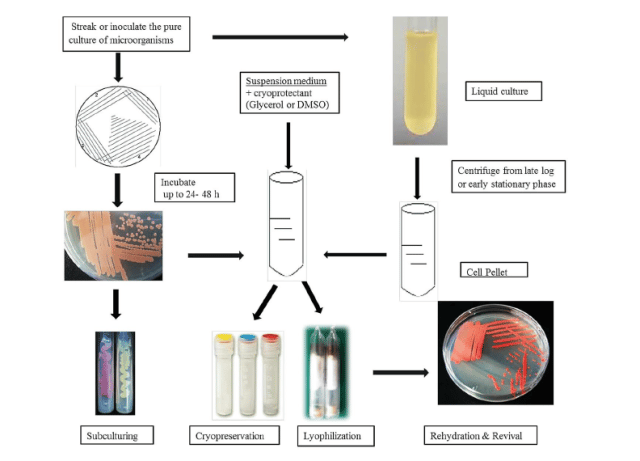 Figure: Maintenance and preservation of microorganisms
The two words in this article's title describe two different endpoints, and mixing them up is the first source of confusion:
- Maintenance keeps a culture actively growing through repeated, periodic subculturing. It's simple and needs no special equipment, but every transfer carries some risk of contamination and, over enough passages, genetic drift.
- Preservation deliberately pushes a culture into dormancy (by cold, drying, or freezing) specifically to avoid repeated subculturing. It takes more equipment or reagents up front but protects the strain's original characteristics far better over the long term.
The choice between them is a trade-off between convenience now and fidelity later. A teaching stock that gets replaced every semester can be maintained by periodic transfer. A reference or QC strain that must still behave identically five years from now needs preservation, not maintenance.
Preservation Methods
Periodic Transfer (Subculturing) to Fresh Media
Strains can be maintained by periodically preparing a fresh culture from the previous stock. The culture medium, the storage temperature, and the time interval at which the transfers are made vary with the species and must be ascertained beforehand. The temperature and the medium chosen should support a slow rather than a rapid rate of growth so that the time interval between transfers can be as long as possible. Many more common heterotrophs remain viable for several weeks or months on a medium like nutrient agar.
The transfer method has the disadvantage of failing to prevent changes in the characteristics of a strain due to the development of variants and mutants.
Refrigeration
Pure cultures can be successfully stored at 0-4°C in refrigerators or cold rooms. This method is applied for a short duration (2-3 weeks for bacteria and 3-4 months for fungi) because the metabolic activities of the microorganisms are significantly slowed down but not stopped. Thus their growth continues slowly, nutrients are utilized, and waste products are released into the medium. This finally results in the microbes’ death after some time.
Molds can be stored on potato dextrose agar (PDA) slants at 4°C for 6 months to 1 year.
Paraffin/Mineral Oil Overlay Method
Preservation of organisms by overlaying culture medium with mineral oil is a simple and economical method of maintaining pure cultures of bacteria and fungi. For example, PDA slants may be overlaid with sterile mineral oil and stored at room temperature for the longer-term storage of fungi.
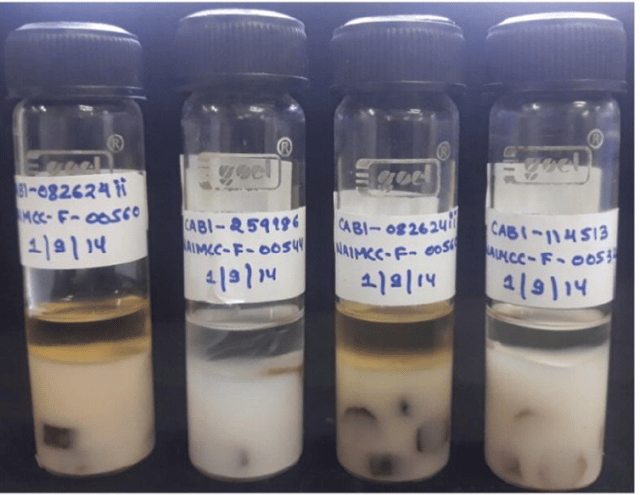 Figure: Preservation with overlaid of mineral oil
In this method, sterile liquid paraffin is poured over the slant (slope) of the culture and stored upright at room temperature. The layer of paraffin ensures anaerobic conditions and prevents dehydration of the medium. This condition helps microorganisms or pure culture to remain dormant; therefore, the culture can be preserved from months to years (varies with species).
Procedure
- Prepare tubes of heart infusion agar with a short slant. For fastidious organisms, add fresh native or heated blood.
- Sterilize mineral oil (liquid petrolatum) in hot air (170 °C for 1 hour).
- Grow a pure culture on the agar slant.
- When good growth is seen, add sterile mineral oil to about 1 cm above the tip of the slant.
- Subculture when needed by scraping growth from under the oil.
- Store at room temperature. Transfer after 6–12 months.
The advantage of this method is that we can remove some of the growth under the oil with a transfer needle, inoculate a fresh medium, and still preserve the original culture. The simplicity of the method makes it attractive, but changes in the characteristics of a strain can still occur.
Preservation in Glycerol at -20 °C
Glycerol storage at -20°C is a genuine medium-term method (12–18 months), distinct from the general, un-cryoprotected storage of an isolate at -20°C described below, which is not recommended for anything beyond the short term. The temperature is the same; the presence of a cryoprotectant and the intended duration are what differ.
- Grow a pure culture on an appropriate solid medium.
- When the culture is fully developed, scrape it off with a loop.
- Suspend small clumps of the culture in sterile neutral glycerol.
- Distribute in quantities of 1–2 ml in screw-capped tubes or vials.
- Store at -20 °C. Avoid repeated freezing and thawing. Transfer after 12–18 months.
Cooked-meat medium (anaerobes)
Cooked-meat medium is used for the preservation of anaerobic bacteria.
- Inoculate tubes of cooked meat medium with the isolate.
- Incubate overnight at 35 °C.
- Close tube with screw-cap or cork.
- Store at room temperature. Transfer every two months.
Fastidious pathogens such as N. meningitidis, S. pneumoniae, and H. influenzae are a special case; they survive only a few days by ordinary methods and need dedicated short-term techniques, covered in Short-Term Storage of Fastidious Bacteria.
Deep Freezing -70°C or Above
Long-term storage of aerobes and anaerobes can be accomplished by freezing at -70°C. Frozen, non-fastidious organisms should be thawed, reisolated, and refrozen every five years; fastidious organisms should be thawed, reisolated, and refrozen every three years. Acid-fast bacilli (AFB) may also be frozen at -70°C in 7H9 broth with glycerol. Viruses may be stored indefinitely at -70°C in a solution containing a cryoprotectant, such as 10% dimethyl sulfoxide (DMSO) or fetal bovine serum.
Cryopreservation in Liquid Nitrogen (-196°C)

Cryopreservation (i.e., freezing in liquid nitrogen at -196°C or in the gas phase above the liquid nitrogen at -150°C) helps the survival of pure cultures for long storage times.
In this method, the microorganisms of culture are rapidly frozen in liquid nitrogen at -196°C in the presence of stabilizing agents such as glycerol or dimethyl sulfoxide (DMSO) that prevent cell damage due to the formation of ice crystals and promote cell survival.
This liquid nitrogen method has been successful with many species that cannot be preserved by lyophilization and most species can remain viable under these conditions for 10 to 30 years without undergoing a change in their characteristics; however, this method is expensive.
Lyophilization(Freeze-Drying)
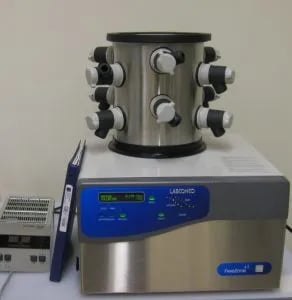 Figure: Freeze Dryer
Most organisms may be successfully stored after lyophilization (freeze-drying). Freeze-drying is a process where water and other solvents are removed from a frozen product via sublimation. Sublimation occurs when a frozen liquid goes directly to a gaseous state without entering a liquid phase.
The freeze-drying process results in a stable, readily rehydrated product. This process consists of three steps:
- pre-freezing the product in laboratory freezer to form a frozen structure,
- primary drying to remove most water,
- and secondary drying to remove bound water.
It is recommended to use slow rates of cooling, as this will result in the formation of vertical ice crystal structures, thus allowing for more efficient water sublimation from the frozen product. Freeze-dried products are hygroscopic and must be protected from moisture during storage. Under these conditions, the microbial cells are dehydrated, and their metabolic activities are stopped; as a result, the microbes go into a dormant state and retain viability for years. Lyophilized or freeze-dried pure cultures are then sealed and stored in the dark at 4°C in refrigerators.
The freeze-drying method is the most frequently used technique by culture collection centers. Many species of bacteria preserved by this method have remained viable and unchanged in their characteristics for more than 30 years.

Advantage of Lyophilization
- Only minimal storage space is required; hundreds of lyophilized cultures can be stored in a small area.
- Small vials can be sent conveniently through the mail to other microbiology laboratories when packaged in a special sealed mailing container.
- Lyophilized cultures can be revived by opening the vials, adding the liquid medium, and transferring the rehydrated culture to a suitable growth medium.
Recovery of Bacteria from Lyophilized storage condition
To recover the isolate, follow the step-wise procedure as mentioned below;
- Remove the frozen cultures from the freezer and place them on dry ice or into an alcohol and dry-ice bath;
- Transfer to a laboratory safety cabinet or a clean area if a cabinet is not available.
- Scrape the top-most portion of the culture using a sterile loop
- Transfer to a growth medium without contaminating the top or inside of the vial.
- Re-close the vial before the contents completely thaw, and return the vial to the freezer; with careful technique, transfers can be successfully made from the same vial several times.
- Incubate for 18–24 hours at 35–37°C; perform at least one subculture before using the isolate to inoculate a test.
CTA Stab Culture for fastidious organisms (Neisseria, streptococci)
These cultures at room temperature are used for non-fastidious organisms only, such as staphylococci and Enterobacteriaceae
- Prepare tubes with a deep butt of carbohydrate-free agar. Tryptic soy agar is recommended.
- Stab the organism into the agar.
- Incubate overnight at 35 °C.
- Close tube with screw-cap or cork. Dip cap or cork into molten paraffin wax to seal.
- Store at room temperature. Transfer after one year.
Stab culture in cystine trypticase agar (CTA) method is recommended for the preservation of Neisseria and streptococci.
- Prepare tubes of cystine trypticase agar.
- Stab the organism into the medium.
- Incubate overnight at 35 °C.
- Close tube with screw-cap or cork. Dip cap or cork into molten paraffin wax to seal.
- For Neisseria, store at 35 °C, and transfer every two weeks. For streptococci, store at room temperature, and transfer every month.
How to Remember
- Maintenance vs. preservation: Maintenance is like a patient walking around; preservation puts them into a controlled coma. Walking around, they can still pick up new habits (mutations). In a coma, nothing changes. Choose the coma for anything you need to stay exactly the same.
- Matching duration to method, fast: Order the shelf life from shortest to longest and the method almost names itself: refrigeration (weeks) → paraffin overlay (about a year) → glycerol at -20°C (12–18 months) → deep freeze at -70°C (years) → liquid nitrogen (decades) → lyophilization (indefinite). If an exam question specifies "decades" or "reference collection," lyophilization or liquid nitrogen is almost always the intended answer, not refrigeration or transfer.
- Why fastidious organisms get their own method: Neisseria and streptococci are fussy about drying out and about nutrients, so they get a stab culture in an enriched medium (CTA) and shorter transfer intervals. If a question names one of these organisms and asks about routine maintenance, the answer involves CTA stab, not a plain nutrient agar stab.
- Why genetic drift matters more for some cultures than others: A teaching stock that mutates slightly is a minor inconvenience. A QC/reference strain that mutates slightly can invalidate every test result compared against it, silently, until someone notices the numbers look wrong. The more a strain is used as a fixed standard, the more its preservation method matters.
Key exam facts in one table
| Method | Approximate duration | Best suited for | Key exam fact |
|---|---|---|---|
| Periodic transfer (subculturing) | Ongoing, indefinite | Routine teaching/working stocks | Simplest method, but the only one with real, ongoing risk of contamination and cumulative genetic drift with every transfer. |
| Refrigeration (0–4°C) | 2–3 weeks (longer for spore-formers) | Short-term holding between uses | Cells are still slowly dying; not a stopping point, just a pause. |
| Paraffin/mineral oil overlay | Up to ~1 year | Simple medium-term storage without freezing equipment | Oil excludes oxygen and slows desiccation; useful where a freezer isn't available. |
| Glycerol stock (-20°C) | 12–18 months | Medium-term storage of routine working strains | Glycerol is the cryoprotectant; -20°C alone, without it, is not a recommended long-term method. |
| Deep freezing (-70°C or lower) | Several years | Long-term storage where lyophilization isn't available | The de facto standard "long-term freezer" method in most diagnostic labs. |
| Liquid nitrogen cryopreservation (-196°C) | 10–30+ years | Reference strains, research collections | Vapor-phase or liquid-phase storage at this temperature essentially halts metabolism entirely. |
| Lyophilization (freeze-drying) | 30+ years, often indefinite | Culture collections, master reference stocks (e.g., ATCC-style QC strains) | Gold standard for genetic stability; minimizes passage number to near zero between preparation and use. |
| CTA stab (fastidious organisms) | 2 weeks (Neisseria) to 1 month (streptococci) | Neisseria, streptococci, and other fastidious organisms | Standard stab culture media are often nutritionally inadequate for these organisms; CTA is enriched specifically for them. |
Where Students Get Confused
- Reading "-20°C" twice and assuming it means two contradictory things. Glycerol stock at -20°C (a real, valid 12–18 month method) and general un-cryoprotected storage at -20°C (explicitly not recommended long-term) use the same temperature but are not the same method. The cryoprotectant and intended duration are what distinguish them, not the freezer setting.
- Treating "maintenance" and "preservation" as interchangeable. They describe opposite strategies: staying active (maintenance, more drift risk) versus going dormant (preservation, less drift risk). A question that asks why a reference strain is preserved rather than maintained is testing this distinction directly.
- Assuming one method fits all organisms. Fastidious organisms (Neisseria, streptococci) fail on routine stab culture media and need CTA specifically, with shorter transfer intervals than non-fastidious organisms tolerate.
- Not connecting genetic drift to real consequences. Repeated subculturing isn't just "less convenient," it is the actual mechanism by which a QC or reference strain can stop matching its original characteristics, which then quietly undermines every test validated against it.
- Assuming higher-tech methods are always the answer. Lyophilization and liquid nitrogen aren't chosen because they're more advanced; they're chosen when genetic stability over years to decades actually matters. For a strain only needed for a few weeks, refrigeration or paraffin overlay is the appropriate, not the inferior, choice.
References
- Jang, T. H., Park, S. C., Yang, J. H., Kim, J. Y., Seok, J. H., Park, U. S., Choi, C. W., Lee, S. R., & Han, J. (2017). Cryopreservation and its clinical applications. Integrative medicine research, 6(1), 12–18. https://doi.org/10.1016/j.imr.2016.12.001
- Butreddy, A., Dudhipala, N., Janga, K. Y., & Gaddam, R. P. (2020). Lyophilization of Small-Molecule Injectables: an Industry Perspective on Formulation Development, Process Optimization, Scale-Up Challenges, and Drug Product Quality Attributes. AAPS PharmSciTech, 21(7), 252. https://doi.org/10.1208/s12249-020-01787-w
- American Type Culture Collection (ATCC). Reference Strains: How Many Passages are Too Many? ATCC Technical Document. Retrieved from https://www.atcc.org/resources/technical-documents/reference-strains-how-many-passages-are-too-many
Frequently Asked Questions
What is the difference between maintenance and preservation of bacterial cultures?
Why is -20°C storage sometimes recommended and sometimes discouraged?
Why do quality control strains need special preservation, not just routine subculturing?
Which preservation method is best for long-term storage of a bacterial culture?
Why do Neisseria and streptococci need a different preservation method than other bacteria?

Tankeshwar Acharya, MSc (Medical Microbiology)
Tankeshwar Acharya is an Assistant Professor in the Department of Microbiology at Patan Academy of Health Sciences (PAHS), Nepal, where he has been teaching and practicing clinical microbiology for over 14 years. He is the founder of Microbe Online, one of the leading free microbiology education resources on the web, covering bacteriology, mycology, parasitology, immunology, and clinical laboratory diagnostics written from direct experience in both the classroom and the diagnostic laboratory.
Comments
No comments yet. Be the first to share your thoughts.
Leave a comment
All comments are reviewed before they appear.