
IgE Antibodies: Structure, Properties, and Functions
IgE Antibodies: Structure, Properties, and Functions
Immunoglobulin E (IgE) is one of five isotypes of human immunoglobulins: IgG, IgA, IgM, IgD, and IgE. IgE is commonly associated with the various manifestations of allergic disease and protection against repeated infestations with helminths. Immunoglobulin E (IgE) antibodies were discovered by Kimishige Ishizaka in 1966-1967 in the serum of patients with certain types of allergies.
Structure
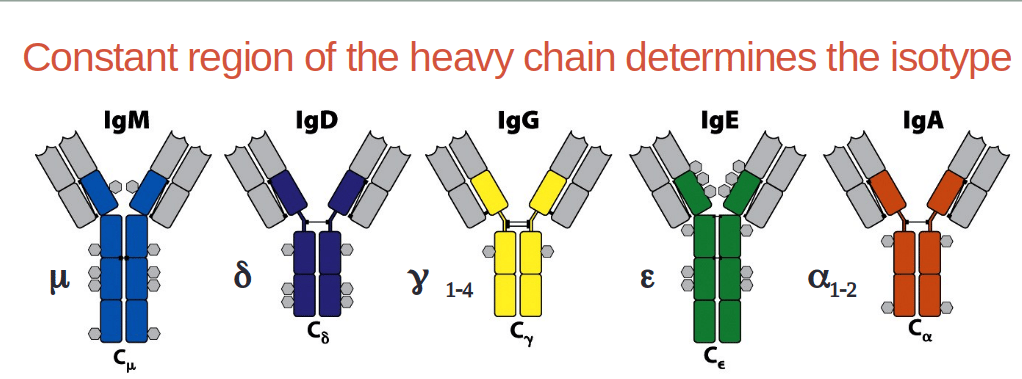 Figure: Structure of Antibodies Isotypes
Antibodies are Y-shaped tetra-peptide molecules consisting of two identical heavy (H) chains and two identical light (L) chains, held together by disulfide bonds. The heavy chain differentiates the various immunoglobulin isotypes. The heavy chain in IgE is epsilon (ε). IgE is a monomer and consists of four constant regions (one additional heavy chain constant domain). Due to this extra domain, the weight of IgE is 190 kDa compared with 150 kDa for IgG, which has 3 constant domains. The absence of a hinge region in the ε-chain is another unique feature of IgE antibody.
Both IgM and IgE lack hinge region and have one additional heavy chain domain.
Properties
Molecular weight
The molecular weight of IgE is 190 kDa, which is more than the molecular weight of IgA, IgG, and IgD, i.e. 150 kDa (as IgE has one extra domain in a heavy chain). As IgA also exists as a dimer, its molecular weight ranges from 150 kDa to 300 kDa. The molecular of IgM (pentameric form) is 900 kDa.
Normal serum level
Average serum concentration of IgE i very low (0.3 μg/mL) i.e, 100,000-fold lower than for IgG. Its concentration is markedly increased in certain allergic conditions, such as bronchopulmonary aspergillosis, or with parasitic diseases, such as schistosomiasis. Blood serum IgE level in a normal individual is only about 0.019% of the immunoglobulin concentration.
Half-Life
The half-life of IgE in plasma is only 2–3 days but is prolonged to 2–3 weeks after IgE binds to the Fc receptor FcεRI on the surface of mast cells, basophils, or dendritic cells.
Function
Strong protective capacity against helminthic infestations and harmful effects by triggering allergic responses are two major functions of IgE.
Protection from helminthic infestations
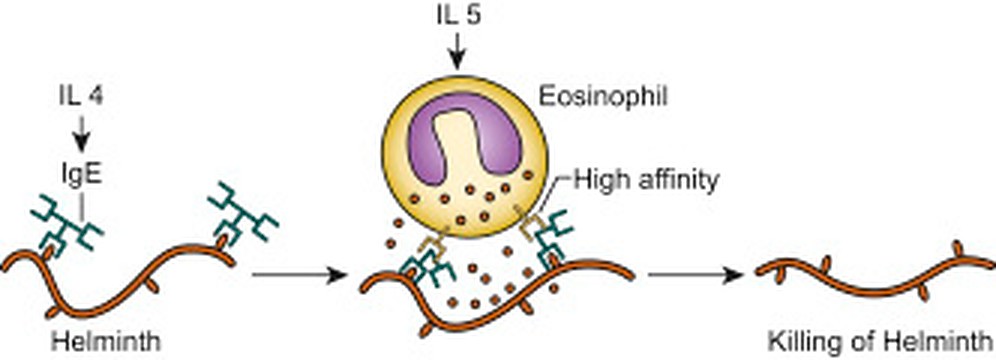 Figure: Role of Immunoglobulin E in Helminthic infestations
IgE is important in defense against parasitic diseases, especially those caused by helminths and some protozoa. Eosinophils have Fc receptors for IgE and binding of eosinophils to IgE-coated helminths results in the killing of the parasite. Since serum IgE levels rise in parasitic diseases, measuring IgE levels is helpful in diagnosing parasitic infections.
IgE does not activate complement or participate in opsonization so its role in defense against bacterial infections is insignificant.
Type I hypersensitivity
IgE antibodies mediate the immediate hypersensitivity reactions that are responsible for the symptoms of hay fever, asthma, hives, and anaphylactic shock. IgE binds to Fc receptors (FcεRI) on the membrane of the mast cells. Cross-linkage of receptor-bound IgE molecules by allergen induces mast cell degranulation and the release of pharmacologically active mediators such as histamine, PGD2, and TNF to give allergic manifestations.
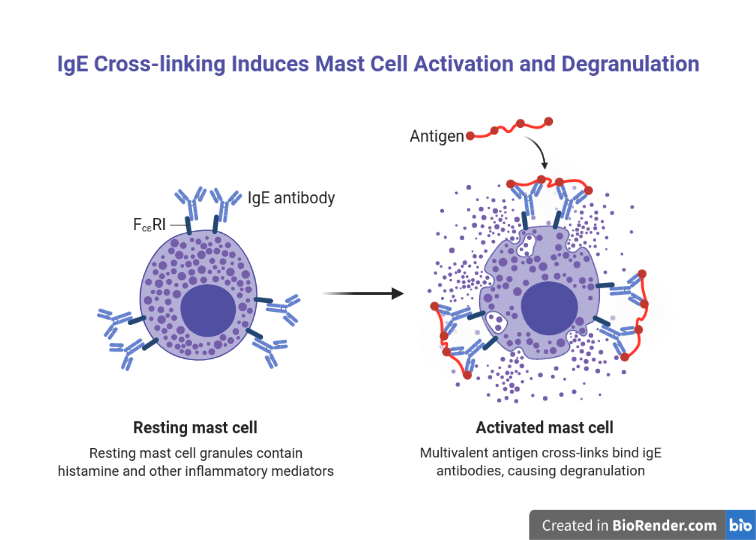 Figure: IgE plays important role in Type I hypersensitivity reaction
References and further readings
- Cellular and Molecular Immunology, 9th Edition
- Kuby Immunology, 8th Edition
- Roitt’s Essential Immunology, 13th Edition
- Image of mast cell degranulation was created with biorenders.com

Tankeshwar Acharya, MSc (Medical Microbiology)
Tankeshwar Acharya is an Assistant Professor in the Department of Microbiology at Patan Academy of Health Sciences (PAHS), Nepal, where he has been teaching and practicing clinical microbiology for over 14 years. He is the founder of Microbe Online, one of the leading free microbiology education resources on the web, covering bacteriology, mycology, parasitology, immunology, and clinical laboratory diagnostics written from direct experience in both the classroom and the diagnostic laboratory.