
Liquid-Based Swab Transport Systems (eSwab): Types, Uses, and Limitations

On this page
A wound swab arrives from theatre with three requests on the form: Gram stain, aerobic and anaerobic culture, and MRSA PCR. It is a single dry rayon swab in gel Amies.
The Gram stain uses it. By the time the culture plates are inoculated, most of what the swab collected is still buried in its fibers, and there is nothing left to send for PCR. The laboratory reports what it can and adds a note asking for a repeat sample. The patient has already left theatre.
A liquid-based system solves exactly this. The swab releases its sample into a milliliter of liquid medium, and that milliliter can be divided. One collection, several tests, no repeat visit.
A liquid-based swab transport system pairs a flocked swab with a measured volume of liquid transport medium in a screw-cap tube. The swab releases its sample into the liquid rather than holding it in fibers, which turns a single collection into a divisible specimen that several tests can share.
Copan's eSwab is the most widely used example and the one most laboratories mean when they refer to the format: a nylon flocked swab supplied with 1 mL of liquid Amies. Equivalent systems are made by other manufacturers, and the working principle is the same across all of them. This article uses eSwab as the worked example while describing the category.
Liquid Amies systems are suitable for aerobic, anaerobic, and fastidious bacteria. They are not suitable for viral specimens, which is covered under limitations below.
The E in eSwab stands for elute, which is the defining feature: the sample elutes off the swab into the liquid. These devices are sterilized by gamma irradiation during manufacture, so the tube and swab arrive sterile and can be opened straight into use without further preparation. Irradiation destroys any nucleic acid present in the device before it leaves the factory, which is what makes the system suitable for molecular testing: there is no residual microbial DNA to give a false positive. It has no effect on specimen DNA collected later, since sterilization is complete long before the swab meets a patient.
How Liquid-Based Transport Works
Three things happen in a liquid-based system that do not happen in a traditional dry or gel swab.
Release instead of retention. A traditional swab wraps fiber around a core, and sample driven into that core stays there. A flocked tip has no core, so the collected material sits near the surface and washes off almost completely on contact with liquid. What was a swab with sample trapped in it becomes a milliliter of suspension.
Divisibility. Once the specimen is a liquid suspension, it can be aliquoted. The same collection can supply a slide for Gram stain, an inoculum for culture plates, and a volume for a molecular assay or rapid antigen test. A dry swab must be spent on whichever test is done first.
Maintenance rather than growth. Amies is a maintenance medium, not a growth medium. It supplies buffered salts and a reducing agent to hold organisms viable in stasis without letting them multiply, so the proportions of a mixed specimen stay roughly as collected. This is why a transport medium is not simply broth: broth would let the fast growers overtake the pathogen in transit.
The liquid formulation matters here. Gel Amies also maintains organisms, but the specimen stays embedded in the swab fibers and must be eluted at the bench, which recovers only part of it. The liquid format does the elution at the moment of collection.
Formats Available
Liquid-based systems are supplied in several formats, differing in the number and size of swabs rather than in the medium. All contain 1 mL of liquid Amies.
Multiple Swabs
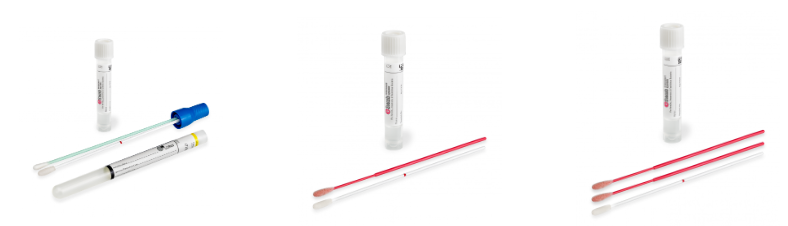 Figure: Multiple Swab, Image Source:Copan
A double or triple swab set. Only the nylon flocked swab carries the 80 mm breakpoint; the additional rayon or flocked swabs do not.
Single Regular
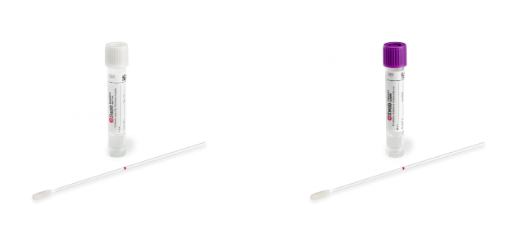 Figure: Single Regular, Image Source:Copan
A single nylon flocked swab with an 80 mm breakpoint.
Single Mini Tip
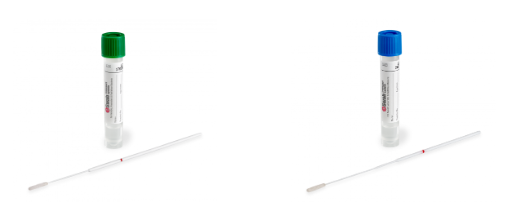 Figure: Single Mini Tip, Image Source:Copan
A nylon flocked swab with a narrower tip and a breakpoint at 80 mm or 100 mm.
| Format | Swab configuration | Choose it for |
|---|---|---|
| Single regular | One nylon flocked swab, 80 mm breakpoint | Routine adult collection: throat, wound, ear, eye, genital |
| Single minitip | One nylon flocked swab, 80 or 100 mm breakpoint, smaller tip | Nasopharyngeal collection, pediatric specimens, narrow or small sites, urethral sampling |
| Multiple (double or triple) | One flocked swab with breakpoint plus one or two additional swabs | Sites needing more than one sampling pass, or where a spare swab allows a second site into the same tube |
The breakpoint is the scored line on the shaft. It exists so the swab can be snapped off cleanly inside the tube at a length that lets the cap seal, without the collector's fingers entering the tube or the shaft protruding.
How to collect the sample
- Put on personal protective equipment like gloves and a mask before sample collection.
- Open the peel pouch, remove the tube and label it properly.
- Then unscrew the cap and remove it.
- Collect the sample from the patient and insert it into the bottom of the tube.
- Do not touch the swab shaft below the breakpoint, since anything your glove contacts there goes into the tube. Bend the shaft against the rim of the tube at the marked breakpoint until it snaps, holding the tube away from your face. The swab tip stays in the medium.
- Screw the cap on tightly to prevent leakage and check the label.
- Transport to the laboratory and process as soon as possible. If there is a delay, hold the tube at either refrigerator temperature (4 to 8°C) or room temperature (20 to 25°C); both are acceptable within the 48-hour window. Specimens for Neisseria gonorrhoeae culture should be processed within 24 hours, per CLSI guidance.
Why the Flocked Tip Matters Here
The liquid format only works because the swab releases its sample. A flocked tip has no internal core, so material stays near the surface and elutes almost completely into the medium, compared with roughly a tenth recovered from a traditional fiber swab. That difference is what makes several aliquots from one collection possible.
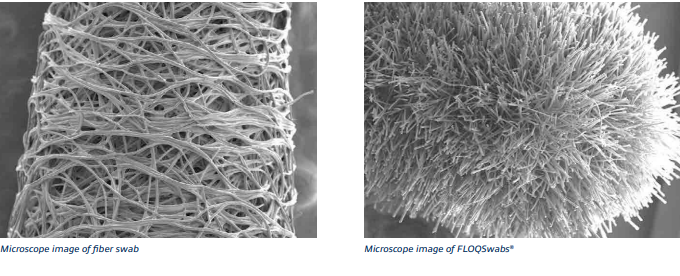 Figure: Image source:Copan
For the full comparison of flocked and traditional fiber swab construction, see Types of Swabs in Microbiology.
Uses
Liquid Amies systems are validated for a broad range of bacterial and fungal work:
- Aerobic and anaerobic bacterial culture
- Fungal culture, validated against CLSI M40-A2
- Staphylococcus aureus and MRSA detection, by culture and by PCR
- Vancomycin-resistant Enterococcus (VRE) screening
- Eye, ear, throat, wound, and genital specimens
- Gram stain directly from the eluted sample
- Rapid antigen testing and molecular assays
- Automated processing, since the liquid can be pipetted and handled by instruments
For anaerobes, deep wounds, and fungal infection, tissue or aspirated fluid remains the preferred specimen where it can be obtained. The system is validated for these applications and performs well among swab-based options, but it does not close the gap between a swab and tissue.
Liquid Amies systems maintain bacterial viability for up to 48 hours at either room temperature (20 to 25°C) or refrigerator temperature (4 to 8°C), validated against CLSI standard M40-A2 for transport device performance. Neisseria gonorrhoeae is the notable exception and should be processed within 24 hours, as it is the most fragile of the commonly transported pathogens and sets the tightest limit in the CLSI guidance.
Limitations and Unsuitable Specimens
Not for viral specimens. This is the most important limitation and the most common error. Liquid Amies is a bacterial maintenance medium. It does not contain the protein stabilizers, antibiotics, and antifungals that a viral transport medium uses to protect virions and suppress bacterial and fungal overgrowth. A respiratory specimen for influenza, RSV, or SARS-CoV-2 belongs in viral transport medium or universal transport medium, not liquid Amies. The confusion arises because both are liquid-based systems with flocked swabs and look almost identical on the shelf. Check the medium, not the swab.
A swab is still a swab. For anaerobic culture, deep wounds, and fungal infection, tissue or aspirated fluid remains the better specimen. A liquid-based system improves what a swab can deliver; it does not make a swab equivalent to tissue. Where an aspirate can be obtained, obtain it.
Time limits still apply. The 48-hour figure is a validated maximum under standard conditions, not a guarantee for every organism. Fastidious organisms generally recover less well the longer they sit, whatever the medium claims.
Cost. Liquid-based systems cost substantially more per collection than a dry rayon swab in gel Amies. Where budgets are tight, they are best reserved for specimens likely to need multiple tests, fastidious organisms, and molecular workflows, rather than used as the default for every routine throat swab.
Not a growth medium. The 1 mL of liquid Amies maintains organisms; it does not enrich them. A low-burden specimen is still a low-burden specimen on arrival.
Liquid Amies versus gel Amies versus dry swab
| Dry swab (no medium) | Gel Amies (traditional) | Liquid Amies (eSwab type) | |
|---|---|---|---|
| Sample recovery | Poorest; specimen dries | Partial; specimen stays in fibers | Near complete; elutes into liquid |
| Tests per collection | One | Usually one | Several aliquots |
| Bacterial viability | Hours at best | Up to 48 hours (organism dependent) | Up to 48 hours (organism dependent) |
| Suits molecular testing | Depends on swab material | Elution step needed, recovery variable | Yes, direct from the liquid |
| Suits automation | No | Limited | Yes, liquid handles readily |
| Anaerobe recovery | Poor | Moderate | Good, reducing agent plus liquid |
| Cost per collection | Lowest | Low | Highest |
| Best for | Situations with no alternative | Routine single-test bacteriology | Multi-test requests, fastidious organisms, molecular workflows, automation |
The honest summary: gel Amies remains adequate and considerably cheaper for a routine single-request bacterial swab. Liquid systems earn their cost when the specimen must serve more than one test, when the organism is fastidious, or when the workflow is automated or molecular.
How to remember
E is for elute, and elute is the whole point. Every advantage of the format follows from one thing: the sample comes off the swab instead of staying in it. More sample recovered, several tests from one collection, direct pipetting for automation. All of it is elution.
Liquid maintains, broth grows. A transport medium is deliberately not nutritious. Amies holds organisms in stasis so the mix that arrives resembles the mix that was collected. Put the same specimen in broth and the fast growers would swamp the pathogen before it reached the bench.
Amies is for bacteria, VTM is for viruses. The two systems look nearly identical, same flocked swab, same liquid, same screw-cap tube. The medium inside is entirely different. Read the label, not the swab.
One tube, ten aliquots, forty-eight hours, twenty-four for GC. The four numbers worth carrying: 1 mL of medium, up to ten aliquots, 48 hours of viability, and the 24-hour exception for Neisseria gonorrhoeae.
Key exam facts in one table
| Question a student actually gets asked | The answer, with the reasoning that makes it stick |
|---|---|
| What does eSwab consist of? | A nylon flocked swab and 1 mL of liquid Amies in a sterile screw-cap tube. |
| What does the E stand for? | Elute. The sample releases from the swab into the liquid rather than staying in the fibers. |
| Why can one collection serve several tests? | Because the specimen becomes a liquid suspension, it can be aliquoted. Up to ten aliquots from one tube, versus one test from a dry swab. |
| How long is bacterial viability maintained? | Up to 48 hours at room (20 to 25°C) or refrigerator (4 to 8°C) temperature, validated against CLSI M40-A2. |
| Which organism is the exception? | Neisseria gonorrhoeae, which should be processed within 24 hours. It is the most fragile common transport pathogen. |
| Why is Amies a maintenance and not a growth medium? | It holds organisms viable without letting them multiply, so the proportions in a mixed specimen stay roughly as collected. |
| Can it be used for viral specimens? | No. Liquid Amies is a bacterial medium. Viral specimens need viral or universal transport medium. |
| Why is the device gamma irradiated? | To sterilize it and destroy any residual nucleic acid before it leaves the factory, so there is no contaminating DNA to cause a false positive in molecular testing. |
| What is the breakpoint? | A scored line on the shaft allowing a clean snap inside the tube, so the cap seals and fingers never enter the tube. |
| Which format for a pediatric or nasopharyngeal specimen? | The single minitip, which has a smaller tip for narrow or small sites. |
| Liquid Amies versus gel Amies? | Gel is cheaper and adequate for a single routine bacterial request. Liquid recovers far more sample and supports multiple tests, automation, and molecular work. |
| Is it better than tissue for anaerobes? | No. Tissue or aspirated fluid remains preferred. Liquid systems are the best swab-based option, not a replacement for tissue. |
Where students get confused
"It is a liquid swab system, so it will do for a COVID or flu swab." No. Liquid Amies and viral transport medium look nearly identical, both a flocked swab in a liquid-filled screw-cap tube, but Amies is a bacterial maintenance medium without the stabilizers and antimicrobials a viral specimen needs. This is the most consequential error with these devices.
"Gamma irradiation might damage the sample." Sterilization happens during manufacture, long before the device meets a patient. Its purpose is to remove any microbial DNA from the device so that molecular testing is not contaminated by it. It has no effect on the specimen collected later.
"The medium keeps the organisms growing." It deliberately does not. Amies maintains viability without supporting multiplication. If it encouraged growth, the fast-growing commensals in a mixed specimen would outcompete the pathogen during transit and the culture would misrepresent what was collected.
"Liquid systems make swabs as good as tissue." They improve swab performance considerably but do not close the gap. For anaerobes, deep wounds, and fungal infection, an aspirate or tissue is still the better specimen.
"48 hours means any organism survives 48 hours." The figure is a validated maximum under standard conditions, not a guarantee for every organism. Neisseria gonorrhoeae needs processing within 24 hours, and fastidious organisms generally recover less well the longer they wait.
eSwab versus flocked swab. These are not the same thing. A flocked swab is a swab construction, available dry or with any medium. eSwab is a complete transport system that uses a flocked swab with liquid Amies.
References
- Vermeiren C, Marchand-Senécal X, Sheldrake E, et al. Comparison of Copan ESwab and FLOQSwab for COVID-19 diagnosis: working around a supply shortage. J Clin Microbiol. 2020;58(6):e00669-20. https://doi.org/10.1128/JCM.00669-20
- Gandhi B, Summerbell R, Mazzulli T. Evaluation of the Copan ESwab transport system for viability of pathogenic fungi by use of a modification of Clinical and Laboratory Standards Institute document M40-A2. J Clin Microbiol. 2018;56(2):e01481-17. https://doi.org/10.1128/JCM.01481-17
- Silbert S, Kubasek C, Uy D, Widen R. Comparison of ESwab with traditional swabs for detection of methicillin-resistant Staphylococcus aureus using two different walk-away commercial real-time PCR methods. J Clin Microbiol. 2014;52(7):2641-2643. https://doi.org/10.1128/JCM.00315-14
- Fontana C, Favaro M, Limongi D, Pivonkova J, Favalli C. Comparison of the eSwab collection and transportation system to an Amies gel transystem for Gram stain of clinical specimens. BMC Res Notes. 2009;2:244. https://doi.org/10.1186/1756-0500-2-244
- Clinical and Laboratory Standards Institute. Quality Control of Microbiological Transport Systems. CLSI document M40-A2. Wayne, PA: CLSI.
- Tille PM, editor. Bailey & Scott's Diagnostic Microbiology. 15th ed. St. Louis: Elsevier; 2022.
- Copan Diagnostics. ESwab collection and transport system, product literature. https://www.copanusa.com/wp-content/uploads/2019/07/LBM-ESwab-051519.pdf
Frequently Asked Questions
What is eSwab and what does the E stand for?
Can I use eSwab for viral specimens such as influenza or SARS-CoV-2?
How long do organisms survive in a liquid Amies system?
How many tests can be run from one eSwab collection?
Why is the device sterilized by gamma irradiation?
What is the difference between liquid Amies and gel Amies?
Is a liquid-based swab as good as a tissue sample?
What is the breakpoint on the swab shaft?
Which eSwab format should I use for a pediatric or nasopharyngeal sample?

Tankeshwar Acharya, MSc (Medical Microbiology)
Tankeshwar Acharya is an Assistant Professor in the Department of Microbiology at Patan Academy of Health Sciences (PAHS), Nepal, where he has been teaching and practicing clinical microbiology for over 14 years. He is the founder of Microbe Online, one of the leading free microbiology education resources on the web, covering bacteriology, mycology, parasitology, immunology, and clinical laboratory diagnostics written from direct experience in both the classroom and the diagnostic laboratory.
Comments
No comments yet. Be the first to share your thoughts.
Leave a comment
All comments are reviewed before they appear.