
Entero Test (String Test): When to Use It, How It Works, and What It Detects
When repeated stool exams miss Giardia or Strongyloides, the Entero Test samples duodenal fluid directly; here's when and how to use it.

On this page
A 28-year-old returns from a three-week trip to Nepal with persistent diarrhea, bloating, and weight loss. Three stool examinations for ova and parasites are reported negative. The clinician still suspects Giardia, the clinical picture fits too well, but the parasite isn't showing up in stool.
The problem is that Giardia trophozoites live in the duodenum and upper jejunum, not in the colon. By the time the organism has passed through the entire GI tract to appear in stool, trophozoites have often encysted or been destroyed. Some infections shed organisms intermittently, and a standard stool examination is essentially sampling whatever happened to be passing through the colon at that moment. Three negative samples from the wrong anatomical location tells you surprisingly little about what's happening at the infection site.
The Entero Test solves this by sampling directly from the duodenum, the parasite's actual habitat, without an endoscope. The patient swallows a gelatin capsule containing a tightly coiled nylon string, the string reaches the duodenum as the capsule dissolves, absorbs the surrounding fluid for four hours, and is then withdrawn for direct microscopy. When you examine what was actually there, you often find what the stool exam missed.
A commercially available device that consists of a gelatin capsule containing either 90 cm (pediatric version) or 140 cm (adult version) of a highly absorbent nylon string is used for this test.
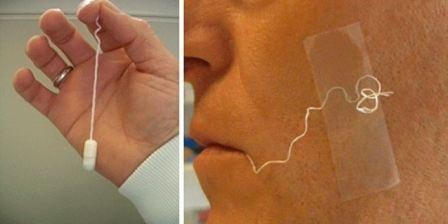 Figure: From left to right: Entero-Test device prior to swallowing, Entero-Test in situ (image source: Guiney WJ et al British Journal of Clinical Pharmacology)
Principle
A string test involves swallowing a string with a weighted gelatin capsule, to obtain a sample from the upper part of the small intestine. The capsule is swallowed and one end of the string is taped to the side of the patient’s face. The capsule dissolves in the stomach and the string, which is weighted at its distal end, passes into the duodenum by peristalsis. Following a period of approximately 4 hr, the string and any adsorbed gastrointestinal fluid is withdrawn through the mouth.
Any Strongyloides larvae, Giardia trophozoites, or Cryptosporidium, or Cystoisospora (Isospora) oocysts that are present will also adhere to the string and will be pulled up with the string when it is removed.
Any bile, blood, or mucus attached to the string is examined under the microscope as a wet preparation for the presence of intestinal parasites (organisms/eggs) or as a permanent stained smear.
For the patient: You may be asked not to eat or drink anything for 12 hours before the test. You may find it difficult to swallow the string, and you may feel an urge to vomit when the string is being removed. When the test is performed? Entero-Test (string test) is performed when a physician suspects a parasite infection, but no parasites were found in a stool sample. As its sensitivity is comparable to duodenal aspirate, it eliminates the need of duodenal intubation.
Procedure
- Loosen the end of the string from the outside of the capsule and tape it to the patient's cheek.
- Ask the patient to swallow the capsule with water (in the stomach, gelatin capsule is dissolved and the weighted string is carried by peristalsis into the duodenum.)
- After approximately 4 hours, withdraw the string (during withdrawal, the small steel weight which is attached to the distal end of the string detaches and is eliminated in the stool).
- Remove the bile-stained mucus clinging to the string by pulling the string between thumbs and finger and collect it in a small petri dish.
- Examine the specimen by a wet mount technique to detect the presence of motility of the organisms or specific morphological forms (trophozoite of Giardia lamblia and larvae of Strongyloides stercoralis).
- Iodine may be added later to facilitate the identification of any organism present.
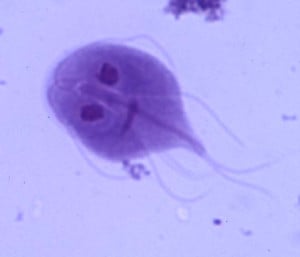 Figure: Trophozoite ofGiardia lamblia
Results
- Normal test result: No presence of blood, parasites, fungus, or abnormal cells is normal.
- Abnormal test result: Presence of giardia or another parasitic infestation.
Report the organism and stage (trophozoite, cyst, oocyst, etc.) without using abbreviations. For example: Giardia lamblia (G. duodenalis, G. intestinalis) trophozoites, Strongyloides stercoralis larvae. Confirmation of some species may require a permanent stained smear.
How to Remember
The string goes where the parasite lives. The fundamental logic of the Entero Test is geographic: Giardia and Strongyloides live in the duodenum and upper jejunum, not the colon. Standard stool O&P samples the colon. The Entero Test samples the duodenum. If you keep the anatomy clear, "duodenal parasite, duodenal sample" both the test's design and its clinical indication make sense without memorization.
Four organisms, two reasons to use this test. The Entero Test's clinical utility comes down to two situations: (1) organisms that preferentially live in the duodenum (Giardia lamblia, Strongyloides stercoralis, Isospora belli, Cryptosporidium parvum) and (2) clinical suspicion that's strong enough despite negative stool results. If you're chasing a colonic parasite, this test adds nothing. If you're chasing a duodenal one after repeated stool negatives, this test is the most direct available option short of endoscopy.
It's a string the patient swallows, not a culture. Students sometimes confuse the Entero Test with laboratory bench-top tests because the name "string test" is also used for the completely different Vibrio cholerae bile-salt test. The Entero Test is a patient procedure, the patient swallows a capsule, waits 4 hours, and the swallowed string is withdrawn. The Vibrio string test is a bench-top biochemical procedure where a bacterial colony is emulsified in bile salt to test DNA-mediated viscosity. They share only a name.
Uses
String test is a reliable and non-invasive diagnostic method of obtaining intestinal fluid samples for the detection of Giardia lamblia and other enteric pathogens such as Cryptosporidium, Cystoisospora (Isospora).
Key Exam Facts
| Feature | Detail |
|---|---|
| Also called | Entero-Test, Duodenal string test, HDC Entero-Test |
| Type of test | Patient-based diagnostic procedure (not a bench-top biochemical test) |
| Sampling site | Duodenum / upper jejunum |
| Target organisms | Giardia lamblia (trophozoites), Strongyloides stercoralis (larvae), Cryptosporidium parvum, Isospora belli |
| Principle | Patient swallows gelatin capsule containing coiled nylon string; capsule dissolves, string reaches duodenum, absorbs duodenal fluid; withdrawn and examined |
| String length | 90 cm (adult); 70 cm (pediatric) |
| Duration in situ | 4 hours |
| Withdrawal | Through the mouth after 4 hours |
| What's examined | The bile-stained (yellow-green) terminal portion of the string — mucus adherent to the string |
| Microscopy | Wet preparation of mucus from string; trichrome stain may improve sensitivity |
| When indicated | Repeated stool examinations negative; strong clinical suspicion; immunocompromised patient with suspected intestinal parasitosis |
| Advantage over stool O&P | Samples the duodenum directly; detects organisms that may not appear in stool reliably |
| Advantage over endoscopy | Non-invasive; no sedation required; less expensive |
| Disadvantage | Patient tolerance variable (nausea, gagging); not suitable for some patients (esophageal strictures, nasal polyps if nasal route used); false negative possible |
| NOT the same as | Vibrio cholerae string test (a bench-top bile-salt/DNA test — completely different) |
Where Students Get Confused
"The string test for parasites and the string test for Vibrio are the same thing." They are not. The Entero Test is a patient procedure where a physical string is swallowed to sample duodenal fluid. The Vibrio cholerae string test is a bench-top procedure where a bacterial colony is emulsified in sodium deoxycholate (bile salt); the bile salt lyses the cell wall, releasing DNA that makes the suspension viscous, forming a mucoid thread when the loop is lifted. Both are called "string tests" and both involve something resembling a string but the principle, methodology, clinical application, and even the organism cluster are entirely different. If an exam question specifies which organism it is about (parasites vs. Vibrio), you're looking at two entirely different tests.
"A negative Entero Test confirms the patient does not have Giardia." It does not. Like all direct examination methods, the Entero Test is dependent on operator technique, timing, and organism burden. Sensitivity is reasonable but not 100%. A negative result in a patient with strong clinical suspicion and a compatible travel history should prompt further investigation (duodenal aspirate by endoscopy, or empirical treatment in some settings) rather than concluding the diagnosis is excluded.
"The entire string is examined." Only the terminal 20–30 cm of the string is examined, the portion that reached the duodenum, identifiable by its yellow-green bile staining. The proximal portion of the string (which remained in the esophagus and stomach) does not contain duodenal material and is discarded.
"The Entero Test is useful for any intestinal parasite." It is specifically useful for organisms that reside in the duodenum and upper jejunum. It adds no value for colonic parasites (Entamoeba histolytica, Trichuris, hookworm, tapeworm segments). The Entero Test's indication is narrow: suspected duodenal-dwelling parasites after negative stool examination.
Note: Two Different Tests Share the Name "String Test"
The term "string test" is used in clinical microbiology for two completely unrelated procedures:
This article (Entero Test): A patient procedure used in parasitology. The patient swallows a gelatin capsule containing a nylon string. The string samples duodenal fluid and is withdrawn for microscopy. The "string" is a physical 90 cm nylon thread.
Vibrio cholerae string test: A bench-top biochemical test used in bacteriology to identify Vibrio cholerae. A colony is emulsified in sodium deoxycholate (bile salt), which lyses the cell wall and releases DNA, making the suspension viscous. A mucoid thread ("string") forms when the inoculating loop is slowly lifted. The "string" is a thread of DNA-containing viscous material.
They share only a name. The principles, organisms, methodology, and clinical applications are entirely different.
References
- Garcia, L. S. (2016). Diagnostic Medical Parasitology (6th ed.). ASM Press.
- Tille, P. M. (2017). Bailey & Scott's Diagnostic Microbiology (14th ed.). Elsevier Mosby.
- Centers for Disease Control and Prevention. Giardia: Diagnosis and treatment. https://www.cdc.gov/parasites/giardia/diagnosis.html
Frequently Asked Questions
Why does the Entero Test sample duodenal fluid when Giardia infection causes diarrhea?
Why does the Entero Test sample duodenal fluid when Giardia infection causes diarrhea?
Giardia trophozoites colonize the duodenum and upper jejunum, not the colon. By the time material reaches the colon and exits in stool, trophozoites have often encysted or been destroyed. The Entero Test bypasses the entire colon and samples directly from the parasite's actual habitat, finding organisms that stool examination misses, particularly in infections with intermittent shedding.
Is the Entero Test the same as the "string test" used for Vibrio cholerae?
Is the Entero Test the same as the "string test" used for Vibrio cholerae?
No. They share a name but are completely different tests. The Entero Test is a patient procedure where a physical nylon string is swallowed to sample duodenal fluid for parasite detection. The Vibrio string test is a bench-top biochemical test where a bacterial colony is emulsified in bile salt; the released DNA creates viscosity and a mucoid "string" forms. Different principle, different organisms, different methodology.
What part of the withdrawn Entero Test string is examined?
Only the terminal 20–30 cm, the bile-stained (yellow-green) portion that reached the duodenum. The rest of the string passed through the oesophagus and stomach and contains no duodenal material. Examining the wrong portion gives a false negative.
When should the Entero Test be used instead of repeat stool examination?
After two to three negative stool examinations in a patient with strong clinical suspicion for duodenal parasitosis (Giardia, Strongyloides, Cryptosporidium, Isospora), particularly in immunocompromised patients where missed infection carries serious consequences. It is not indicated for suspected colonic parasites, where stool examination remains the correct first-line method.

Tankeshwar Acharya, MSc (Medical Microbiology)
Tankeshwar Acharya is an Assistant Professor in the Department of Microbiology at Patan Academy of Health Sciences (PAHS), Nepal, where he has been teaching and practicing clinical microbiology for over 14 years. He is the founder of Microbe Online, one of the leading free microbiology education resources on the web, covering bacteriology, mycology, parasitology, immunology, and clinical laboratory diagnostics written from direct experience in both the classroom and the diagnostic laboratory.
Comments (1)
Thank you so much for the wonderful article. I had a doubt. What is the use of the gelatin capsule?
Leave a comment
All comments are reviewed before they appear.