
Biofilm: Formation, Antibiotic Resistance Mechanisms, and Clinical Significance
Why a bacterium that tests "sensitive" in the lab can still cause an infection that won't clear, the two separate ways a biofilm defends itself, and where biofilm-associated infections actually show up in patients.
The lab report said "sensitive." The patient didn't get better.
A patient with a prosthetic heart valve develops persistent fevers weeks after surgery. Blood cultures grow Staphylococcus epidermidis, an organism normally dismissed as harmless skin flora, but here, clearly the cause of a real infection. Susceptibility testing comes back clean: the organism is sensitive to the antibiotic already being given, at an adequate dose, for an adequate duration. By every standard the lab can measure, treatment should be working.
It isn't. Fevers continue. Repeat blood cultures stay positive. Eventually, the valve has to be surgically replaced before the infection resolves.
The susceptibility test wasn't wrong, it was answering a different question than the one that mattered. It measured how the organism behaves as free-floating (planktonic) cells in a test tube. But on the valve surface, that same organism wasn't floating freely at all. It was living inside a biofilm, a structured, self-built community that behaves nothing like the same species growing alone in broth, and that difference is exactly why a "sensitive" result on paper doesn't guarantee a cure in a patient.
A biofilm is a clustered group of microorganisms, often comprising multiple species, embedded in a self-produced matrix called extracellular polymeric substance (EPS), essentially a self-built slime layer. A single gram of biofilm can contain 10⁸ to 10¹¹ cells. Critically, the same bacterial species can behave very differently once inside a biofilm than it does living freely (planktonic state), exactly the gap that caught the treatment team off guard in the hook above.
Biofilms form on medical implants such as prosthetic joints, prosthetic heart valves, and intravenous catheters, as well as on native structures like heart valves. They also play a central role in cystic fibrosis lung infections, dental plaque, and wound healing.
Formation of the Biofilm
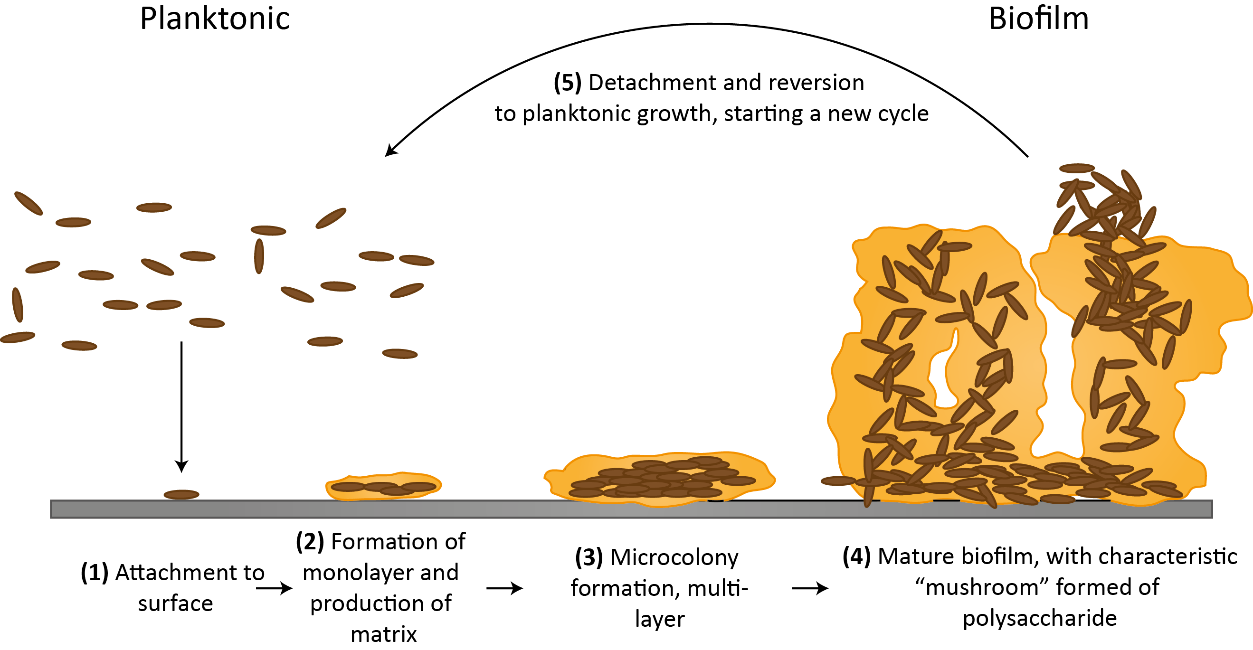 Figure: Schematic representation of biofilm formation
Matrix formation depends on nutrient availability and the bacteria's own synthesis and secretion of EPS. Biofilms form wherever there's water and a surface, kitchen drains, contact lenses, the gut lining, and medical devices alike. Initial attachment happens through weak, reversible Van der Waals forces; if the cells aren't dislodged quickly, structures like pili help anchor them more permanently. Quorum sensing controls biofilm production in several organisms, including Pseudomonas; the full mechanism of that signaling system is covered in that article rather than repeated here.
Stages of biofilm formation:
- Reversible attachment of planktonic cells to a surface, via random collision or environmental signaling
- Irreversible attachment, as exopolymeric material forms a stronger adhesive bond
- Cell growth and early development
- Maturation into a 3D structure of tightly packed cell clusters with internal channels, forming a nearly impenetrable mature biofilm
- Dispersion, as some cells release back into the surrounding liquid to seed new colonization sites
Factors affecting initial attachment include the nature of the surface (hydrophobic, rougher surfaces favor attachment), properties of the surrounding medium and microbial cell surface (pH, nutrients, EPS production, presence of fimbriae/flagella), and environmental/microbial signaling systems, including two-component systems, the c-di-GMP secondary messenger, and quorum sensing.
Why Antibiotics Fail Against Biofilms: Two Separate Mechanisms
This is the part standard susceptibility testing doesn't capture, and it's actually two distinct mechanisms working together, not one:
- The matrix as a physical and chemical barrier. The dense EPS matrix slows or blocks antibiotic penetration and shields the community from host immune defenses like antibodies and neutrophils. Bacteria within an established biofilm have been reported to be up to 1,000 times more resistant to a given antibiotic than the same species growing planktonically.
- Persister cells. Separately from the matrix, a small subpopulation of cells within the biofilm enters a metabolically dormant state. Most antibiotics work by disrupting an active process, cell wall synthesis, protein synthesis, DNA replication, and a dormant cell isn't doing any of these quickly enough for the drug to have a target. This is why persister-cell tolerance isn't the same thing as classical antibiotic resistance: it's not a genetic, heritable change. If a persister cell disperses from the biofilm and resumes normal growth, its offspring are typically just as susceptible to the antibiotic as before, the tolerance was a temporary state, not a mutation.
Together, these two mechanisms explain the hook above: the organism's genes hadn't changed, and a susceptibility test on planktonic cells from that same organism would still show "sensitive." The biofilm environment itself, not the organism's genetics, was what made standard treatment fail. In practice, this is exactly why biofilm-associated device infections often require physically removing the infected device rather than relying on antibiotics alone.
Clinical and Industrial Significance
Biofilm-related infections are a major driver of healthcare costs and prolonged hospital stays; biofilms are estimated to account for a majority of chronic, device-associated bacterial infections in humans (see Flemming et al., 2016, cited below, for a fully sourced review of these estimates).
Biofilms also cause real problems outside medicine: fouling industrial equipment, contaminating products, damaging water distribution systems, and souring fuels and chemicals through hydrogen sulfide production by biofilm bacteria.
Advantages of Biofilm Formation (from the bacterium's perspective)
- Protection from phagocytosis. Cells attached within a biofilm are far harder for phagocytes to engulf than free-floating cells, and attachment itself triggers increased slime (EPS) production, further reinforcing the community.
- Protection from desiccation. The EPS matrix acts as a hydrogel, retaining water and protecting the community from drying out, a real advantage free-living bacteria don't have.
- Enhanced gene transfer. The close proximity of cells within a biofilm favors horizontal gene transfer, which can produce more highly pathogenic strains.
- Nutrient capture. The matrix helps trap and concentrate nutrients from the surrounding water phase or substratum.
Biofilm-Associated Human Infections
Prosthetic devices and implants: Candida albicans, coagulase-negative staphylococci, Enterococcus spp., Klebsiella pneumoniae, Pseudomonas aeruginosa, Staphylococcus aureus, Streptococcus spp.
Cystic fibrosis: chronic Pseudomonas aeruginosa lung infection, where the biofilm matrix prevents antibiotics from adequately reaching the bacteria within it.
Prosthetic valve endocarditis (the condition from the hook above): Staphylococcus aureus, Staphylococcus epidermidis, Streptococcus spp., Gram-negative bacilli, diphtheroids, Enterococcus spp., Candida spp.
Catheter-associated urinary tract infections: Staphylococcus epidermidis, Enterococcus faecalis, Escherichia coli, Proteus mirabilis, Pseudomonas aeruginosa, Klebsiella pneumoniae.
Foodborne contamination: Listeria monocytogenes biofilms on food-processing surfaces are a well-documented contamination source.
Dental plaque: begins with initial colonization of the tooth pellicle and matures into a complex biofilm; if not regularly removed, it leads to dental caries.
How to Remember
The "castle and sleeping soldiers" analogy for the two resistance mechanisms. The EPS matrix is the castle wall, slowing down and partly blocking the antibiotic from ever reaching its target. Persister cells are soldiers who have gone to sleep inside the walls, so even an antibiotic that makes it through the wall has nothing active to hit. Real biofilm defense uses both at once, a wall to slow the attack, and defenders who can't be woken up by it even if it gets through.
Anchor for the hook: "sensitive on paper, resistant in the patient." Whenever a susceptibility report doesn't match the clinical response, ask where the organism actually is. A standard susceptibility test grows the organism planktonically, alone, in broth. A biofilm is a completely different environment, and the same organism's genes can produce a completely different outcome depending on which one it's living in.
Key exam facts in one table
| Fact | Detail |
|---|---|
| Definition | A structured community of microorganisms embedded in a self-produced extracellular polymeric substance (EPS) matrix |
| Cell density | 10⁸–10¹¹ cells per gram of biofilm |
| Five stages | Reversible attachment → irreversible attachment → growth/early development → maturation → dispersion |
| Regulatory signal | Quorum sensing controls biofilm formation in several organisms, including Pseudomonas |
| Resistance mechanism 1 | EPS matrix as a physical/chemical barrier; can confer up to ~1,000-fold antibiotic resistance compared to planktonic cells |
| Resistance mechanism 2 | Persister cells: a dormant subpopulation not actively carrying out the processes most antibiotics target; not a genetic/heritable change |
| Key clinical trap | Standard susceptibility testing is performed on planktonic cells and does not predict how the same organism will behave in a biofilm |
| Classic clinical associations | Prosthetic joints/valves, IV catheters, cystic fibrosis lung disease, catheter-associated UTIs, dental plaque |
| Typical definitive treatment for device-associated biofilm infection | Removal of the infected device; antibiotics alone are often insufficient |
Where Students Get Confused
- Assuming biofilm resistance has one cause. The matrix acting as a barrier and persister cells being dormant are two separate mechanisms, and a biofilm typically relies on both simultaneously.
- Confusing persister-cell tolerance with classical antibiotic resistance. Classical resistance is a genetic, heritable trait passed to offspring. Persister-cell tolerance is a temporary physiological state; once a persister cell disperses and resumes active growth, its offspring are generally just as susceptible as before.
- Assuming a "sensitive" susceptibility report guarantees clinical cure. Susceptibility testing is performed on planktonic cells; it does not capture how the same organism behaves once established in a biofilm.
- Conflating "what a biofilm is" with "how quorum sensing works." Quorum sensing is one of the signals that triggers and coordinates biofilm formation, but the biofilm itself, and its resistance mechanisms, are a separate topic from the signaling system that helps regulate it.
References
- Flemming, H. C., Wingender, J., Szewzyk, U., Steinberg, P., Rice, S. A., & Kjelleberg, S. (2016). Biofilms: An emergent form of bacterial life. Nature Reviews Microbiology, 14(9), 563–575. https://doi.org/10.1038/nrmicro.2016.94
- Santos, A. L. S. D., Galdino, A. C. M., Mello, T. P., Ramos, L. S., Branquinha, M. H., Bolognese, A. M., Columbano Neto, J., & Roudbary, M. (2018). What are the advantages of living in a community? A microbial biofilm perspective! Memórias do Instituto Oswaldo Cruz, 113(9), e180212. https://doi.org/10.1590/0074-02760180212
- Lewis, K. (2010). Persister cells. Annual Review of Microbiology, 64, 357–372.
Frequently Asked Questions
What is a biofilm?
Why are bacteria in a biofilm more resistant to antibiotics?
Is persister-cell tolerance the same as antibiotic resistance?
Why can a "susceptible" lab result still fail to cure an infection?
What are the stages of biofilm formation?
Why do biofilm-associated device infections often require removing the device?
What conditions are commonly associated with biofilms?

Tankeshwar Acharya, MSc (Medical Microbiology)
Tankeshwar Acharya is an Assistant Professor in the Department of Microbiology at Patan Academy of Health Sciences (PAHS), Nepal, where he has been teaching and practicing clinical microbiology for over 14 years. He is the founder of Microbe Online, one of the leading free microbiology education resources on the web, covering bacteriology, mycology, parasitology, immunology, and clinical laboratory diagnostics written from direct experience in both the classroom and the diagnostic laboratory.