
Bacterial Typing Methods: Aim, Attributes, Types
What bacterial typing methods are and why they matter in epidemiology, the attributes of a good typing method, the phenotypic and molecular (genotypic) methods, and how to choose the right one for an outbreak or clinical isolate.

On this page
Two patients in the same ward grow Klebsiella pneumoniae from their blood in the same week. Are these two unrelated infections, or is one strain spreading between patients through a lapse in infection control? They look identical on the culture plate and on routine biochemical tests. The only way to answer the question, and to know whether to launch an outbreak investigation, is to type the isolates: to compare them below the species level, down to the strain. That is what bacterial typing does, and choosing the right typing method is the difference between catching an outbreak early and missing it.
Typing bacteria is a core part of epidemiological work. Many typing techniques are in use, and they differ in their study objectives, cost, reliability, and discriminatory power. No single method is best for every situation, so understanding what each one can and cannot do is the real skill.
Aim of typing
- To confirm epidemiological relationships in the spread of an infection.
- To generate epidemiological hypotheses about the relationships between isolates when direct epidemiological data are missing.
- To describe the distribution of bacterial types and identify the factors that affect it.
Desirable attributes of a typing method
No method has all of these at once, but a good typing method aims for:
- Typeability: it can assign a type to every isolate studied (an isolate that cannot be typed is a gap in the investigation).
- Discriminatory power: it can tell epidemiologically unrelated isolates apart. In an outbreak, it should ideally distinguish very closely related isolates well enough to reveal person-to-person transmission, which is what lets a team act to stop further spread.
- Reproducibility: it gives the same result on the same isolate every time, and it should be rapid, affordable, and straightforward to perform and interpret.
- Portability and standardized nomenclature: for surveillance across laboratories or countries, the data should be shareable (ideally through an open, web-accessible database) and use an internationally agreed naming system, and the method should work across a broad range of species.
- Quality control: there should be internal and external controls in place to check and validate that the typing data are of high quality.
None of the available methods has every one of these attributes. A method can have high discriminatory power and good reproducibility yet still be too complex or too expensive for a given laboratory to set up and run. So the choice of method depends on the laboratory's skill level and resources, and on the aim and scope of the study.
Which method should you choose?
Because no method is universally best, the choice is a bench decision that follows the question being asked:
- Investigating a suspected outbreak (are these isolates the same strain?): you need high discriminatory power. A molecular method such as PFGE or whole-genome sequencing is preferred where available; among phenotypic methods, phage typing and antibiogram give a first, quick comparison.
- Long-term surveillance across laboratories or countries: you need portability and a standardized nomenclature. Sequence-based methods such as MLST and whole-genome sequencing produce shareable, database-friendly data.
- A resource-limited laboratory (a common reality in many settings): phenotypic methods such as antibiogram, serotyping, and biotyping are still useful, inexpensive first-line tools, and are often what is realistically available. They are increasingly supplemented by molecular methods where resources allow, rather than being fully replaced.
Bacterial strains can be differentiated on the basis of phenotypic or genotypic differences. In general, genotyping methods perform better (higher discriminatory power and reproducibility) than phenotypic ones, but they cost more and need more infrastructure.
Phenotypic typing methods
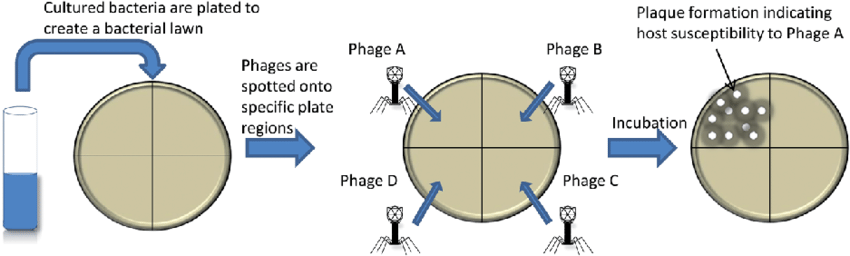 Figure: Bacteriophage typing
Phenotypic methods detect characteristics the organism actually expresses, based on its biochemical, antigenic, or susceptibility (to phages or antimicrobials) properties.
- Biotyping: groups isolates by their metabolic (biochemical) characteristics; the groups are called biotypes.
- Serotyping: groups isolates by the antigens expressed on their surface; the groups are called serotypes. See the dedicated article on serotypes and serotyping for the method and examples.
- Phage typing: groups isolates by their pattern of susceptibility or resistance to a standard set of bacteriophages; the groups are called phage types. See the dedicated bacteriophage typing article.
- Resistotyping: groups isolates by their resistance or susceptibility to a set of chosen chemical agents.
- Bacteriocin typing: groups isolates by their susceptibility to a set of bacteriocins (antibacterial peptides produced by certain bacteria).
- Antibiogram typing: compares isolates by their susceptibility profiles against a panel of antibiotics.
Molecular (genotypic) typing methods
Molecular methods analyze the organism's genetic material, chromosomal or extrachromosomal (such as plasmids). Many are based on cutting DNA with specific restriction enzymes and comparing the fragment patterns; their discriminatory power and complexity vary widely.
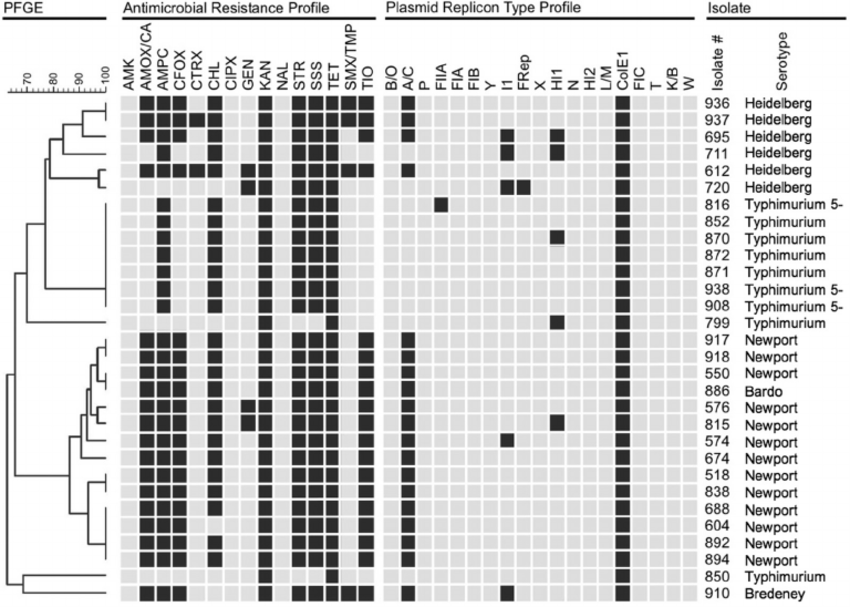 Figure: Figure: PFGE-based dendrogram of Salmonella
Modern molecular epidemiology can generate, from a single platform, enough information to detect, monitor, and control new threats such as drug resistance and emerging pathogens.
- Amplified fragment length polymorphism (AFLP): compares patterns of selectively amplified restriction fragments.
- ERIC-PCR (enterobacterial repetitive intergenic consensus PCR): fingerprints the genome using conserved repetitive sequences.
- Multilocus sequence typing (MLST): sequences several housekeeping genes and assigns a type from the allele combination; highly portable and database-friendly.
- Multilocus variable-number tandem repeat analysis (MLVA): compares the number of tandem repeats at several loci.
- Pulsed-field gel electrophoresis (PFGE): separates large restriction fragments; long regarded as a reference standard for many species. See the dedicated PFGE article.
- PCR ribotyping: compares the ribosomal RNA gene regions (agarose- or sequence-based).
- Repetitive-element PCR (rep-PCR): fingerprints the genome using repetitive elements.
- Restriction endonuclease analysis (REA): compares whole-genome restriction patterns.
- Surface-layer protein A gene sequence typing (slpAST): sequences the slpA gene (used notably for Clostridioides difficile).
- Whole-genome sequencing (WGS): reads the entire genome; the highest-resolution method and increasingly the reference for outbreak and surveillance work.
Uses of typing methods
Epidemiological uses. To trace the source of strains in an outbreak, to check for laboratory cross-contamination, to determine whether a second episode of disease is a relapse with the original strain or a new infection, and to determine whether an infection involves more than one strain.
Infection control. To monitor the prevalence of particular strains within a hospital, and to work out whether a cluster of infections is unrelated or part of a single outbreak.
How to Remember
Typing answers "same strain or not?" below the species level. Identification tells you the species (this is K. pneumoniae). Typing goes one level deeper: are these two K. pneumoniae isolates the same strain, or two different ones? That is why typing is an epidemiology tool, not an identification tool.
Phenotype = what the organism does; genotype = what it is. Phenotypic methods read expressed traits (which sugars it uses, which antigens it carries, which phages kill it). Molecular methods read the DNA directly. Genotypic methods usually discriminate better, but cost more, which is the whole trade-off in one line.
The four attributes, as a checklist: Type every isolate, Discriminate the unrelated, Reproduce the result, Share the data. Typeability, discriminatory power, reproducibility, portability. If a method fails any one of these, it limits the investigation in a predictable way.
Match the method to the question. Outbreak needs discrimination (PFGE, WGS). Surveillance needs portability (MLST, WGS). A resource-limited bench needs cheap and available (antibiogram, serotyping, biotyping). The "best" method is the one that fits the question and the laboratory.
Key exam facts
| Concept | Detail |
|---|---|
| What typing does | Differentiates isolates below the species level, down to the strain |
| Main aim | Epidemiology: confirm or generate hypotheses about how infection spreads |
| Two broad categories | Phenotypic (expressed traits) and molecular/genotypic (DNA) |
| Desirable attributes | Typeability, discriminatory power, reproducibility, portability, quality control |
| Phenotypic methods | Biotyping, serotyping, phage typing, resistotyping, bacteriocin typing, antibiogram typing |
| Molecular methods | AFLP, ERIC-PCR, MLST, MLVA, PFGE, PCR ribotyping, rep-PCR, REA, slpAST, WGS |
| Phenotypic vs molecular | Molecular usually discriminates better and is more reproducible; phenotypic is cheaper and often what a resource-limited lab has |
| Outbreak method of choice | High discrimination: PFGE or WGS |
| Surveillance method of choice | Portable, standardized: MLST or WGS |
| Key limitation | No single method has all desirable attributes; choice depends on the question and the laboratory |
Where Students Get Confused
- "Typing and identification are the same thing." They are not. Identification names the species. Typing goes deeper, distinguishing strains within that species. You identify an isolate as Salmonella, then type it to find which serovar or strain.
- "Molecular methods have made phenotypic typing obsolete." Not in practice, and not everywhere. Molecular methods usually discriminate better, but phenotypic methods (antibiogram, serotyping, biotyping) remain cheap, fast, and often the only realistic option in resource-limited laboratories. In many settings they are still first-line.
- "The method with the highest discriminatory power is always the best choice." Not necessarily. A method that discriminates beautifully but is too costly, too slow, or too complex for your laboratory to run reliably is the wrong choice for that setting. The best method is the one that fits both the question and the resources.
- "Serotyping and biotyping are types of molecular methods." They are phenotypic. Serotyping reads surface antigens and biotyping reads metabolic traits; neither reads DNA directly. The molecular methods are the DNA-based ones (PFGE, MLST, WGS, and the rest).
Frequently Asked Questions
What is bacterial typing?
What is bacterial typing?
Bacterial typing is the laboratory process of distinguishing isolates of the same species below the species level, down to the strain. It is used mainly in epidemiology, for example to tell whether two patients are infected by the same strain.
What is the difference between typing and identification?
What is the difference between typing and identification?
Identification tells you which species an organism is. Typing goes one step further and tells you which strain it is, so you can compare isolates that have already been identified as the same species.
What are the main types of bacterial typing methods?
What are the main types of bacterial typing methods?
They fall into two groups. Phenotypic methods (biotyping, serotyping, phage typing, resistotyping, bacteriocin typing, antibiogram typing) read traits the organism expresses. Molecular or genotypic methods (AFLP, ERIC-PCR, MLST, MLVA, PFGE, PCR ribotyping, rep-PCR, REA, slpAST, WGS) read the DNA directly.
Which typing method is best?
Which typing method is best?
There is no single best method. For an outbreak you want high discriminatory power (PFGE or whole-genome sequencing). For surveillance across laboratories you want portable, standardized data (MLST or WGS). For a resource-limited laboratory, phenotypic methods such as antibiogram and serotyping are practical and affordable. The best method fits both the question and the laboratory.
What is biotyping?
What is biotyping?
Biotyping groups isolates by their metabolic (biochemical) characteristics. The resulting groups are called biotypes. It is a phenotypic method.
Why is no single typing method ideal?
Why is no single typing method ideal?
Because the desirable attributes (typeability, discriminatory power, reproducibility, portability, low cost, and ease of use) pull against each other. A method that is highly discriminating may also be expensive and complex, while a cheap, simple method may not discriminate well enough. Laboratories choose the method that best balances these for their situation.
References
- Sabat AJ, Budimir A, Nashev D, Sá-Leão R, van Dijl JM, Laurent F, Grundmann H, Friedrich AW. Overview of molecular typing methods for outbreak detection and epidemiological surveillance. Euro Surveillance. 2013;18(4):20380.
- Van der Merwe RG, van Helden PD, Warren RM, Sampson SL, Gey van Pittius NC. Phage-based detection of bacterial pathogens. The Analyst. 2014;139(11):2617-2626. DOI: 10.1039/c4an00208c
- Tille PM. Bailey & Scott's Diagnostic Microbiology. 15th ed. Elsevier; 2022.

Tankeshwar Acharya, MSc (Medical Microbiology)
Tankeshwar Acharya is an Assistant Professor in the Department of Microbiology at Patan Academy of Health Sciences (PAHS), Nepal, where he has been teaching and practicing clinical microbiology for over 14 years. He is the founder of Microbe Online, one of the leading free microbiology education resources on the web, covering bacteriology, mycology, parasitology, immunology, and clinical laboratory diagnostics written from direct experience in both the classroom and the diagnostic laboratory.
Comments
No comments yet. Be the first to share your thoughts.
Leave a comment
All comments are reviewed before they appear.