
Automated Pipette: Liquid Handling System
Automated pipettes use software-controlled robotic arms for precise high-throughput liquid handling. Learn their working principles, parts, benefits, and limitations in microbiology.
During the early months of the COVID-19 pandemic, reference laboratories across the world faced a problem that had nothing to do with reagent supply or test sensitivity: they could not pipette fast enough. A trained technician performing manual RNA extraction can process 48–96 samples in a working day. A single robotic liquid handling system running a validated automated extraction protocol can process 384 or more samples in the same period — with lower error rates and without fatigue-related drift in the final hours of a shift.
For most clinical microbiology laboratories — a district hospital lab in Nepal, a regional diagnostic centre in Nigeria, a teaching hospital laboratory in the Philippines — an automated liquid handling system remains out of reach financially. But understanding how these systems work, where they are being deployed, and what problems they solve is increasingly important. Automation is not a distant future for laboratory medicine. It is already the standard in reference laboratories, blood banks, and genomics facilities that students will encounter during training and careers.
A pipette is equipment that helps measure and dispense liquid materials of desired measurements in any laboratory. Since almost all science laboratories require precise and accurate liquid measurement for their experiments, the pipette is used widely.
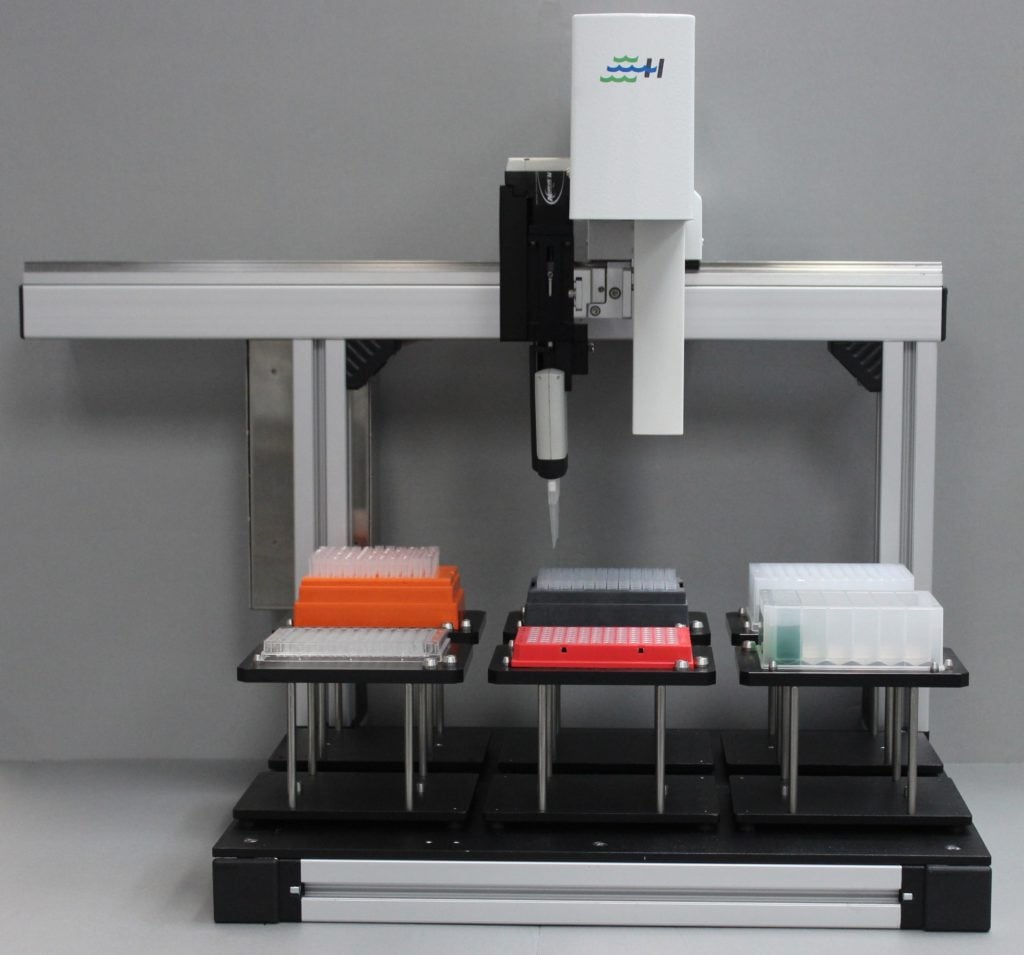 Figure: Solo Liquid Handlerby Hudson Robotics
An automated pipette or automated liquid handling system is a pipette operated by software that commands a pipette/robotic liquid handling tool to aspirate the desired amount of sample and dispense it into the required container. Although these pipettes provide automated aspiration and dispensation, changing pipette tips, and placing and holding trays can be either automatic or manual. Commonly, automated pipettes are called liquid handling robots.
Why Automated Pipetting Matters
Manual pipetting is accurate and reliable for small sample numbers. But it has three inherent limitations that become critical at scale:
Fatigue-related error: A technician pipetting 200 samples over six hours applies slightly different plunger pressure, tip immersion depth, and aspiration angle as the session progresses. These variations are small per sample but systematic across the batch — the last 50 samples of the run are pipetted differently from the first 50.
Throughput ceiling: One technician with one micropipette processes one sample at a time. In a high-burden laboratory during an outbreak, this becomes the rate-limiting step for diagnosis.
Contamination risk from repeated human contact: Every manual tip change, every plate movement, every tube uncapping is a contamination opportunity. Automation eliminates most of these touchpoints.
Automated liquid handling systems address all three. In genomics laboratories, automated RNA extraction has been shown to reduce processing time per sample by up to 75% while improving inter-sample reproducibility. In blood banking, automated pipetting for grouping and crossmatching eliminates transcription errors that occur when technicians manually record results from individual tubes.
For microbiology students: even if you never operate a liquid handling robot in your career, you will encounter reports and quality documents generated by these systems. Understanding the principle is essential for interpreting what those systems do and what their error modes are.
Liquid Handling System
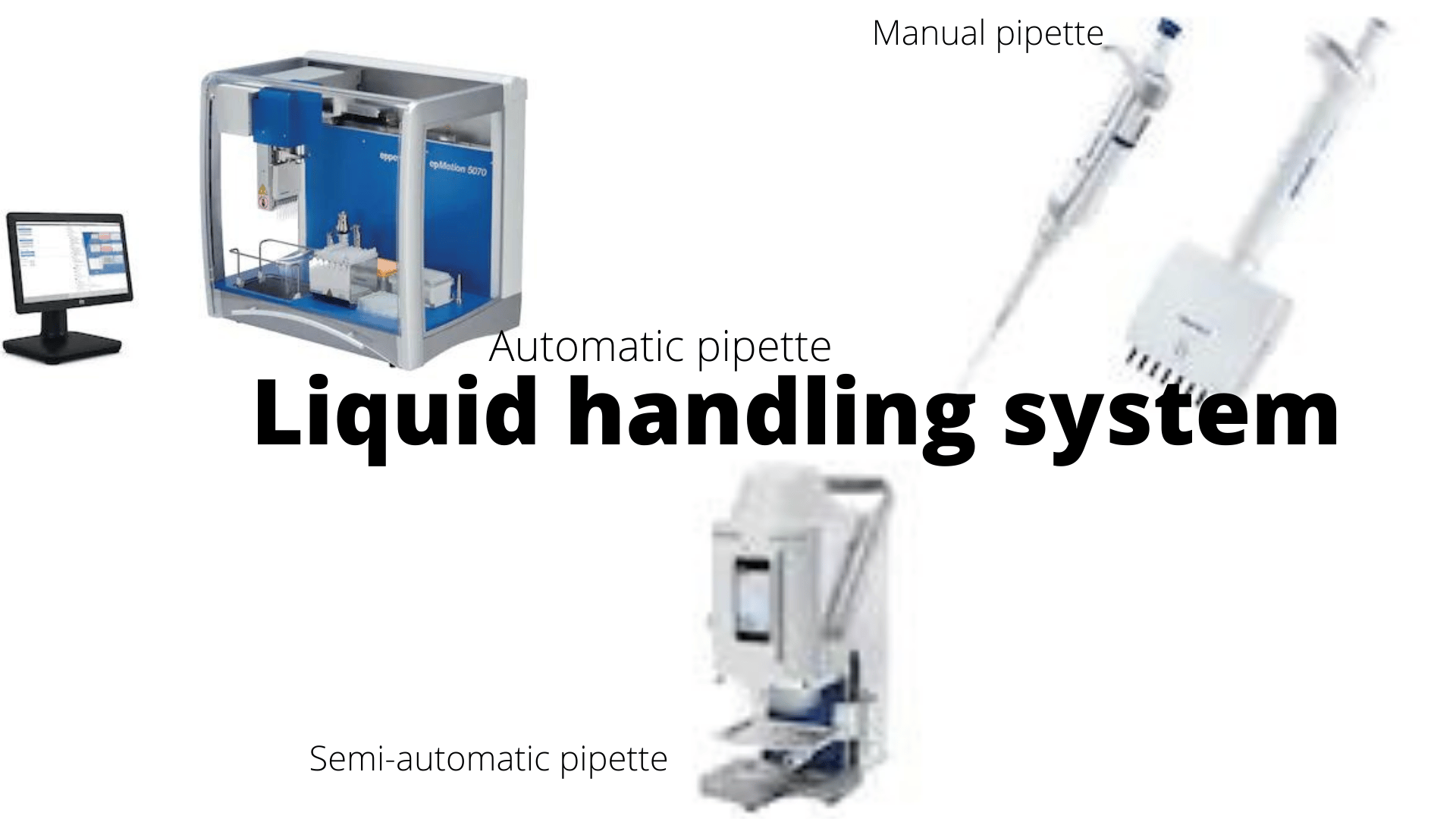 Figure: Liquid handling system
Image source:https://online-shop.eppendorf.co.in/IN-en/Automated-Pipetting-44509.html#goto-Automated-Pipetting-WebPMain-44509
There are various systems for handling liquids. Pipettes are one of the liquid handling systems. These can be manual, semi-automatic, or automatic.
The manual pipetting requires calibrating the pipettes, entering the desired volume in the pipette, and aspirating and dispensing the liquid by laboratory workers. It works best for laboratories dealing with small sample volumes because only a sample is processed at a time.
The semi-automatic pipettes require user intervention during moving the plates/tube in-between steps or exchanging the tips but not during aspiration and dispensation. It provides handling of 10-100 samples at a time depending on the types. The pipettes can have a single channel or multiple channels for liquid handling.
The automatic pipettes or robotic liquid handlers have robotic arms for moving the plates/tubes and exchanging tips during experiments. Only the step of entering the desired volume in the software requires the intervention of humans, and it provides a walk-away facility. It also helps in handling more than 100 samples at a time.
Working Mechanism of Pipette
Pipettes usually work based on two mechanisms; air displacement and positive displacement. The basic principle of pipetting is to displace/dispense (pushing out) a sample volume after aspiration (pulling in). The plunger and piston control these actions. The difference in piston and displacement methods determines the types of pipettes. These methods use plastic tips for displacement.
Besides these, other methods that do not use tips are also available. The technique like acoustic droplet ejection method is one of the non-tip-based pipetting methods.
Air Displacement Method
As the name suggests, the air displacement method for aspirating a certain amount of liquid dispenses almost the exact amount of air. The air displacement method has a piston-cylinder system that helps in measurement. The piston is connected to a plunger that pushes out the air volume equal to the liquid to be aspirated. The aspiration creates an air cushion that separates the aspirated sample (liquid) in a plastic tip from the pipette piston.
With the expansion of the air in the cushion, the 2-8% extra liquid is drawn. In order to overcome the problem, proper calibration of the pipette is necessary. In addition, temperature, humidity, and air pressure of the liquid also determine the amount of air trapped which might create inaccuracy during aspiration.
Positive Displacement Method
The air displacement method is not applicable when handling liquid that has more density, higher viscosity, and high air pressure. Since the air displacement method lacks precision while handling such samples due to the air-cushioning, positive displacement overcomes these problems. The method’s accuracy depends on the disposable plastic tips used because these tips have integrated pistons. The piston is coupled to the piston rod of the dispensing devices. The method requires specially designed tips instead of tips from any other system.
The aspiration of liquid in positive displacement occurs by pulling the piston up rather than pushing down, preventing the formation of an air cushion. The pulling up creates a vacuum which draws the liquid into the tips.
Acoustic Droplet Ejection (ADE) Method
ADE method is an entirely contactless method of dispensing liquids. Here, placing the source of acoustics (sound energy) near the surface helps eject a small droplet of samples into the plate. The frequency of the sound determines the sample volume.
Parts of Automated Pipette
The automated pipette has the following parts.
- Control system: These control the movement of robotic arms.
- Washing area: It is the place where cleaning or dispensing heads and plates occurs.
- Sensors: These feed information to the control systems and help maintain accuracy.
- Dispensing heads: These control the liquid flow in the vessels.
Benefits of Automated Pipette
The benefits of the automated pipette or liquid handling system are as follows:
- Thorough output
The pipetting obtained by using automation is thorough or accurate. Unlike manual pipetting, there is a decrease in human errors because the machines carry out all the manual work.
- Enhanced reproducibility
The automated pipetting provides increased reproducibility in the laboratory. That means the technique helps obtain consistent results.
- Walk away facility
The machines carry out all the work, and the contamination decreases. Once the information is fed in, they can perform other laboratory duties by running the pipetting process in the background.
- Decreased contamination
Since the machine carries out almost labor work susceptible to contamination, the risk of contamination due to human contact decreases. Likewise, continuous cleaning and maintenance also decrease the contamination.
When to Switch to an Automated Pipette?
- Conversion into a molecular laboratory
An automated pipette helps in many molecular techniques like sequencing and blotting because it provides precision while handling liquid samples. Also, it helps in processing multiple samples at a time.
- One-time investment
The cost of automated pipettes is high compared to manual and semi-automatic pipettes, but it is sustainable in the laboratory that is opting for decreasing manual labor.
- Automation
Since many laboratories are switching to automation, an automated pipetting system is another good addition to the automation of the laboratory.
- Processing a larger sample size
The processing of the liquid samples in your laboratory is increasing, leading to an increase in pipetting tasks. An automated pipette can pipette more than 100 samples in an hour, which helps complete the work faster with accuracy.
Limitation of Automated Pipette
The limitation of automated pipettes are as follows:
- High installation cost
The cost of robotic liquid handlers ranges from approximately $10,000 for entry-level systems to $150,000 or more for fully integrated high-throughput platforms. This makes them inaccessible to most smaller diagnostic laboratories, particularly in resource-limited settings.
- High maintenance cost
The maintenance of an automated pipette needs to be carried out regularly, and the maintenance cost is also high. In addition, trained maintenance workers are scarce.
How to Remember
Manual → Semi-automatic → Automatic: increasing throughput, decreasing human touchpoints. Think of it as a spectrum of human involvement:
- Manual: human does everything (aspirate, dispense, move plates, change tips)
- Semi-automatic: machine aspirates and dispenses; human moves plates and changes tips
- Automatic (robotic): human enters the program; machine does everything else
Each step up the spectrum increases throughput and reproducibility, and increases cost and maintenance complexity.
Air displacement = cushion between piston and liquid. Positive displacement = no cushion. Air displacement is the standard for aqueous samples — the air cushion is reliable, and temperature/viscosity effects are manageable with calibration. Positive displacement removes the air cushion entirely — the piston contacts the liquid directly — making it essential for viscous, volatile, or high-density samples where an air cushion would compress or expand and produce volume errors.
ADE = sound ejects droplets, no tip needed. Acoustic droplet ejection uses sound energy to eject precise nanoliter-to-microliter droplets from the source well directly into the target well — no tip, no contact, no contamination risk. It is the most precise and contamination-free method, but also the most expensive and least common. If asked about contactless pipetting in an exam — ADE is the answer.
The walk-away principle: An automated system runs unsupervised once programmed. This is the single most important practical advantage in a high-throughput laboratory — the technician can perform other tasks while the system processes samples.
Key exam facts in one table
| Topic | Key fact |
|---|---|
| Definition | Software-controlled pipetting system; robotic arms aspirate and dispense without continuous human intervention |
| Also called | Liquid handling robot; automated liquid handling system |
| Manual pipetting | Human-controlled; one sample at a time; best for small volumes and small batches |
| Semi-automatic | Machine aspirates/dispenses; human moves plates and changes tips; 10–100 samples at a time |
| Fully automatic (robotic) | Walk-away facility; >100 samples/hour; human intervention only for programming |
| Air displacement principle | Piston displaces air equal to target volume; air cushion separates piston from liquid; affected by temperature and viscosity |
| Positive displacement principle | No air cushion; piston contacts liquid directly; accurate for viscous, volatile, high-density samples; requires specialised tips |
| Acoustic droplet ejection (ADE) | Contactless; sound energy ejects droplets; no tip required; highest precision and contamination control; most expensive |
| Key benefits | Throughput (>100 samples/hour), reproducibility, reduced human error, walk-away operation, reduced contamination |
| Key limitations | High installation cost ($10,000–$150,000+), high maintenance cost, trained operators required, not feasible for most LMIC diagnostic labs |
| Clinical microbiology applications | COVID-19 nucleic acid extraction, blood bank automation, high-throughput ELISA, genomic sequencing setup |
| CV of automated systems | Typically <1% coefficient of variation — superior to manual pipetting at high volumes |
References
- Tegally, H., San, J. E., Giandhari, J., et al. (2020). Unlocking the efficiency of genomics laboratories with robotic liquid-handling. BMC Genomics, 21, 729. https://doi.org/10.1186/s12864-020-07137-1
- Clinical and Laboratory Standards Institute (CLSI). (2016). Clinical Microbiology Procedures Handbook (4th ed.). American Society of Microbiology. https://doi.org/10.1128/9781555818814
- ISO 8655-1:2022. Piston-operated volumetric apparatus — Part 1: Terminology, general requirements and user recommendations. International Organization for Standardization.
- Eppendorf AG. (2019). The Lab Pipetting Guide. Eppendorf. https://www.eppendorf.com/pipetting-guide
- Mahon, C. R., Lehman, D. C., & Manuselis, G. (2018). Textbook of Diagnostic Microbiology (6th ed.). Elsevier.
Frequently Asked Questions
What is an automated pipette and how does it differ from a manual micropipette?
What is the difference between semi-automatic and fully automatic pipetting systems?
What is acoustic droplet ejection (ADE) and how is it different from standard pipetting?
What are the main advantages of automated liquid handling in clinical microbiology?
Why are automated pipetting systems not commonly used in district-level laboratories in low- and middle-income countries?

Tankeshwar Acharya, MSc (Medical Microbiology)
Tankeshwar Acharya is an Assistant Professor in the Department of Microbiology at Patan Academy of Health Sciences (PAHS), Nepal, where he has been teaching and practicing clinical microbiology for over 14 years. He is the founder of Microbe Online, one of the leading free microbiology education resources on the web, covering bacteriology, mycology, parasitology, immunology, and clinical laboratory diagnostics written from direct experience in both the classroom and the diagnostic laboratory.