
Archaea: Characteristics, Examples, and Differences from Bacteria
Archaea are a separate domain of prokaryotes, distinct from bacteria. Learn their key characteristics, real examples (methanogens, halophiles, thermophiles), how they compare with bacteria and eukarya, and why they have no confirmed human pathogens.

On this page
Some archaea live in boiling acid springs, others in water so salty nothing else survives, and still others in the airless mud of a swamp, making the methane that bubbles to the surface. They are among the toughest cells on Earth. And yet, of the three domains of life, archaea are the only one with no confirmed human pathogen: not a single archaeon is established as a cause of human disease.
How can a group of organisms be hardy enough to thrive where almost nothing else can, and still never have learned to make us sick? The answer runs through the way archaea are built, and it starts with why they were placed in a domain of their own.
Cellular life on earth has evolved along three major lineages, called Bacteria, Archaea, and Eukarya. Comparative rRNA sequencing revealed these three distinct cellular lineages, also called domains. Bacteria and Archaea are prokaryotic lines whereas Eukarya is the eukaryotic line.
Archaea were not so much discovered as recognized. Several of these organisms (such as methanogens and extreme halophiles) were already known, but they were assumed to be unusual bacteria. In 1977, American microbiologist Carl Woese compared their ribosomal RNA sequences and showed they form a completely separate branch of life, distinct from bacteria. That insight (the use of rRNA to reveal deep evolutionary relationships) is why archaea are placed in their own domain, and it reshaped how biology classifies all cellular life.
Archaea is the domain of phylogenetically related prokaryotes distinct from Bacteria and known for tolerance to physiochemical extremes.
 Figure: Universal Phylogenetic tree
Examples of archaea
Archaea are usually grouped by the extreme condition they tolerate or the metabolism they use. Here are representative examples in each group.
| Group | Example organisms | Where they live / what they do |
|---|---|---|
| Methanogens | Methanobacterium, Methanococcus, Methanopyrus kandleri | Strict anaerobes that produce methane; found in swamps, marshes, the guts of animals (including the human gut), and deep-sea hydrothermal vents. Methanopyrus grows up to 122 °C. |
| Extreme halophiles | Halobacterium salinarum, Natronobacterium gregoryi | Need very high salt to survive; live in salterns (salt-evaporation ponds) and soda lakes. Some use the pigment bacteriorhodopsin to make ATP from light. |
| Hyperthermophiles | Thermococcus, Pyrolobus, Methanopyrus kandleri | Thrive at extreme heat, often near hydrothermal vents and hot springs, some above the boiling point of water. |
| Acidophiles / thermoacidophiles | Picrophilus oshimae, Thermoplasma, Ferroplasma | Grow at very low pH (Picrophilus near pH 0) in acidic hot springs and acidic mine drainage. Thermoplasma and Ferroplasma also lack a cell wall. |
| Alkaliphiles | Natronobacterium gregoryi | Grow at very high pH in soda lakes. |
A note on the two names: you will also see archaea called archaebacteria. This is the older term, used before molecular sequencing showed that archaea are a separate domain and not a kind of bacteria. Archaea is the correct modern term; archaebacteria means the same organisms but reflects the outdated idea that they were bacteria.
Some unique features
The table below zooms in on a few record-holding extremophiles, showing the actual temperature and pH ranges they tolerate.
| Genus/Species | Extremophile | Habitat | Minimum | Optimum | Maximum |
|---|---|---|---|---|---|
| Methanopyrus kandleri | Hyperthermophile | Under sea hydrothermal vents | 90°C | 106 °C | 122 °C |
| Picrophilus oshimae | Acidophile | Acidic hot springs | pH -0.06 | pH 0.7 | pH 4 |
| Natronobacterium gregoryi | Alkaliphile | Soda lakes | pH 8.5 | pH 10 | pH 12 |
| Halobacterium salinarum | Halophile | Salterns (salt evaporation ponds) | 15% salt concentration | 25% | 32% |
All are chemotrophic, Halobacterium can use light to make ATP but the mechanism is quite distinct from that of phototrophic organisms. Most are chemolithotrophs, with hydrogen gas (H2) being a widely used inorganic substance. Chemolithotrophic metabolisms are particularly widespread among hyperthermophilic archaea.
Most archaea are anaerobes. E.g., methanogens.
They can thrive on extreme environmental conditions such as hot springs (to temperatures above the boiling point of water), extremely salty bodies of water, and high acidic or alkaline soils and water.
The organism Pyrolobus, for example, is a hyperthermophile capable of growth at up to 113°C, and the methanogen Methanopyrus can grow up to 122°C. Hyperthermophiles do not contain fatty acids in their membranes but instead have C40 hydrocarbons composed of repeating units of isoprene bonded by ether linkage to glycerol phosphate.
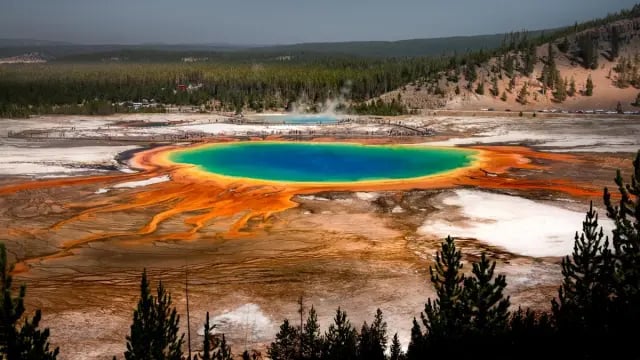 Figure: Grand Prismatic Spring in Yellowstone Park, USA. The colors are due to microbial mats formed by thermophiles
Archaea comprises most of the current “record holders” for growth at a particular extreme condition.
Certain archaea also show unusual biochemical features, such as the production of methane (natural gas)as an integral part of their energy metabolism. Strictly anaerobic methanogenic archaea can produce methane from carbon dioxide and hydrogen or from acetate or methanol.
Similarities Between Bacteria and Archaea
- Prokaryotic cell structure
- The cytoplasmic membrane has inner and outer hydrophilic surfaces and a hydrophobic interior.
- Both show chemotaxis, and many proteins that control chemotaxis in bacteria are also present in motile archaea.
- Presence of a single circular chromosome that carries 500 to a few thousand genes
- Absence of membrane-enclosed nucleus
- Presence of 70S ribosomes
- Introns are present in tRNA genes but absent in other genes
- Presence of operons
- Absence of capping and poly-A tailing of mRNA.
- Presence of plasmids
- Gas vesicles are present mainly in aquatic bacteria and archaea but never in eukaryotic microorganisms.
- Can synthesize carbon storage granules composed of poly-beta-hydroxyalkanoate
- Chemolithotrophy (Fe, S, H2)
- Has the ability of nitrogen fixation as well as denitrification
Bacteria vs Archaea vs Eukarya at a glance
| Feature | Bacteria | Archaea | Eukarya |
|---|---|---|---|
| Cell type | Prokaryote | Prokaryote | Eukaryote |
| Membrane-bound nucleus | Absent | Absent | Present |
| Cell wall | Peptidoglycan | No peptidoglycan (pseudomurein, protein, or polysaccharide) | Varies (cellulose in plants, chitin in fungi; none in animals) |
| Membrane lipids | Ester-linked, straight fatty acids | Ether-linked, branched isoprenoid chains | Ester-linked, straight fatty acids |
| Ribosome | 70S | 70S | 80S |
| Histones (DNA packaging) | Absent | Present | Present |
| First amino acid in protein synthesis | Formyl-methionine | Methionine | Methionine |
| Sensitivity to penicillin | Sensitive (many) | Not sensitive | Not applicable |
| Methanogenesis | No | Yes (some) | No |
| Known human pathogens | Many | None confirmed | Some |
The key pattern to notice: archaea are prokaryotes like bacteria (no nucleus, 70S ribosomes, single circular chromosome), but their molecular machinery (histones, methionine start, DNA replication proteins) is more like eukarya. This is why archaea are said to be more closely related to eukarya than to bacteria, even though they look like bacteria under the microscope.
Major Difference Between Bacteria and Archaea
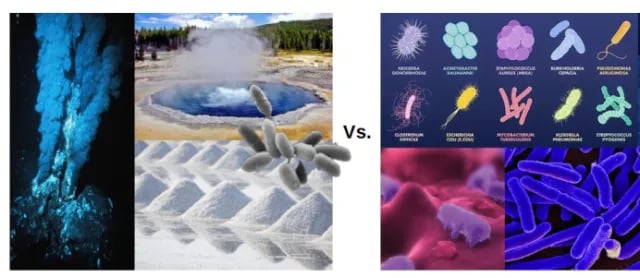 Figure: Archaea vs Bacteria Similarities and Differences
Characteristic | Bacteria | Archaea |
|---|---|---|
Peptidoglycan | It is a key biomarker of bacteria. It is thicker in gram-positive and thinner in gram-negative. | Peptidoglycan is absent in archaea. They may instead contain pseudomurein or polysaccharides. |
Composition of peptidoglycan/pseudomurein | The backbone of peptidoglycan contains alternating units of N-acetylglucosamine (NAG) and N-acetylmuramic acid (NAM) connected in β-1,4 linkage. Both L and D- amino acids and diaminopimelic acid (DAP) is present. | Some archaeal cell-wall contains a polysaccharide called pseudomurein. The backbone of pseudomurein is composed of alternating units of NAG but contains N-acetyltalosaminuronic acid in place of NAM. The glycosidic bonds between the sugar derivatives are β-1,3 and the amino acids are all of the L stereoisomer . DAP is absent in archaea. |
Paracrystalline surface layer (S-layer) | Present in several species of bacteria. | S-layers have been found in representatives of all major lineages of Archaea. |
Endospore formation | Bacteria form endospores. For example, Bacillus and Clostridium. | No archaea have been shown to form endospores. |
Flagella | Bacterial flagella are made up of a single type of protein, and their diameter is 15-20 nm. | Archaeal flagella are made up of multiple proteins, and their diameter is roughly half the diameter of bacterial flagella. |
Membrane lipids | In bacteria and eukaryotic microorganisms ester linkages bond glycerol to the fatty acids. | Archaea contain ether bonds between glycerol and their hydrophobic side chains. Archaeal lipids lack true fatty acids; instead, they contain branched side chains constructed of multiples of isoprene. |
Replication of DNA | In DNA gyrase helps in the packaging of very large DNA by supercoiling. Histones are absent. | DNA replication apparatus of archaea is much more similar to that of eukaryotes. Archaea possess both DNA gyrase and histones. |
Antimicrobial Susceptibility | Bacteria are susceptible to antimicrobial agents, but the susceptibility differs among bacteria depending on cell-wall composition and acquired resistance. | Most antibiotics do not affect archaea. For example, penicillins do not affect archaea because their cell walls lack peptidoglycan. |
Methanogenesis | No | Yes |
Cholorophyll based photosynthesis | Yes | No |
Pathogenicity | Not all bacteria are pathogens. Some are saprophytic, some are beneficial and are used to make yogurt and beer, and also used as probiotics, but some bacteria are pathogenic and cause diseases like tuberculosis, pneumonia, and diarrhea, among others. | No archaeon is confirmed as a human pathogen. Some methanogens in the gut and mouth are being studied for a possible contributing role in conditions such as periodontal disease and gut disorders, but none is established as a direct cause of disease. |
Cell-wall lacking organisms | Mycoplasma and Ureaplasma are cell-wall-lacking bacteria | Thermoplasma and Ferroplasma are cell-wall lacking archaea. |
Examples | Examples of bacteria include E. coli, Staphylococcus aureus, Neisseria gonorrhoeae, H. influenzae, etc. | Examples of archaea include Methanobacterium, Methanococcus, Thermococcus, Methanopyrus, Thermoplasma, etc. |
Though both bacteria and archaea are prokaryotes, molecular sequencing criteria suggest that Archaea are more closely related to Eukarya than Bacteria.
Quick answers: common archaea questions
Do archaea have peptidoglycan? No. This is one of the defining differences from bacteria. Archaeal cell walls contain pseudomurein (also called pseudopeptidoglycan), other polysaccharides, or a protein S-layer, but never true peptidoglycan. Because peptidoglycan is the target of penicillin and lysozyme, archaea are naturally unaffected by both.
Do archaea form endospores? No archaeon has been shown to form endospores. Endospore formation (as in Bacillus and Clostridium) is a bacterial feature.
Are archaea Gram-positive or Gram-negative? The Gram stain is designed around peptidoglycan, which archaea lack, so the Gram reaction is not meaningful for them in the way it is for bacteria. Some archaea may stain Gram-positive or Gram-negative depending on their wall type, but the result does not carry the same cell-wall information it does in bacteria. In practice, Gram staining is not used to classify archaea.
Are archaea prokaryotic or eukaryotic? Prokaryotic. Archaea have no membrane-bound nucleus and no membrane-bound organelles. However, several of their molecular processes resemble those of eukaryotes.
Are archaea more closely related to bacteria or to eukarya? To eukarya. Despite looking like bacteria (both are prokaryotes), archaea share more of their core molecular machinery (histones, DNA replication and transcription proteins, methionine as the starting amino acid) with eukaryotes.
Do archaea cause disease in humans? No archaeon is confirmed as a human pathogen. This is unique among the three domains. Some gut and oral methanogens are being researched for a possible contributing role in a few conditions, but none is established as a direct cause.
How to Remember
"Same body, different engine." Archaea have a bacterial body plan (prokaryote, no nucleus, 70S ribosome, one circular chromosome) but eukaryote-like molecular machinery (histones, methionine start). If you remember archaea as a prokaryote running eukaryote software, you can reconstruct most of the comparison.
"No peptidoglycan, no penicillin problem." The single most important archaeal difference is the missing peptidoglycan. From that one fact you can derive three exam answers: no peptidoglycan, so penicillin doesn't work, and lysozyme doesn't work. One cause, three consequences.
"Ether is tougher than ester." Archaeal membranes use ether bonds (bacteria and eukaryotes use ester bonds). Ether linkages are more chemically stable, which fits archaea living in extreme heat and acid. The odd-one-out bond matches the odd-one-out lifestyle.
The three E's of archaeal habitats: Extreme heat, Extreme salt, Extreme pH. Plus the methanogens in oxygen-free mud and guts. Four homes, easy to picture.
"Tough everywhere, harmless to us." The memorable paradox: the domain that survives the harshest places on Earth has no confirmed human pathogen. It sticks precisely because it is surprising.
Key exam facts
| Point | Fact | Memory aid |
|---|---|---|
| Domain status | One of three domains (Bacteria, Archaea, Eukarya) | Woese, rRNA, 1977 |
| Old name | Archaebacteria (deprecated) | Old name = wrong idea (not bacteria) |
| Cell type | Prokaryote (no nucleus, 70S ribosome) | Bacterial body |
| Closest relatives | Eukarya (molecular machinery) | Eukaryote engine |
| Cell wall | No peptidoglycan; pseudomurein / protein S-layer / polysaccharide | Missing peptidoglycan is the key fact |
| Penicillin & lysozyme | Both ineffective (no peptidoglycan target) | One cause, two more consequences |
| Membrane lipids | Ether-linked, branched isoprenoid chains | Ether = tougher |
| DNA packaging | Histones present (like eukaryotes) | Eukaryote software |
| Endospores | None form endospores | Endospores are bacterial |
| Methanogenesis | Only archaea do it | Methane makers |
| Extremophiles | Thermophiles, halophiles, acidophiles, alkaliphiles | Three E's: heat, salt, pH |
| Human pathogens | None confirmed | Tough everywhere, harmless to us |
| Example genera | Methanobacterium, Halobacterium, Thermococcus, Thermoplasma, Picrophilus | Grouped by habitat |
Where Students Get Confused
"Are archaea just weird bacteria?" No, and this is the central point. Archaea and bacteria are both prokaryotes and look alike under a microscope, but molecular sequencing places them in separate domains. Archaea are actually more closely related to eukaryotes at the molecular level. Treating archaea as a kind of bacteria is exactly the outdated thinking behind the old name "archaebacteria."
"Do archaea have a cell wall or not?" Most do have a cell wall, but it is never made of peptidoglycan. Archaeal walls use pseudomurein, other polysaccharides, or a protein S-layer. A few archaea (Thermoplasma, Ferroplasma) have no cell wall at all, just as a few bacteria (Mycoplasma, Ureaplasma) lack one. So "no peptidoglycan" is not the same as "no cell wall."
"If archaea are prokaryotes, why are they more like eukaryotes?" Because "prokaryote" describes cell structure (no nucleus), while relatedness is judged by molecular sequence. Archaea have a prokaryotic structure but eukaryote-like information processing (histones, replication and transcription machinery, methionine start). Structure and ancestry are answering two different questions.
"Why don't antibiotics like penicillin work on archaea?" Penicillin works by blocking peptidoglycan synthesis in the bacterial cell wall. Archaea have no peptidoglycan, so there is nothing for penicillin to block. The same logic explains why lysozyme, which cleaves peptidoglycan, also does not harm them.
"Can archaea make us sick?" No archaeon is confirmed as a human pathogen, which makes archaea unique among the three domains. Some gut methanogens are being studied for a possible contributing role in certain conditions, but "under research" is not the same as "established cause." As of now, there is no proven archaeal disease of humans.
"Archaea vs archaebacteria: which is right?" Archaea. Archaebacteria is the older term from before archaea were recognized as a separate domain. The two words refer to the same organisms, but archaebacteria carries the outdated implication that they are a type of bacteria, which is why the field moved to archaea.
References and further readings
- Madigan MT, Bender KS, Buckley DH, Sattley WM, Stahl DA. Brock Biology of Microorganisms. 16th ed. Pearson; 2021.
- Willey JM, Sherwood LM, Woolverton CJ. Prescott's Microbiology. 11th ed. New York: McGraw Hill; 2020.
- Bruslind L. Archaea. In: General Microbiology. Oregon State University. Available from: https://open.oregonstate.education/generalmicrobiology/chapter/archaea/
- Berthold E. What are archaea? Curious. Australian Academy of Science; 2018. Available from: https://www.science.org.au/curious/earth-environment/what-are-archaea

Tankeshwar Acharya, MSc (Medical Microbiology)
Tankeshwar Acharya is an Assistant Professor in the Department of Microbiology at Patan Academy of Health Sciences (PAHS), Nepal, where he has been teaching and practicing clinical microbiology for over 14 years. He is the founder of Microbe Online, one of the leading free microbiology education resources on the web, covering bacteriology, mycology, parasitology, immunology, and clinical laboratory diagnostics written from direct experience in both the classroom and the diagnostic laboratory.
Comments
No comments yet. Be the first to share your thoughts.
Leave a comment
All comments are reviewed before they appear.