Biosafety level designations are based on a composite of the design features, construction, containment facilities, equipment, practices, and operational procedures required for working with agents from the various risk groups.
Classification of microorganisms according to risk group.
Laboratory facilities are designated as:
- basic – Biosafety Level 1,
- basic – Biosafety Level 2,
- containment – Biosafety Level 3, and
- maximum containment – Biosafety Level 4.
Bio-safety Level One
- Facilities and PracticesStandard, open bench, no special facilities needed; typical of most microbiology teaching labs; access may be restricted.
- Risk of Infection and Class of PathogensLow infection hazard; microbes not generally considered pathogens and will not colonize the bodies of healthy persons; Micrococcus luteus, Bacillus megaterium, Lactobacillus, Saccharomyces.
Bio-safety Level Two
- Facilities and PracticesAt least level 1 facility and practices; plus personnel must be trained in handling pathogens; lab coats and gloves required; safety cabinets may be needed; biohazard signs posted; access restricted.
- Risk of Infection and Class of PathogensAgents with moderate potential to infect; class 2 pathogens can cause disease in healthy people but can be contained with proper facilities; most pathogens belong to class 2; including Staphylococcus aureus, Escherichia coli, Salmonella spp., Corynebacterium diphtheriae; pathogenic helminths; hepatitis A, B, and rabies viruses; Cryptococcus and Blastomyces.
| Risk Group | Biosafety Level | Laboratory Type | Laboratory Practices | Safety Equipment |
|---|---|---|---|---|
| 1 | Basic-Biosafety Level 1 | Basic teaching, research | Good Microbiological Techniques (GMT) | None; open benchwork |
| 2 | Basic-Biosafety Level 2 | Primary health services; diagnostic services, research | GMT plus protective clothing, biohazard sign | Open bench plus BSC for potential aerosols |
| 3 | Containment-Biosafety Level 3 | Special diagnostic services, research | As Level 2 plus special clothing, controlled access, directional airflow | BSC and/or other primary devices for all activities |
| 4 | Maximum containment- Biosafety Level 4 | Dangerous pathogen units | As Level 3 plus airlock entry, shower exit, special waste disposal | Class III BSC, or positive pressure suits in conjunction with Class II BSCs, double-ended autoclave (through the wall), filtered air |
Relation of risk groups to biosafety levels, practices, and equipment
Bio-safety Level Three
- Facilities and PracticesMinimum of level 2 facilities and practices; plus all manipulation performed in safety cabinets; lab designed with special containment features (airlock, negative air pressure); only personnel with special clothing (body fully covered) can enter; no unsterilized materials can leave the lab; personnel warned, monitored, and vaccinated against infection dangers.
- Risk of Infection and Class of PathogensAgents can cause severe or lethal disease especially when inhaled; class 3 microbes include Mycobacterium tuberculosis,Francisella tularensis, Yersinia pestis, Brucella spp., Coxiella burnetii, Coccidioides immitis, and yellow fever, WEE, and HIV.
Bio safety Level Four
- Facilities and PracticesMinimum of level 3 facilities and practices; plus facilities must be isolated with very controlled access (increased surveillance, entry security such as proximity key card, retinal scan); clothing changes and showers (chemical showers) required for all eligible people entering and leaving; completely sealed doors, rooms with negative pressure; materials must be autoclaved or fumigated prior to entering and leaving the lab.
- Risk of Infection and Class of PathogensAgents are highly virulent microbes that pose extreme risk for morbidity and mortality when inhaled in droplet or aerosol form; most are exotic flaviviruses; arenaviruses, including Lassa fever virus; or filoviruses, including Ebola and Marburg viruses.
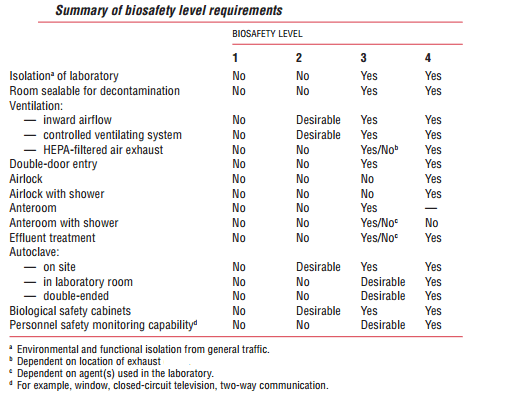
Reference and further reading
- Download Laboratory Biosafety Manual – Third Edition from World Health Organization
- Table Source: Laboratory Biosafety Manual published by WHO
Related Posts
Microbial Fuel Cells (MFCs): Types, Components, and Applications
•Ashma Shrestha•general-microbiology
Feedback Loop: Negative and Positive Feedback Mechanisms
•Ashma Shrestha•general-microbiology
Biopreservation of Art: Microbes as Art Protectant
•Ashma Shrestha•general-microbiology
Eutrophication: Causes, Types, and Effects
•Samikshya Acharya•general-microbiology