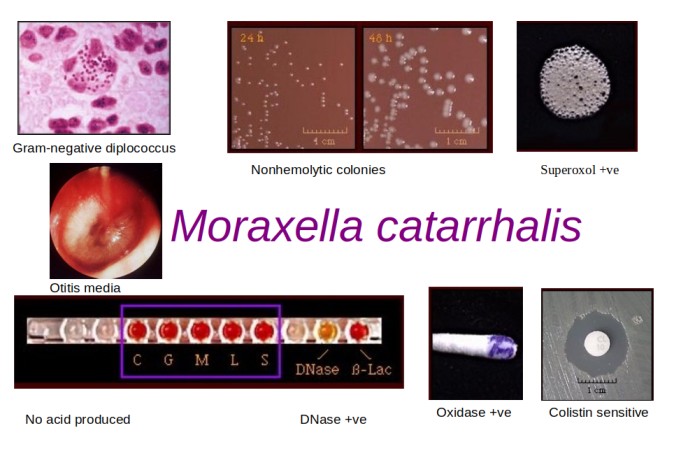
Moraxella catarrhalisis a small gram-negative diplococcus that resembles the cocci of the genus *Neisseria.*The genus Moraxella is one of the several in the family Neisseriaceae; other medically important genera are Neisseria, Kingella, and Acinetobacterspp).
Gram stain morphology of “diplococcus” separatesMoraxella catarrhalisfrom otherMoraxellaorganisms, which are “coccobacilli”
Moraxella catarrhalis is the new name for Branhamella catarrhalis. Moraxellais named after a Swiss ophthalmologist, Victor Morax, who first described it. Catarrhalisis derived from catarrh, the Greek meaning “to flow down” (cata- implies down; -rrh implies flow), describing the profuse discharge from the eyes and nose typically associated with severe inflammation in colds.
Source and Transmission
Moraxella catarrhalisis found only in humans and is a commensal of the upper respiratory tract and genital tract. M. catarrhalisis not frequently isolated from the oropharynx of healthy adults but may be carried more frequently in children and older adults. It is transmitted by respiratory aerosol and can cause opportunistic respiratory tract infections.
Disease
M. catarrhaliscauses acute, localized infections such as otitis media, and sinusitis in children. In elderly patients with chronic obstructive pulmonary diseases, it may cause opportunistic lower respiratory tract infections such as bronchitis and bronchopneumonia.
It may cause life-threatening, systemic diseases including endocarditis and meningitis.
Laboratory Diagnosis
Gram staining
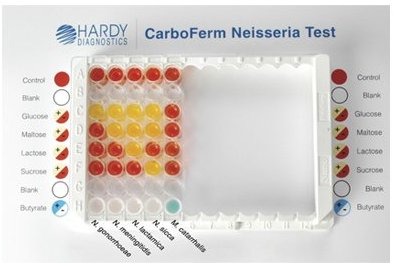
| Properties | Moraxella catarrhalis | Neisseria gonorrhoeae |
|---|---|---|
| Gram Stain | Gram-negative diplococcus | Gram-negative diplococcus |
| Growth of basic agar media at 35°C | Yes | No |
| Enzyme Substrate | No reaction | Hydroxyprolylaminopeptidase (+ve) |
| GLUT (δ-glutamyl-aminopeptidase) | -ve | -ve |
| DNase | +ve | -ve |
| Catalase test | +ve | +ve |
| Superoxol (30% H 2 O 2 ) | Strain variable (1+ to 4+) | Strong 4+ “explosive” |
| Butyrate test | +ve | -ve |
| Polysaccharide from sucrose | -ve | -ve |
| Acid from glucose | -ve | +ve |
| Acid from maltose | -ve | +ve |
| Acid from lactose | -ve | +ve |
| Acid from sucrose | -ve | +ve |
| Nitrate reduction | +ve | -ve |
| Pigment | -ve | -ve |
| Colistin susceptibility | Most strains susceptible | Resistant |
Gram-negative diplococci, 0.6-1 um oval with flattened adjacent sides. It can be found with pus cells (sometimes intracellular) in sputum smears.
Colony characteristics
On blood agar and chocolate agar, M. catarrhalisproduces distinctive grey-white, medium to large, raised or dome-shaped, dry, and brittle colonies which can be easily lifted off the medium with a wire loop.
In the clinical laboratory, isolates of M. catarrhalis must be distinguished from Neisseria spp.
Treatment
Most clinical isolates produce β-lactamase. Trimethoprim-sulfamethoxazole or amoxicillin-clavulanate can be used to treat these infections.
References and further reading
- Color Atlas and Textbook of Diagnostic Microbiology, Koneman, 5th edition
- Bailey & Scott’s Diagnostic Microbiology, Forbes, 11th edition
- Gonorrhea Laboratory Information, Characteristics of N. gonorrhoeae and Related Species, Moraxella catarrhalis. Center for Disease Control (CDC)