
Infective dose (ID) and Lethal Dose (LD)
Why cholera needs 100 million organisms to cause disease while a single measles virus can, and how ID50 and LD50 quantify a pathogen's virulence.
A daycare center has an outbreak. Over the course of a week, illness moves slowly from room to room, one or two new cases at a time, despite reasonably thorough handwashing and surface cleaning between exposures. Before any stool sample comes back from the lab, this pattern alone already suggests something specific: whatever this is, it doesn't take much of it to make the next child sick. A pathogen like norovirus, with an infective dose as low as 18 viral particles, spreads exactly this way, through small amounts of contamination that ordinary hygiene doesn't fully catch.
Now imagine the same daycare reporting a cholera case instead. That pattern, slow person-to-person spread through casual contact, would be genuinely surprising, because cholera typically requires an infective dose upward of 100 million organisms. Person-to-person contact essentially never delivers that much contamination; cholera outbreaks trace back to a shared, heavily contaminated water or food source, not casual contact between children.
The infective dose isn't just a lab statistic. It's often the first clue in reading an outbreak's shape correctly, well before any organism is identified in a sample.
The severity and duration of any infectious disease depend on the infective dose of the pathogen and predisposing host factors.
The infective dose is defined as a minimum number of microorganisms required for an infection to proceed. Some pathogens can cause infection only with a small number of cells in the initial inoculum, whereas others require many cells to infect a host successfully. For example, only about ten cells of EHEC (Enterohemorrhagic Escherichia coli) can cause infection. Whereas Vibrio cholerae requires 10³ to 10⁸ cells..
Estimated Infective Dose of Selected Pathogens
Microbes with small infective doses have greater virulence. The presence of a suboptimal dose of disease-causing pathogens does not result in infection.
| Name of the Organism | Primary Route of Infection | Disease | Estimated Infectious Dose |
|---|---|---|---|
| Measles virus | Respiratory | Measles | 1 virus |
| Noroviruses | Ingestion (fecal-oral) | Acute gastroenteritis | ≥18 viral particles |
| Coxiella burnetii | Respiratory | Q Fever | 1-10 bacteria |
| Cryptosporidium parvum | Ingestion | Cryptosporidiosis | 10-100 oocyst |
| Francisella tularensis | Various | Tularemia | 10-50 bacteria |
| Smallpox virus | Respiratory | Smallpox | 10-100 viruses |
| Brucella spp | Various | Brucellosis | 10-100 bacteria |
| Shigella spp | Ingestion | Shigellosis | 10-100 bacteria |
| Various | Mosquito bite | Viral Encephalitis | 10-100 viruses |
| Yersinia pestis | Flea bite | Plague | 100-500 bacteria |
| Neisseria gonorrhoeae | Sexual contact | Gonorrhea | 1,000 bacteria |
| Bacillus anthracis | Respiratory, cutaneous | Anthrax | 8,000-50,000 bacteria |
| Salmonella Typhi | Ingestion | Typhoid | 10,000 bacteria |
| Vibrio cholerae | Ingestion | Cholera | 100,000,000 bacteria |
Infective dose of Bacillary Dysentery vs Cholera
Bacillary Dysentery
Shigellae are only pathogenic in humans. The ingestion of pathogens are through oral route. Only a few hundred Shigella bacteria are sufficient for an infective dose.
Cholera
Infection results from oral ingestion of the pathogen. The infective dose must be large (≥10⁸), since many Vibrios are killed by the hydrochloric acid in gastric juice.
For the underlying mechanism, how organisms differ in their tolerance to acid, and why that tolerance directly explains differences in infective dose, see pH Requirements of Microorganisms.
Measurement of Virulence
Virulence is a quantitative measure of pathogenicity related to an organism’s invasiveness and toxigenic potential. Virulence of a pathogen can be measured experimentally by determining the Lethal dose 50 (LD₅₀) or the Infectious dose 50 (ID₅₀).
- Infectious dose 50 (ID₅₀) refers to the dose or number of organisms that will infect 50% of an experimental group of hosts within a specified time.
- Lethal dose 50 (LD₅₀) refers to the dose or number of organisms that will kill 50% of an experimental group of hosts within a specified time.
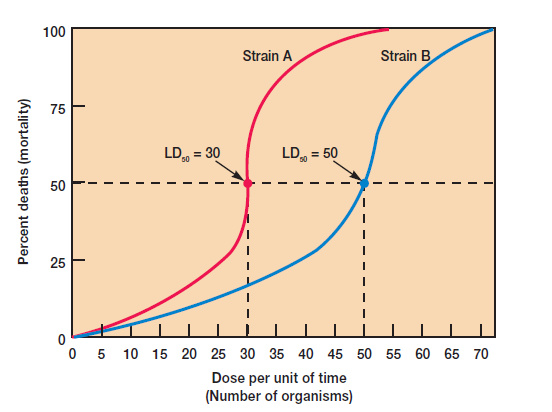 Figure: Determination of the LD₅₀ of a Pathogenic Microorganism
In this example, 30 doses of strain A of a pathogen can kill 50% of host cells, whereas, for strain B, 50 doses are required. As a smaller dose of strain A (compared with strain B) can kill 50% population of host cells, strain A is more virulent than strain B.
How to Remember
- ID50 vs. LD50, in one line: ID50 asks how much it takes to make half a group sick; LD50 asks how much it takes to kill half a group. Same statistical idea, a dose affecting 50% of a test population within a set time, but two very different endpoints.
- Why "50" is the number used: dose-response isn't all-or-nothing, some hosts get infected or die at lower doses and some resist higher ones. The 50% point is simply the most statistically stable, reproducible point on that curve to measure and compare across experiments.
- Reading the extremes of the table as anchor points: measles sits at one end, a single virus can in principle cause infection, reflecting extraordinary transmissibility. Vibrio cholerae sits at the other end, needing on the order of 100 million organisms, because most die in stomach acid before ever reaching the intestine. Everything else on the table falls somewhere between these two anchors.
- Low infective dose doesn't automatically mean "spreads like the flu." Coxiella burnetii has an extremely low infective dose (1–10 organisms) but is typically acquired by inhaling contaminated aerosols from livestock, not through casual person-to-person respiratory contact. Route of exposure and ease of person-to-person spread are related but separate questions.
Key exam facts in one table
| Concept | Detail | Why it's tested |
|---|---|---|
| Infective dose (ID50) | Dose infecting 50% of a test population within a specified time | Defines a population-level statistical threshold, not a fixed number guaranteeing infection in every host |
| Lethal dose (LD50) | Dose killing 50% of a test population within a specified time | A distinct endpoint from infection; a pathogen can have a low ID50 without a correspondingly low LD50 |
| Inverse relationship | Smaller infective dose generally reflects greater virulence | Explicitly stated in the article; a frequently tested relationship |
| Lowest infective doses in the table | Measles (1 virus), Coxiella burnetii (1–10 bacteria) | Useful anchor points for the low end of the spectrum |
| Highest infective dose in the table | Vibrio cholerae (~10⁸ bacteria) | The anchor point for the high end, directly explained by gastric acid sensitivity |
| Why cholera's dose is so high | Most ingested Vibrios are killed by stomach acid before reaching the intestine | Ties directly to acid tolerance concepts covered in pH Requirements of Microorganisms |
Where Students Get Confused
- Using "infective dose" and "lethal dose" interchangeably. They measure different endpoints, becoming infected (ID50) versus dying (LD50), and a pathogen's values for each don't have to track together.
- Treating table values as fixed, guaranteed thresholds. These are statistical estimates from experimental or epidemiological data; actual infective dose in a real exposure varies with host immune status, achlorhydria or antacid use, strain virulence factors, and other predisposing factors, exactly as the article's own opening line notes.
- Assuming a low infective dose always means easy person-to-person spread. Coxiella burnetii's very low infective dose depends on inhaling contaminated aerosols from animal sources, not casual respiratory contact between people, which is a very different transmission picture than something like measles.
- Missing the mechanistic reason behind the numbers. The infective dose isn't an arbitrary fact to memorize per organism; for ingested pathogens especially, it's frequently explained by how well that organism tolerates the acidic environment of the stomach.
References
- Chan, T. C., Jiang, J., Temenak, J. J., & Richards, A. L. (2003). Development of a rapid method for determining the infectious dose (ID₅₀) of Orientia tsutsugamushi in a scrub typhus mouse model for the evaluation of vaccine candidates. Vaccine, 21(31), 4550–4554. https://doi.org/10.1016/s0264-410x(03)00505-x
- Aldous, E. W., Seekings, J. M., McNally, A., Nili, H., Fuller, C. M., Irvine, R. M., Alexander, D. J., & Brown, I. H. (2010). Infection dynamics of highly pathogenic avian influenza and virulent avian paramyxovirus type 1 viruses in chickens, turkeys and ducks. Avian pathology : journal of the W.V.P.A, 39(4), 265–273. https://doi.org/10.1080/03079457.2010.492825
Frequently Asked Questions
What is the difference between infective dose and lethal dose?
Why does cholera require such a large infective dose compared to other pathogens?
Is Coxiella burnetii's low infective dose the same as being easily spread person-to-person?
What is the primary route of norovirus transmission?
Does a smaller infective dose mean a pathogen is more virulent?

Tankeshwar Acharya, MSc (Medical Microbiology)
Tankeshwar Acharya is an Assistant Professor in the Department of Microbiology at Patan Academy of Health Sciences (PAHS), Nepal, where he has been teaching and practicing clinical microbiology for over 14 years. He is the founder of Microbe Online, one of the leading free microbiology education resources on the web, covering bacteriology, mycology, parasitology, immunology, and clinical laboratory diagnostics written from direct experience in both the classroom and the diagnostic laboratory.