The Enterobacteriaceae family contains a large number of genera that are biochemically and genetically related to one another. Taxonomically, the Enterobacteriaceae family currently has 53 genera and over 170 named species, of these 26 genera are known to be associated with infections in humans. Many of the familiar bacteria are found in this family e.g. Escherichia coli, Shigella, Salmonella, Enterobacter, Proteus, Yersinia, etc.
Common Characteristics
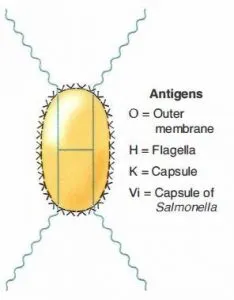
Antigens of Enterobacteriaceae are:
- O: Outer membrane
- H: Flagella
- K: Capsule
- Vi: Capsule of Salmonella
Medically Important Genera
- Citrobacterspecies
- Enterobacterspecies
- Escherichia species
- Hafnia species
- Klebsiella species
- Morganellaspecies
- Plesiomonas shigelloides
- Proteusspecies
- Providencia species
- Salmonella species
- Serratiaspecies
- Shigella species
- Yersinia species
List of lactose fermenter and non-lactose fermenter
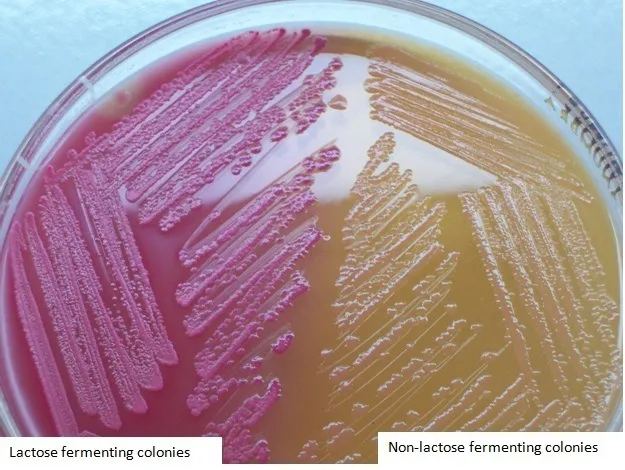
Lactose fermenters: (CEEK)
- Citrobacter
- Escherichia
- Enterobacter
- Klebsiella
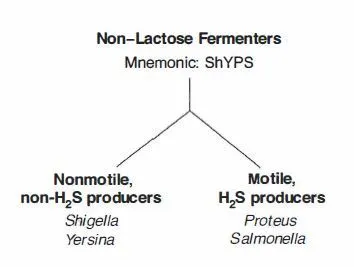
Non lactose fermenter (ShYPS)
- Shigella
- Yersinia
- Proteus
- Salmonella
Primary Isolation Media
- Blood Agar (BA)
- MacConkey (MAC) agar
- Cystine-lactose-electrolyte deficient (CLED) agar
- Desoxycholate citrate agar (DCA)
- Xylose-lysine-desoxycholate agar (XLD)
- Brilliant Green Agar (BGA)
- Cefixime-tellurite-sorbitol-MacConkey (CT-SMAC) agar
- Thiosulphate-citrate-bile salt (TCBS) agar
- Cefsulodin-Irgasan-novobiocin (CIN) agar
- Chromogenic media
Colonial Appearance
| Name of the culture media | Colony morphology |
|---|---|
| Blood agar | Colonies are 2-3 mm in diameter, low, convex, grey, smooth, or mucoid, and may be hemolytic or swarming. |
| MAC | Colonies may appear pink (lactose fermenting) or colorless (lactose non fermenting), size and shape vary with individual species |
| CLED | Colonies may appear yellow (lactose fermenting) or blue (lactose nonfermenting), size and shape vary with individual species. |
| DCA | Colonies may appear pink (lactose fermenting) or colorless (lactose nonfermenting) and may have a black center (H2S producers). |
| XLD | Colonies may appear yellow (xylose, lactose, or sucrose fermenting) or pink (non-fermenting) and may have a black center (H2S producers). |
| BGA | Colonies appear as red-pink, 1-3mm in diameter, surrounded by brilliant red zones in the agar. |
| CT-SMAC | Colonies may appear pink (sorbitol fermenting) or colorless (sorbitol nonfermenting). |
| TCBS | Colonies may appear yellow (sucrose fermenting) or blue-green (sucrose nonfermenting). |
| CIN | Colonies may have deep-red centers (mannitol fermenting) surrounded by a translucent border giving the appearance of a “bull’s eye”. |
Tests for the Identification of Enterobacteriaceae Family
Members of the Enterobacteriaceae family are identified based on their biochemical properties. Commonly used biochemical tests are;
- Citrate utilization Test
- Indole Test
- Motility Test
- Methyl Red (MR) Test
- Voges–Proskauer (VP) Test
- Triple Sugar Iron (TSI) Agar Test
- Urease Test
Summary of biochemical reactions of Enterobacteriaceae
| TSI | Indole | MR | VP | Citrate | Urease | Motility | |
|---|---|---|---|---|---|---|---|
| E.coli | A/A, Gas | +ve | +ve | -ve | -ve | -ve | Motile |
| Citrobacter freundii | A/A or K/A, Gas, H2S | +ve | +ve | +ve | -ve | -ve | Motile |
| Klebsiella pneumoniae | A/A, Gas (++), H2S | -ve | -ve | +ve | +ve | +ve | Non-motile |
| Enterobacter cloacae | A/A, Gas (++) | -ve | -ve | +ve | +ve | +ve | Motile |
| Salmonella Typhi | k/A, H2S (weak) | -ve | +ve | -ve | +ve | -ve | Motile |
| Shigella boydii | K/A, No Gas, No H2S | -ve | +ve | -ve | -ve | -ve | Non-motile |
| Proteus mirabilis | K/A, Gas, H2S | -ve | +ve | -ve | +ve | +ve | Motile (swarming) |
Antimicrobial Resistance
Certain members of the Enterobacteriaceae possess chromosomally determined inducible AmpC beta-lactamases. These include the so-called MYSPACE organisms:Morganella morgannii, Yersinia enterocolitica,Serratia marcescens, Providencia spp., Aeromonas spp. Citrobacter freundiicomplex, and Enterobacter spp.
Carbapenem-resistant or carbapenamase-producing Enterobacteriaceae have been reported worldwide and are major threats to global well-being. Carbapenem-resistant Enterobacteriaceae (CRE) are usually resistant to all β-lactam agents as well as most other classes of antimicrobial agents, which limits the available treatment options.
Carbapenem resistance in Enterobacteriaceae occurs when an isolate acquires a carbapenemase or whenan isolate produces an extended-spectrum cephalosporinase, such as an AmpC-type β-lactamase, incombination with porin loss. Klebsiella pneumoniae carbapenemase (KPC) is one of the most common mechanism of carbapenem resistance.
Modified Hodge Test (MHT) is one of the recommended tests for the detection of carbapenemase production.
References
- Madigan Michael T, Bender, Kelly S, Buckley, Daniel H, Sattley, W. Matthew, & Stahl, David A. (2018). Brock Biology of Microorganisms (15th Edition). Pearson.
- Color Atlas and Textbook of Diagnostic Microbiology, Koneman, 5th edition
- Pelczar Jr., M., Chan, E., & Krieg, N. (2007). Microbiology (5th edition). Tata McGraw-Hill
- Bailey & Scott’s Diagnostic Microbiology, Forbes, 11th edition