
Widal Test: How to Read Titers Against a Local Baseline (with Nepal Data)

On this page
A titer that means typhoid in London and nothing in Kathmandu
A 24-year-old man in Kathmandu has had a fever for eight days. His Widal test comes back anti-O 1:80, anti-H 1:160. In a travel clinic in London, those numbers would be reported as significant and treated as typhoid without hesitation.
Here, they may mean nothing at all.
When we measured Widal titers in 490 apparently healthy Nepalese blood donors, people with no fever and no illness, a large share already carried anti-O titers of 1:80 and anti-H titers of 1:160. Years of subclinical exposure and vaccination in an endemic population had raised their baseline. The titer that flags disease in a non-endemic country sits inside the normal background range here.
This is the single most important fact about the Widal test, and the one most often ignored: the same number means different things in different places. A test result read against the wrong baseline does not just fail to help. It actively misleads, treating healthy carriers of background antibody as typhoid cases while the real cause of the fever goes unlooked-for.
The Widal test is cheap, available in every district lab in South Asia, and more than a century old. Used well, against a locally established baseline, it still earns its place. Used as a fixed cutoff copied from a textbook written for a non-endemic country, it is one of the most overinterpreted tests in tropical medicine. This article is about the difference.
Widal test is the most widely used diagnostic test for typhoid fever in developing countries. The Widal test has been in use for more than a century as an aid in the diagnosis of typhoid fever. The Widal test is positive after the tenth day of the disease and may be falsely positive if an individual previously received a typhoid vaccine.
The Widal agglutination test is performed using a standardized suspension of S. enterica serotype Typhi ‘O’ and ‘H’ and S. enterica serotype Paratyphi A ‘H’ and S. enterica serotype Paratyphi B ‘H’ antigen. It measures agglutinating antibody levels against O and H antigens using serial dilutions of sera. Tube agglutination method is the recommended method of performing the Widal test; where serial two-fold dilutions of the patient’s serum from 1:20 to 1:1280 are tested. After its development, the rapid slide test became the most commonly used technique in local laboratories because of its convenience.
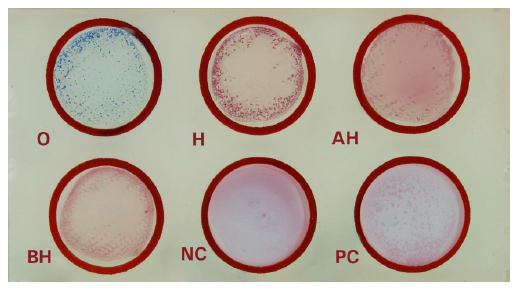 Figure: Agglutination reactions of O, H, AH, and BH antigen in Widal test
The test was devised by Georges-Fernand Widal in 1896 as a serological aid in the diagnosis of typhoid fever caused by Salmonella enterica serotype Typhi. The paratyphoid antigens (AH and BH) were added to the panel later, after the paratyphoid organisms were characterized.
Principle
Patients infected with S. enterica serotype Typhi and Paratyphi produce serum antibodies to the O and H antigens of these pathogens, and the detection of these specific antibodies forms the basis of Widal test.
Antigens specifically prepared from Salmonella are used in the Widal agglutination test to detect the presence of antibodies in patients’ serum. Four specific antigen suspensions are used in Widal test; they are O, H, AH, and BH. Unfortunately, S. enterica serotype Typhi shares these antigens with other Salmonella serotypes and shares cross-reacting epitopes with other Enterobacteriaceae which increases the chance of false-positive results.
The earliest serological response in acute typhoid fever is a rise in the titer of the O antibody, with an elevation of the H- antibody titer developing more slowly but persisting longer than that of the O- antibody. Usually, O antibodies appear on 6 to 8 days and H antibodies on 10-12 days after the onset of the disease. Patients from communities where typhoid is endemic have higher H-antibody titers so some researchers claim that the level of H agglutinins is unhelpful in the diagnosis of typhoid.
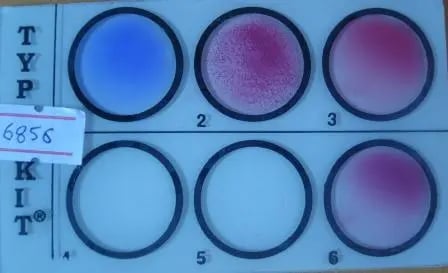 Figure: Widal Test: Sample showing H positive in screening test
Salmonella Antigens Used in the Widal Test
Understanding the antigens used in the Widal test is essential for interpreting results correctly. Four antigen suspensions are used:
O Antigen (Somatic antigen)
The O antigen is a somatic (cell body) antigen located on the outer membrane lipopolysaccharide (LPS) of the bacterial cell wall. Its specificity is determined by the repeating units in the outer O-polysaccharide chain.
Key properties:
- Heat stable and alcohol resistant
- Forms compact, granular clumps when mixed with O antisera — the clumps are small and granular, distinctly different from H agglutination
- O antibodies appear earlier in disease — typically 6–8 days after onset of illness
- O antibody titers decline faster after recovery or treatment
- More specific for active/current infection than H antibody, but cross-reacts with other Enterobacteriaceae
H Antigen (Flagellar antigen)
The H antigen is a flagellar antigen — it is a protein component of the bacterial flagella.
Key properties:
- Heat labile — inactivated by boiling and alcohol
- Forms large, fluffy, loose clumps when treated with corresponding antisera — easily distinguishable from O agglutination
- H antibodies appear later — typically 10–12 days after illness onset
- H antibodies persist longer after recovery — sometimes for years after infection or vaccination
- In endemic populations, high H titers may reflect past infection or vaccination rather than current disease
AH antigen — flagellar antigen of S. enterica serotype Paratyphi A BH antigen — flagellar antigen of S. enterica serotype Paratyphi B
Vi Antigen (Virulence antigen)
The Vi antigen is a capsular polysaccharide that overlays the O antigen on the cell surface.
Key properties:
- Heat labile
- Increases bacterial infectivity by reducing complement-mediated killing and phagocytosis
- Can interfere with O antigen testing — if Vi antigen is present in large quantities, it may block O antibody detection, giving a false-negative O result
- Vi antigen is NOT routinely included in standard Widal test kits but is detected using specific Vi antisera
- A positive Vi agglutination may suggest chronic typhoid carriage
| Antigen | Type | Stability | Agglutination appearance | Antibody timeline |
|---|---|---|---|---|
| O | Somatic (LPS) | Heat stable, alcohol resistant | Compact, granular, small clumps | Appears day 6–8; declines early |
| H | Flagellar (protein) | Heat labile, alcohol labile | Large, fluffy, loose clumps | Appears day 10–12; persists long |
| AH | Flagellar (Paratyphi A) | Heat labile | Large, fluffy clumps | Indicates Paratyphi A infection |
| BH | Flagellar (Paratyphi B) | Heat labile | Large, fluffy clumps | Indicates Paratyphi B infection |
| Vi | Capsular polysaccharide | Heat labile | — | Chronic carrier detection |
Materials required
- Widal test kit (killed colored suspension of S. enterica serotype Typhi O antigen, S. enterica serotype Typhi H antigen and S. enterica serotype Paratyphi AH antigen, and S. enterica serotype Paratyphi BH antigen).
- Incubator
- Normal saline
- Refrigerator
- Applicator stick
- Graduated pipette
Before use, bring all reagents to room temperature and mix well.
Procedure of Widal Test
Rapid screening test
- Mark the circles of the slide as PC (positive control), NC (negative control), O, H, AH, and BH, as per the antigen solutions used for testing.
- Add 1 drop of positive control (25μL) into the circle marked as PC.
- Then add 1 drop of negative control (25μL) into the circle marked as NC.
- Add 1 drop of the test sample (25μL) into each circle labeled as O, H, AH, and BH.
- Add 1 drop of the polyvalent (polyspecific) positive control antigen to the PC circle and 1 drop of saline (or the kit-supplied negative control) to the NC circle. Mix each with a fresh stick. (Follow the specific kit insert, as control reagents vary between manufacturers.)
- To circles labeled as O, H, AH, BH in which test samples have been added, add antigen solutions of Salmonella typhi ‘O’, Salmonella typhi ‘H’, Salmonella paratyphi ‘AH’ and Salmonella paratyphi ‘BH’, respectively.
- Mix the content of each reaction circle uniformly with a separate mixing stick.
- Rock the glass slide gently (approximately for one minute) and observe for agglutination.
Result:
- Positive Widal test: Agglutination was observed within a minute.
- Negative Widal test: No agglutination
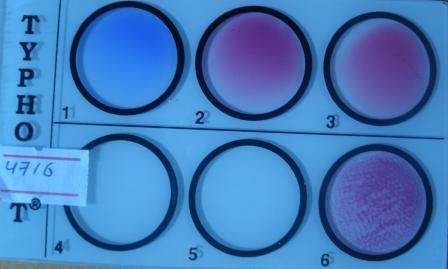 Figure: Widal Test Result: Sample (6) showing BH positive in screening test
Slide Titration
Rapid slide titration needs to perform for the samples which showed positive titer during rapid screening.
- Using a micropipette, dispense 80, 40, 20, 10, and 5 µl of undiluted serum onto a row of 3 cm diameter circles. These five volumes correspond to equivalent tube titers of 1:20, 1:40, 1:80, 1:160, and 1:320 respectively (see the reporting table below).
- Shake the reagent bottle rigorously, then add a drop (0.03 ml) of the undiluted antigen suspension to each serum aliquot.
- Mix thoroughly with a stirring stick and rotate the slide gently.
- Observe the reactions after a minute.
Result:
- Positive test: Agglutination was observed within a minute.
- Negative test: No agglutination
Reporting Widal test
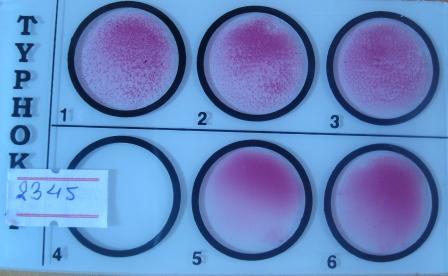 Figure: Widal Test: Quantitative test for H antibody (Serial double dilution order from 1-2-3-6-5)
| Circle | 1 | 2 | 3 | 4 | 5 |
|---|---|---|---|---|---|
| Serum volume | 80 µl | 40 µl | 20 µl | 10 µl | 5 µl |
| Amount of antigen | 1 drop | 1 drop | 1 drop | 1 drop | 1 drop |
| Equivalent tube titer | 1:20 | 1:40 | 1:80 | 1:160 | 1:320 |
The Widal test is reported by giving the titer for both O and H antibodies. The titer of each serum is read as the highest serum dilution giving visible agglutination. The agglutination observed in any circle was indicative of the following results in a test tube.
Quality control
Quality control was done using the positive polyspecific control of the same dilutions as the test sample. Normal saline was used for negative control.
Importance of Baseline Titer in Widal Test
Ideally, the Widal test should be run on both acute and convalescent-phase sera to detect an increase in the agglutination titer but patient management cannot wait for results obtained with a convalescent-phase sample. For practical purposes, a treatment decision must be made on the basis of the results obtained with a single acute-phase sample. It is, therefore, important to establish the antibody level in the normal population in a particular locality in order to determine a threshold above which the antibody titer is considered significant.
In a situation where second sample collection is not feasible, knowledge of the agglutinin levels in the sera of normal subjects from the patients’ community can form the baseline on which a diagnosis can be made.
Interpretation of Widal Test Results
What titer is significant?
There is no universal consensus on a single diagnostic titer, because the significant titer varies with the local endemicity of typhoid fever and the baseline agglutinin levels in the population. This is the most important concept in Widal test interpretation and the most commonly misunderstood.
Interpreting a single acute-phase sample:
| Setting | Suggested significant O titer | Suggested significant H titer |
|---|---|---|
| Non-endemic area (traveller) | ≥1:40 | ≥1:80 |
| Low-endemic area | ≥1:80 | ≥1:160 |
| Endemic area (general recommendation) | ≥1:160 | ≥1:160 |
| Nepal (established local baseline) | >1:80 for anti-O | >1:160 for anti-H |
Interpreting paired acute and convalescent samples (ideal):
A fourfold or greater rise in titer between acute (first week) and convalescent (3–4 weeks later) samples is the most reliable criterion for diagnosis, regardless of the absolute titer. This is the gold standard approach but is impractical in most clinical settings where treatment decisions cannot be delayed.
O vs H titer — what does each tell you?
| Result pattern | Most likely interpretation |
|---|---|
| Elevated O titer only | Active/recent infection — O antibody rises first |
| Elevated H titer only | Past infection or previous typhoid vaccination |
| Elevated both O and H | Active infection — most diagnostically significant combination |
| Elevated AH only | Salmonella Paratyphi A infection |
| Elevated BH only | Salmonella Paratyphi B infection |
| Elevated O + H + AH/BH | Mixed infection or cross-reaction |
Nepal-specific baseline titer data
Our research (Acharya T, Tiwari BR, Pokhrel BM. Baseline Widal Agglutination Titre in Apparently Healthy Nepalese Blood Donors. JHAS. 2013;3(1):27–30) established the baseline Widal agglutination titers among 490 apparently healthy blood donors across five developmental regions of Nepal. The study found that a significant proportion of healthy, uninfected individuals already carried anti-O titers ≥1:80 and anti-H titers ≥1:160, reflecting background exposure in an endemic population.
Based on these findings, the appropriate diagnostic cutoffs for Nepal are:
- Anti-O titer: >1:80 (titers at or below this level may be seen in healthy individuals)
- Anti-H titer: >1:160 (titers at or below this level may reflect past infection or vaccination)
This is important because applying a lower threshold — such as ≥1:20 or ≥1:40, which may be used in non-endemic settings — in Nepal leads to significant overdiagnosis, as many healthy individuals from endemic communities already carry titers at these levels due to past subclinical infection or vaccination.
This highlights the fundamental principle: a Widal test result must always be interpreted against locally established baseline titers, not against a universal fixed threshold.
Limitations of Widal Test
The value of the Widal test in diagnosing enteric fever in endemic areas remains controversial but is still a useful and widely available test in endemic areas. Epidemiologic studies in an endemic country have shown that at least seven subclinical cases of typhoid fever occur for each clinical case. Therefore a positive Widal test may be seen in apparently healthy persons from an endemic area as a result of previous subclinical infection.
- Previous typhoid vaccination may contribute to elevated agglutinins in the non-infected population.
- Malaria can raise Widal titers, most likely through nonspecific polyclonal stimulation of antibody production rather than true antigenic cross-reaction, and may cause a false-positive result.
- False-positive Widal tests have also been reported for patients with non-enteric salmonella infection, for example, typhus, immunological disorders, chronic liver disease, and cryptococcal meningitis.
- Prior use of antibiotics can dampen antibody response giving a low titer in the Widal test even in the face of bacteriologically confirmed typhoid fever resulting in misdiagnosis
- The Widal agglutination titer varies with the geographic location based on the endemicity of the enteric fever, the prevalence of non-typhoid salmonellae infection, and other infections which cross-react with salmonella antigen.
- Past infection with serotype Typhi or another nontyphoidal Salmonella serotype that shares common antigens gives a false positive Widal test.
Sensitivity and Specificity of the Widal Test
The Widal test's sensitivity and specificity vary widely depending on the cut-off titer used, the endemicity of the region, and the population studied. This variability is the central reason why the test remains controversial despite over 125 years of use.
| Region | Cut-off titer | Sensitivity | Specificity |
|---|---|---|---|
| Philippines (tube agglutination) | O ≥1:80 | 64% | 100% |
| Philippines (slide agglutination) | O ≥1:160 | 72.5% | 57.5% |
| Ethiopia | O and H ≥1:160 | 82% | — |
| South Africa | O and H ≥1:200 | 75% | 92.5% |
| Nepal (Kathmandu) | O and H ≥1:160 | See Acharya T et al., 2013 | — |
The wide variation in reported sensitivity (roughly 47 to 82 percent) and specificity (roughly 50 to 100 percent) across studies reflects the difficulty of using a fixed titer threshold across different endemic settings. A titer that is diagnostically significant in a non-endemic country may be entirely within the normal background range in a highly endemic region like Nepal, India, or the Philippines.
Widal Test vs Newer Diagnostic Tests for Typhoid Fever
The Widal test remains the most widely used typhoid diagnostic tool in developing countries due to its low cost and wide availability. However, several newer tests have been developed with improved sensitivity and specificity:
| Diagnostic test | Principle | Sensitivity | Specificity | Cost | Availability |
|---|---|---|---|---|---|
| Widal test | Tube/slide agglutination of O and H antibodies | 47–82% | 50–100% | Very low | Universally available |
| Blood culture | Gold standard — isolation of S. typhi | 40–80% (depends on timing and prior antibiotics) | ~100% | Moderate | Limited in resource-poor settings |
| Typhidot (IgM/IgG ELISA) | Detects IgM and IgG against a 50 kDa outer membrane protein of S. typhi | 70–80% | 75–90% | Low-moderate | Increasingly available |
| Typhidot-M | Detects IgM only (eliminates IgG cross-reactivity) | 70–85% | 85–96% | Low-moderate | Available in endemic areas |
| Tubex TF | Inhibition agglutination detecting anti-O9 IgM antibody | 56–78% | 87–95% | Moderate | Available in some endemic areas |
| PCR | Detects S. typhi DNA | High | High | High | Reference laboratories only |
| Vi serology | Detects anti-Vi IgG | 70–80% | 80–90% | Moderate | Useful for carrier detection |
Key points:
- Blood culture remains the gold standard but has low sensitivity in the second and third weeks of illness and after antibiotic use — exactly when the Widal test is most positive
- Typhidot and Typhidot-M are better suited for early diagnosis (detects IgM from day 3–4 of illness)
- In settings where blood culture is unavailable or impractical, the Widal test combined with clinical judgment and local baseline titers remains a reasonable diagnostic tool
- No single test is perfect — the clinical picture, local epidemiology, and laboratory results must be interpreted together
→ Full article: Salmonella — Disease, Properties, and Laboratory Diagnosis
→ Full article: Culture Media for Salmonella → Full article: SS Agar
Where students get confused
Treating a single titer as a fixed cutoff. This is the central error, and the whole article exists to correct it. There is no universal significant titer. A titer of anti-H 1:160 diagnoses typhoid in a traveler returning to a non-endemic country and means nothing in a healthy resident of Kathmandu, where background titers already reach that level. Always interpret against a locally established baseline, never against a number copied from a textbook written for a different population.
Confusing what O and H tell you. O is the somatic antigen: it appears earlier (day 6 to 8), falls faster, and a rising O titer points to active, current infection. H is the flagellar antigen: it appears later (day 10 to 12), persists for years, and rises after past infection or vaccination as well as current disease. An isolated high H with a low O in an endemic-area patient is more likely a memory of past exposure than proof of present typhoid. If you remember one thing: O for Ongoing, H for History.
Reading a single acute sample as if it were a paired sample. The most reliable Widal criterion is a fourfold rise between an acute and a convalescent sample. That is the gold standard, and it is almost never available, because treatment cannot wait three weeks. In practice you interpret one acute-phase sample against a local baseline, and you should know that this is a compromise, not the ideal the textbooks describe.
Assuming a negative Widal rules out typhoid. Prior antibiotics blunt the antibody response, and a bacteriologically confirmed typhoid case can still give a low or negative titer. A negative Widal in a patient who has already had antibiotics does not exclude the diagnosis.
Forgetting the Vi trap. A large amount of Vi capsular antigen can mask the O antigen and block O antibody detection, giving a false-negative O result. This matters most in chronic carriers, where Vi is the antigen of interest, not the one to overlook.
Believing blood culture and Widal fail at the same time. They do the opposite, and that is the point of using them together. Blood culture is most sensitive in the first week and falls off in weeks two and three. The Widal test is often negative in the first week and becomes positive in weeks two and three, exactly when culture is failing. Their windows are complementary.
How to Remember
- O for Ongoing, H for History. O antibody rises first and fades first, so a high O points to current, ongoing infection. H antibody comes late and lingers for years, so a high H may be only a history of past infection or vaccination. This single pairing resolves most O-versus-H interpretation questions.
- O is somatic, and both words are round and compact, like the clumps. The O (somatic, LPS) antigen gives compact, granular clumps. The H (flagellar) antigen gives large, fluffy, loose clumps, like a flagellum waving loose. Picture the clump and you recall the antigen.
- The baseline rule in one line: the number is meaningless without a map. A Widal titer without knowledge of the local baseline is like a temperature reading with no idea of the normal range. Same value, different meaning depending on where you are standing.
Key exam facts in one table
| Question | Answer | The reason behind it |
|---|---|---|
| Who devised the test, and when? | Georges-Fernand Widal, 1896 | Originally for typhoid (S. Typhi), not paratyphoid |
| What four antigens are used? | O, H, AH, BH | O and H of Typhi; AH and BH are the flagellar antigens of Paratyphi A and B |
| What does O antigen detect? | Somatic (LPS) antibody | Appears day 6 to 8, declines early, points to active infection |
| What does H antigen detect? | Flagellar (protein) antibody | Appears day 10 to 12, persists for years, may reflect past infection or vaccination |
| Which appears first in illness? | O antibody | Earliest serological response in acute typhoid |
| Clumping appearance, O vs H? | O = compact, granular; H = large, fluffy, loose | Somatic clumps are tight; flagellar clumps are loose |
| What is the single most important interpretive rule? | Interpret against a local baseline, not a fixed cutoff | Endemic populations carry high background titers |
| Nepal baseline cutoffs? | Anti-O >1:80, anti-H >1:160 | From 490 healthy Nepalese blood donors (Acharya et al., 2013) |
| Most reliable diagnostic criterion? | Fourfold rise between acute and convalescent samples | Independent of absolute titer, but rarely practical |
| Why can Widal be falsely positive? | Past subclinical infection, vaccination, malaria, other Enterobacteriaceae cross-reaction, some non-enteric conditions | Shared and cross-reacting antigens plus nonspecific stimulation |
| Why can Widal be falsely negative? | Prior antibiotics; early illness; Vi antigen masking O | Blunted or not-yet-developed antibody response |
| How does Vi cause a false negative? | Excess Vi capsule masks the O antigen, blocking O antibody detection | Vi overlays the O antigen on the cell surface |
| When is blood culture most sensitive? | First week of illness | Falls in weeks 2 to 3, when Widal is often positive |
| Better test for early diagnosis? | Typhidot-M (IgM from day 3 to 4) | Detects IgM against a 50 kDa outer membrane protein |
| Positive control? | Polyvalent (polyspecific) control antigen | Validates all antigen reactions, per kit insert |
References
- Tille, P. M. (2022). Bailey and Scott's Diagnostic Microbiology (15th ed.). St. Louis: Elsevier.
- Procop, G. W., Church, D. L., Hall, G. S., Janda, W. M., Koneman, E. W., Schreckenberger, P. C., & Woods, G. L. (2017). Koneman's Color Atlas and Textbook of Diagnostic Microbiology (7th ed.). Philadelphia: Wolters Kluwer.
- Olopoenia, L. A., & King, A. L. (2000). Widal agglutination test: 100 years later, still plagued by controversy. Postgraduate Medical Journal, 76(892), 80–84. https://doi.org/10.1136/pmj.76.892.80
- Adhikari, A., Rauniyar, R., Raut, P. P., Manandhar, K. D., & Gupta, B. P. (2015). Evaluation of sensitivity and specificity of ELISA against Widal test for typhoid diagnosis in endemic population of Kathmandu. BMC Infectious Diseases, 15, 523. https://doi.org/10.1186/s12879-015-1248-6
- Acharya T, Tiwari BR, Pokhrel BM. Baseline Widal Agglutination Titre in Apparently Healthy Nepalese Blood Donors. Journal of Health and Allied Sciences. 2013;3(1):27–30.
Frequently Asked Questions
What is the significant titer for a positive Widal test?
What is the difference between O and H agglutination?
Why can the Widal test be falsely positive?
Can the Widal test be negative in proven typhoid?
Why must baseline titers be established locally?
Is the Widal test still recommended?
What is the best time to perform the Widal test?
What does positive AH or BH mean?

Tankeshwar Acharya, MSc (Medical Microbiology)
Tankeshwar Acharya is an Assistant Professor in the Department of Microbiology at Patan Academy of Health Sciences (PAHS), Nepal, where he has been teaching and practicing clinical microbiology for over 14 years. He is the founder of Microbe Online, one of the leading free microbiology education resources on the web, covering bacteriology, mycology, parasitology, immunology, and clinical laboratory diagnostics written from direct experience in both the classroom and the diagnostic laboratory.
Comments
No comments yet. Be the first to share your thoughts.
Leave a comment
All comments are reviewed before they appear.