
Salmonella-Shigella (SS) Agar: Composition, Principle, Colony Characteristics, and Limitations
SS agar is a highly selective medium for Salmonella isolation from stool — but despite its name, it inhibits most Shigella strains. Learn its principle, brilliant green mechanism, colony morphology, and when to use XLD or DCA instead.
A clinical microbiologist reviewing a stool culture protocol for a new district hospital is asked: "Can we just use SS agar for all suspected enteric pathogen cases?" The answer is no — and the reason is one of the most instructive examples of a medium that does less than its name implies.
Salmonella-Shigella agar is excellent at what it does: suppressing coliforms and recovering Salmonella from heavily contaminated fecal specimens. But the same high selectivity that makes it good for Salmonella makes it inhibitory to Shigella dysenteriae and unreliable for Shigella species in general. A laboratory using SS agar as its only enteric selective medium will miss some of the most clinically important cases of bacillary dysentery.
Salmonella-Shigella (SS) agar is used for selective isolation and differentiation of Salmonella and Shigella. It is used for the isolation, cultivation and differentiation of gram-negative enteric microorganisms from both clinical and non-clinical specimens such as from feces, urine, and suspected food items (fresh and canned foods). This medium is not recommended for the primary isolation of Shigella as some Shigella strains may not grow on SS agar due to a relatively high level of selectivity.
Other less inhibitory media used for the isolation, cultivation and differentiation of gram-negative enteric microorganisms are:
- Desoxycholate (DCA) Agar,
- MacConkey Agar,
- Eosin Methylene Blue (EMB) Agar,
- Xylose Lysine Deoxycholate (XLD Agar), and
- Hektoen Enteric Agar
Despite its name, Salmonella-Shigella (SS) agar is not suitable for isolating shigellae as it is inhibitory to most strains.
Composition of Salmonella-Shigella (SS) Agar and their function
| Ingredient | Amount (g/L) | Function |
|---|---|---|
| Beef extract | 5.0 | Nitrogen, vitamins, minerals |
| Proteose peptone | 5.0 | Nitrogen, amino acids |
| Lactose | 10.0 | Fermentable carbohydrate — lactose fermenters produce acid → red/pink colonies |
| Bile salts mixture | 8.5 | Selective agent — inhibits Gram-positive organisms |
| Sodium citrate | 8.5 | Selective agent — suppresses coliforms and Gram-positives |
| Sodium thiosulfate | 8.5 | Selective agent; sulphur source; H2S indicator (with ferric citrate) |
| Ferric citrate | 1.0 | H2S indicator — reacts with H2S → black iron sulfide precipitate |
| Brilliant green | 0.00033 | Primary selective agent — potent inhibitor of most Gram-negatives except Salmonella |
| Neutral red | 0.025 | pH indicator — red/pink in acid (lactose fermenters); colourless in neutral/alkaline |
| Agar | 13.5 | Solidifying agent |
Final pH: 7.0 ± 0.2 at 25°C
Principle
SS agar achieves its high selectivity through four synergistic inhibitory agents working simultaneously:
1. Bile salts — inhibit Gram-positive organisms and suppress some Gram-negatives.
2. Sodium citrate — inhibits Gram-positive organisms and suppresses most coliforms.
3. Sodium thiosulfate + ferric citrate (H2S indicator system) — the same system used in DCA: organisms producing H2S from thiosulfate form black iron sulfide precipitate, giving Salmonella its characteristic black-centred colonies.
4. Brilliant green — the key selective agent that sets SS agar apart: Brilliant green is a triphenylmethane dye with potent inhibitory activity against most Gram-negative bacteria, including the majority of coliforms. At the low concentration used in SS agar (0.00033 g/L — just 0.33 mg per liter), it is bacteriostatic to most enterics while Salmonella species have inherent resistance. This allows Salmonella to grow where other organisms are suppressed.
Why Shigella is inhibited — the critical limitation: Shigella species are more susceptible to brilliant green than Salmonella. At the concentration incorporated in SS agar, brilliant green inhibits Shigella dysenteriae almost completely, and suppresses growth of S. flexneri and S. sonnei to a variable but significant degree. This is the direct cause of the paradox embedded in the medium's name: the medium named for Salmonella and Shigella is poorly suited for Shigella isolation.
The brilliant green concentration in SS agar is approximately 5 times higher than in MacConkey agar and 2–3 times higher than in DCA. This makes SS agar the most inhibitory of the common enteric selective media — a property that maximises suppression of competing flora in heavily contaminated specimens but at the cost of reducing Shigella recovery.
Differential mechanism: Neutral red is the pH indicator. Lactose fermenters produce acid, turning colonies red to pink. Non-fermenters (Salmonella, Shigella, Yersinia) produce colourless colonies. H2S-producing species (Salmonella, some Proteus) develop black centres.
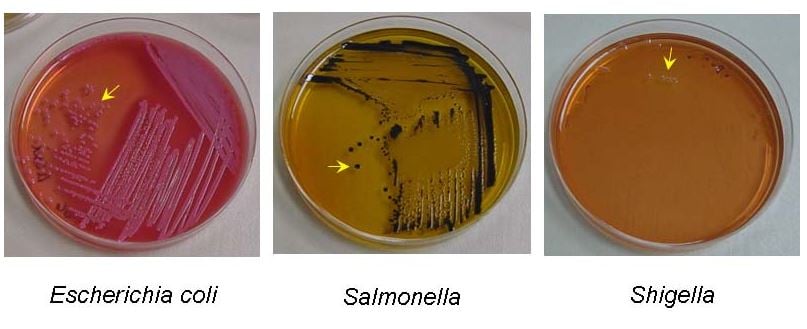 Figure: Colony morphology of E.coli, Salmonella and Shigella in Salmonella-Shigella Agar
Preparation of the media
- Suspend 60 g of the medium in one liter of deionized or distilled water.
- Mix well.
- Heat with frequent agitation and boil for one minute.
- Sterilization in an autoclave is not necessary.
- Pour into plates
- Let the agar solidify and store it in the refrigerator (avoid freezing). Prepared culture media can be kept for at least a week in refrigeration. Note: Various commercial suppliers now supplies ready-to-use culture plates.
Culturing the sample
- Allow the plates to warm to room temperature and the agar surface to dry before inoculating.
- Heavily inoculate and streak the specimen as soon as possible after collection.
- If the specimen to be cultured is on a swab, roll the swab over a small area of the agar surface.
- Streak for isolation with a sterile loop.
- Incubate plates aerobically at 35-37**°**C 18-24 hours.
- Examine colonial morphology.
Results
- Lactose fermenter: If lactose fermentation occurs, the medium will turn red due to the acidic pH. e.g. Escherichia coli, Klebsiella pneumoniae gives red colonies.
- Non-Lactose fermenter: Salmonella, Shigella, and other non-lactose fermenters appear as transparent or translucent colorless colonies. Colonies of Salmonella spp. may appear with or without black centers (depending on the species isolated).
Colony Characteristics on SS Agar
| Organism | Colony colour | Black centre | Notes |
|---|---|---|---|
| Salmonella typhi | Colourless | Yes (variable; may be small) | Lactose non-fermenter; H2S positive; confirm with TSI + serology |
| Salmonella typhimurium (non-typhi) | Colourless | Yes (prominent) | Classic Salmonella appearance on SS agar |
| Salmonella paratyphi A | Colourless | No | H2S negative; red colonies without black centre — cannot distinguish from Shigella |
| Shigella sonnei | Colourless (if grows) | No | Variable growth — often inhibited or produces very small colonies |
| Shigella flexneri | Colourless (if grows) | No | Variable growth; more reliable on XLD or DCA |
| Shigella dysenteriae | Often no growth | — | Most inhibited species — SS agar is not suitable for S. dysenteriae isolation |
| Escherichia coli | Pink to red | No | Lactose fermenter; slightly inhibited but residual E. coli may still form pink colonies |
| Klebsiella pneumoniae | Pink, mucoid | No | Lactose fermenter; mucoid capsule |
| Proteus mirabilis | Colourless | Large black centre | Strongly H2S positive; characteristic large central black dot; "fishy" odour; can mimic Salmonella — differentiate by urease test |
| Pseudomonas aeruginosa | Irregular, slight growth | No | Partially inhibited; irregular colony edges |
| Gram-positive bacteria | No growth | — | Completely inhibited by bile salts + brilliant green |
Proteus vs Salmonella on SS agar: Both produce colourless colonies with black centres. Key distinction: Proteus colonies are more glossy and translucent, often with a large central black dot; Salmonella colonies are more opaque. Always confirm with urease test (Proteus strongly positive) and TSI before reporting Salmonella.
When to Use SS Agar — and When Not To
Use SS agar when:
- Specimens are heavily contaminated with coliform flora (e.g., formed stool, rectal swabs) and maximum suppression of background flora is needed
- Salmonella is the primary clinical concern (typhoid fever, non-typhoidal salmonellosis, food poisoning investigation)
- Used alongside a less inhibitory medium — SS agar is best used as one plate in a two-plate battery, not as the sole medium
Do not use SS agar as the sole medium when:
- Shigella dysentery is the primary concern — Shigella dysenteriae and most other Shigella strains are inhibited
- Specimens are from paediatric patients (children with bloody diarrhoea — Shigella is a leading cause)
- Investigating outbreaks of bacillary dysentery
Recommended two-medium battery for enteric stool culture:
| Clinical concern | Primary medium | Secondary medium |
|---|---|---|
| Typhoid / non-typhoidal Salmonella | SS agar (high selectivity for Salmonella) | MacConkey agar |
| Dysentery (Shigella suspected) | XLD agar (best Shigella recovery) | MacConkey agar |
| Broad enteric screen | XLD agar + MacConkey agar | DCA if available |
| Cholera suspected | TCBS agar + APW enrichment | — |
How to Remember
SS agar — high selectivity is both its strength and its flaw:
The key to understanding SS agar is the brilliant green dye. At the concentration used, brilliant green:
- Suppresses nearly all coliforms → clean background, easy to read
- Suppresses Shigella → misses the pathogen in the medium's own name
- Does not suppress Salmonella → the medium's real target
Memory anchor — "SS agar should be called S agar": Despite being named Salmonella-Shigella agar, it is functionally a Salmonella-selective agar. Renaming it mentally as "S agar" is not just a memory trick — it prevents the clinical error of relying on SS agar alone when Shigella dysentery is suspected.
The enteric media selectivity spectrum:
| Selectivity | Medium | Best for |
|---|---|---|
| Low | MacConkey agar | General GN screen; grows almost everything GN |
| Moderate | DCA | Salmonella + Shigella; good for standard stool culture |
| Moderate-high | XLD agar | Best Shigella recovery; three-step Salmonella differentiation |
| High | SS agar | Maximum coliform suppression; Salmonella specialist; poor for Shigella |
Colony reading — two questions, three outcomes:
| Colony colour | H2S (black centre) | Most likely organism |
|---|---|---|
| Colourless | Yes | Salmonella (confirm with TSI + serology) |
| Colourless | No | Shigella (if it grew) or S. paratyphi A |
| Pink/red | No | E. coli, Klebsiella — coliform contaminants |
Precautions:
As SS Agar media contains components of animal origin (absence of transmissible pathogenic agents cannot be ruled out) so treat it as potentially infectious, and handle observing the usual universal blood precautions. Do not ingest, inhale, or allow the media to come into contact with skin.
References
- Tille, P. M. (2017). Bailey and Scott's Diagnostic Microbiology (14th ed.). Elsevier.
- Cheesbrough, M. (2006). District Laboratory Practice in Tropical Countries, Part 2 (2nd ed.). Cambridge University Press.
- World Health Organization. (2005). Guidelines for the Control of Shigellosis, including Epidemics due to Shigella dysenteriae type 1. Geneva: WHO.
- Mahon, C. R., Lehman, D. C., & Manuselis, G. (2018). Textbook of Diagnostic Microbiology (6th ed.). Elsevier.
- Image source: Collin college

Tankeshwar Acharya, MSc (Medical Microbiology)
Tankeshwar Acharya is an Assistant Professor in the Department of Microbiology at Patan Academy of Health Sciences (PAHS), Nepal, where he has been teaching and practicing clinical microbiology for over 14 years. He is the founder of Microbe Online, one of the leading free microbiology education resources on the web, covering bacteriology, mycology, parasitology, immunology, and clinical laboratory diagnostics written from direct experience in both the classroom and the diagnostic laboratory.