
Extracellular vs Intracellular Bacteria: Facultative, Obligate, and Examples
Extracellular vs intracellular bacteria explained: where each type replicates, why it matters for immunity and antibiotics, the difference between facultative and obligate intracellular pathogens, and examples of each.

On this page
Where a bacterium chooses to live inside the body is not a small detail. It decides almost everything about the infection: whether antibodies can reach it, whether the body needs one arm of the immune system or another to clear it, and even which antibiotics will work.
An organism floating in the blood and tissue fluid is exposed and reachable. An organism hidden inside the host's own cells is shielded, like an enemy soldier who has slipped inside a building the patrols cannot search.
This is why microbiologists divide pathogenic bacteria by where they replicate. Some stay outside cells (extracellular). Some live inside them (intracellular), and of those, some can do either while others have no choice. Understanding which group an organism belongs to tells you how the body will fight it and how you will treat it.
Pathogenic bacteria can be grouped into two major categories on the basis of their invasive properties for eukaryotic cells.
- Extracellular bacteria
- Intracellular bacteria
- Facultative intracellular
- Obligate intracellular
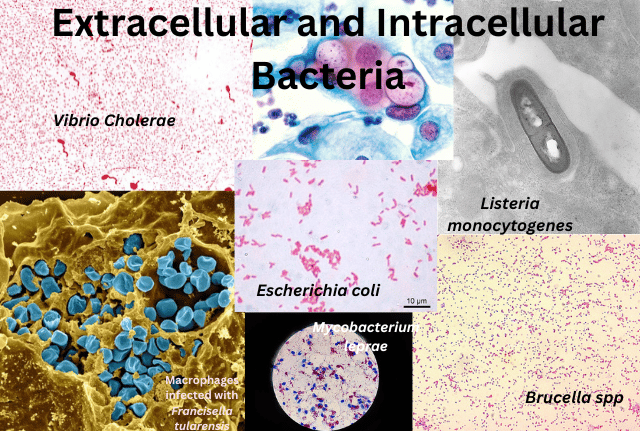 Figure: Extracellular and Intracellular Bacteria
Why the distinction matters
Before the two lists, it is worth being clear about why this classification is one of the most useful in medical microbiology. Three consequences follow directly from where an organism lives.
It decides which part of the immune system clears the infection. Antibodies circulate in blood and tissue fluid, so they can reach and neutralize extracellular organisms. But antibodies cannot enter a host cell. An organism hidden inside a cell is invisible to circulating antibodies, and the body must instead use cell-mediated immunity, cytotoxic T cells and activated macrophages, to find and destroy the infected cells. This is why defects in cellular immunity (for example in advanced HIV) leave patients especially vulnerable to intracellular pathogens.
It shapes the kind of tissue damage. Extracellular bacteria often cause disease through toxins and pus-forming (pyogenic) inflammation. Intracellular bacteria, which the body cannot easily clear, often provoke a walling-off reaction called granuloma formation, the body's attempt to contain what it cannot eliminate. This is why tuberculosis and leprosy produce granulomas.
It changes antibiotic choice. To kill an intracellular organism, an antibiotic has to get inside the host cell first. Many antibiotics penetrate cells poorly, so drugs that cannot reach the intracellular compartment will fail even if the organism is sensitive to them in a test tube. Effective treatment of intracellular infections relies on drugs that enter cells well.
Histoplasma capsulatum is a facultative intracellular fungus that survives within macrophages.
Intracellular survival is one of the pathogen's evasion tactics, hiding from the immune system inside the host's own cells. For how this fits among the other strategies pathogens use, see Bacterial Pathogenesis and Bacterial Virulence Factors, articles.
| Feature | Extracellular | Facultative intracellular | Obligate intracellular |
|---|---|---|---|
| Where it replicates | Outside host cells, in blood and tissue fluid | Can live and replicate both inside and outside cells | Only inside host cells |
| Can grow on lab media? | Yes | Yes (this is what "facultative" means here) | No; needs living cells (cell culture, eggs, animals) |
| Main immune defense against it | Antibodies (humoral immunity) | Cell-mediated immunity when intracellular | Cell-mediated immunity |
| Typical tissue reaction | Pyogenic (pus), toxin-mediated | Often granulomatous | Often granulomatous |
| Examples | Staphylococcus aureus, Streptococcus pyogenes, Vibrio cholerae | Mycobacterium tuberculosis, Salmonella, Listeria, Legionella, Brucella | Chlamydia, Rickettsia, Coxiella, Mycobacterium leprae |
Extracellular bacteria
Extracellular bacterial pathogens do not invade cells instead, they proliferate in the extracellular environment which is enriched with body fluids. Some extracellular bacteria even don’t penetrate body tissues (e.g. Vibrio cholerae) but adhere to epithelial surfaces and cause disease by secreting potent toxins.
Although bacteria such as E. coli and P. aeruginosa are termed noninvasive, they frequently spread rapidly to various tissues once they gain access to the body. Extracellular bacteria do not have the capacity to survive the intracellular environment or to induce their own uptake by most host cells. Extracellular pathogens are reachable by antibodies, which is why vaccines that generate antibodies (for example against the pneumococcal capsule) work well against many extracellular organisms.
Predominantly extracellular bacteria are
- Bacillus anthracis
- Enterotoxigenic Escherichia coli
- Haemophilus influenzae
- Mycoplasma spp
- Pseudomonas aeruginosa
- Staphylococcus aureus
- Streptococcus pyogenes
- Vibrio cholerae
Intracellular Bacteria
Intracellular pathogens commonly cause “granulomatous lesions”. They are divided into two groups-
- Those that can be cultured in microbiologic media in the laboratory (facultative) or
- Those that required living cells/animals (obligate).
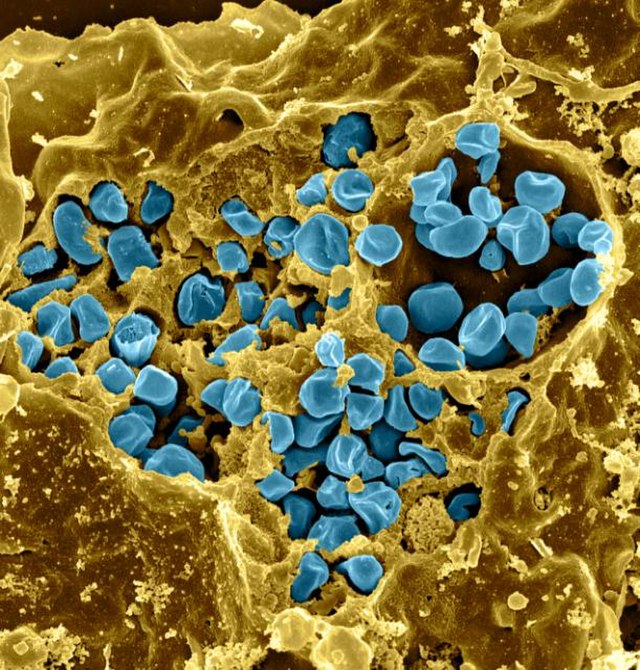 Figure: Macrophage infected with Francisella tularensis
Facultative Intracellular Bacteria
Facultative intracellular bacteria can live and multiply both inside and outside host cells, and they can be grown on ordinary laboratory media. They invade host cells when it gives them a selective advantage. Bacteria that can enter and survive within eukaryotic cells are shielded from humoral antibodies and can be eliminated only by a cellular immune response. However, these bacteria must possess specialized mechanisms to protect them from the harsh environment of the lysosomal enzymes encountered within the cells.
- Legionella pneumophila: It prefers the intracellular environment of macrophages for growth. Legionella induces its own uptake and blocks lysosomal fusion by an undefined mechanism.
- Mycobacterium tuberculosis: M. tuberculosis survives intracellularly by inhibiting phagosome-lysosome fusion.
- Listeria monocytogenes: escapes the phagosome into the cytoplasm before phagosome-lysosome fusion.
- Salmonella spp: very resistant to intracellular killing by phagocytic cells; survives inside a modified vacuole.
Other facultative intracellular bacteria are:
- Invasive Escherichia coli
- Neisseria spp.
- Brucella spp.
- Shigella spp.
- Francisella tularensis
How each intracellular organism survives inside the cell
The reason intracellular bacteria are so hard for the body to clear is that each has a specific trick for surviving inside a phagocyte, the very cell meant to destroy it. Learning these as a set of tactics makes them memorable, and it is exactly the kind of detail the organism lists alone do not give.
| Organism | Survival tactic inside the cell |
|---|---|
| Mycobacterium tuberculosis | Blocks the phagosome from fusing with the lysosome, so it is never exposed to killing enzymes |
| Listeria monocytogenes | Escapes out of the phagosome into the cytoplasm before the lysosome can fuse |
| Legionella pneumophila | Induces its own uptake and then blocks phagosome-lysosome fusion |
| Rickettsia | Breaks out of the phagosome by destroying its membrane |
| Coxiella burnetii | Does the opposite; it thrives inside the acidic phagolysosome rather than avoiding it |
| Salmonella | Survives inside a modified vacuole, resisting the phagocyte's killing |
Notice the pattern: most of these organisms solve the same problem, avoid being digested by the lysosome, but they solve it in different ways. Some block fusion, some escape before fusion, some destroy the compartment, and Coxiella uniquely turns the killing compartment into its home. These are intracellular-survival virulence factors; see an article on Bacterial Virulence Factors.
Obligate intracellular bacteria
Obligate intracellular bacteria cannot live or replicate outside a host cell at all, and they cannot be grown on artificial laboratory media. For e.g. Chlamydial cells are unable to carry out energy metabolism and lack many biosynthetic pathways, therefore they are entirely dependent on the host cell to supply them with ATP and other intermediates. Because of this dependency, chlamydiae were earlier thought to be a virus.
All viruses are obligate intracellular parasites.
Obligate intracellular bacteria cannot be grown in artificial media (agar plates/broths) in laboratories but requires viable eukaryotic host cells (eg. cell culture, embryonated eggs, susceptible animals).
Note: Pneumocystis jirovecii is not intracellular. It is an extracellular fungus that attaches to the type I alveolar epithelial cells lining the lung rather than living inside them. It is a common point of confusion.
Other obligate intracellular bacteria are:
- Mycobacterium leprae cannot be cultured in vitro; it is an obligate intracellular parasite.
- Coxiella burnetii: unusually, its metabolic activity increases in the acidic environment of the phagolysosome, so it thrives in the very compartment meant to kill it.
- Rickettsia destroys the phagosomal membrane, escaping into the cytoplasm. (Note: Rickettsia is generally classed as an obligate intracellular organism; it is included here only to illustrate the escape mechanism.)
Toxoplasma, Cryptosporidium, Plasmodium, Leishmania, Babesia, and Trypanosoma are obligate intracellular parasites.
How to Remember
Location decides the battle. Outside the cell, antibodies can reach the enemy (humoral immunity). Inside the cell, they cannot, so the body must send cell-mediated immunity to destroy the infected cell. Where the organism lives decides which weapon the body uses, and which antibiotic can reach it.
Facultative has a choice; obligate does not. Facultative intracellular bacteria can live inside cells but do not have to, and they grow on lab media. Obligate intracellular bacteria have no choice; they cannot live or be cultured outside a host cell. Memory hook: facultative = flexible, obligate = obligated.
Obligate intracellular bacteria "steal" from the host. The reason they cannot live alone is that they depend on the host cell for energy and building blocks. Chlamydia cannot make its own ATP, so it must live where ATP is provided. No host cell, no life.
The survival tricks, in one line: TB blocks the lock (no phagosome-lysosome fusion), Listeria breaks out (escapes to cytoplasm), Rickettsia smashes the wall (destroys the phagosome), Coxiella moves into the furnace (thrives in the acidic phagolysosome). Same goal, different tactics.
Key exam facts
| Fact | Detail and memory aid |
|---|---|
| Basis of classification | Where the organism replicates relative to host cells: extracellular, facultative intracellular, or obligate intracellular. |
| Extracellular defense | Cleared mainly by antibodies (humoral immunity); often pyogenic or toxin-mediated disease. |
| Intracellular defense | Cleared by cell-mediated immunity (cytotoxic T cells, activated macrophages); often granulomatous disease. |
| Facultative intracellular | Can live inside or outside cells; grows on lab media. Examples: M. tuberculosis, Salmonella, Listeria, Legionella, Brucella, Francisella, Shigella, invasive E. coli, Neisseria. |
| Obligate intracellular | Cannot grow on artificial media; needs living cells. Examples: Chlamydia, Rickettsia, Coxiella burnetii, Mycobacterium leprae. |
| Why obligates cannot be cultured | They depend on the host for energy (ATP) and metabolites; Chlamydia is the classic energy parasite. |
| Antibiotic implication | Drugs must penetrate host cells to kill intracellular organisms; poor-penetrating antibiotics fail despite in-vitro sensitivity. |
| Intracellular parasites (protozoa) | Toxoplasma, Plasmodium, Leishmania, Cryptosporidium, Babesia, Trypanosoma are obligate intracellular parasites. |
| All viruses | Obligate intracellular parasites, by definition. |
Where Students Get Confused
"Facultative and obligate intracellular are just two names for the same thing." They are opposites in one key respect. Facultative intracellular bacteria can live inside cells but do not have to, and they grow on ordinary lab media. Obligate intracellular bacteria cannot live outside a host cell and cannot be cultured on media at all. The lab test is the giveaway: if it grows on agar, it is not obligate intracellular.
"Pneumocystis jirovecii is an intracellular organism." It is not. Pneumocystis is an extracellular fungus that attaches to the surface of type I alveolar cells in the lung; it does not live inside them. This is a common error, including in some textbooks.
"Antibodies clear all bacterial infections." Antibodies work well against extracellular organisms, but they cannot enter host cells, so they cannot reach organisms hiding inside. Intracellular infections are cleared by cell-mediated immunity instead. This is why patients with weakened cellular immunity are especially prone to intracellular pathogens such as tuberculosis.
"If an antibiotic kills the organism in the lab, it will work in the patient." Not for intracellular organisms. The drug also has to penetrate the host cell to reach the bacterium. An antibiotic that cannot get inside the cell will fail even when the organism tests sensitive.
"Rickettsia is facultative because it has a survival mechanism." Having a survival trick does not make an organism facultative. Rickettsia cannot be grown on artificial media and needs living host cells, so it is obligate intracellular. Facultative status is about whether it can live outside cells, not about how cleverly it survives inside them.
Resumen en español: bacterias intracelulares y extracelulares
Las bacterias patógenas se clasifican según dónde se multiplican dentro del cuerpo.
Bacterias extracelulares. Viven y se multiplican fuera de las células del huésped, en la sangre y los líquidos de los tejidos. Los anticuerpos pueden alcanzarlas, por lo que el sistema inmunitario humoral es la defensa principal. Suelen causar enfermedad por toxinas o por inflamación con pus. Ejemplos: Staphylococcus aureus, Streptococcus pyogenes y Vibrio cholerae.
Bacterias intracelulares facultativas. Pueden vivir tanto dentro como fuera de las células, y sí crecen en medios de laboratorio. Entran en las células cuando les da una ventaja. La inmunidad celular es necesaria para eliminarlas. Ejemplos: Mycobacterium tuberculosis, Salmonella, Listeria, Legionella y Brucella.
Bacterias intracelulares obligadas. No pueden vivir fuera de la célula del huésped y no se pueden cultivar en medios artificiales, porque dependen de la célula para obtener energía (ATP) y nutrientes. Ejemplos: Chlamydia, Rickettsia, Coxiella burnetii y Mycobacterium leprae. Todos los virus son parásitos intracelulares obligados.
Por qué importa: el lugar donde vive el microorganismo decide qué parte del sistema inmunitario lo combate y qué antibióticos funcionan. Para eliminar una bacteria intracelular, el antibiótico debe penetrar dentro de la célula del huésped.
References
- Madigan, M. T., Bender, K. S., Buckley, D. H., Sattley, W. M., & Stahl, D. A. (2021). Brock Biology of Microorganisms (16th ed.). Pearson.
- Procop, G. W., Church, D. L., Hall, G. S., et al. (2017). Koneman's Color Atlas and Textbook of Diagnostic Microbiology (7th ed.). Wolters Kluwer.
- Murray, P. R., Rosenthal, K. S., & Pfaller, M. A. (2021). Medical Microbiology (9th ed.). Elsevier.
- Abbas, A. K., Lichtman, A. H., & Pillai, S. (2022). Cellular and Molecular Immunology (10th ed.). Elsevier. (Immunity to extracellular vs intracellular bacteria.)
Frequently Asked Questions
What is the difference between extracellular and intracellular bacteria?
What is the difference between extracellular and intracellular bacteria?
Extracellular bacteria live and multiply outside host cells, in blood and tissue fluid, where antibodies can reach them. Intracellular bacteria live inside host cells, shielded from antibodies, so the body must use cell-mediated immunity to clear them. Where the organism replicates decides how the body fights it and which antibiotics can reach it.
What does facultative intracellular mean?
What does facultative intracellular mean?
Facultative intracellular bacteria can live and multiply both inside and outside host cells. They enter cells when it gives them an advantage, but they do not depend on it, and they can be grown on ordinary laboratory media. Examples include Mycobacterium tuberculosis, Salmonella, Listeria, Legionella, and Brucella.
What is the difference between facultative and obligate intracellular bacteria?
What is the difference between facultative and obligate intracellular bacteria?
Facultative intracellular bacteria can live both inside and outside cells and grow on lab media. Obligate intracellular bacteria cannot live outside a host cell at all and cannot be cultured on artificial media, because they depend on the host cell for energy and nutrients. Chlamydia, Rickettsia, and Coxiella are obligate; M. tuberculosis and Salmonella are facultative.
What are examples of intracellular bacteria?
What are examples of intracellular bacteria?
Facultative intracellular examples: Mycobacterium tuberculosis, Salmonella, Listeria monocytogenes, Legionella, Brucella, Francisella, Shigella. Obligate intracellular examples: Chlamydia, Rickettsia, Coxiella burnetii, and Mycobacterium leprae. All viruses are also obligate intracellular parasites.
Why can obligate intracellular bacteria not be grown in the lab?
Why can obligate intracellular bacteria not be grown in the lab?
They depend on the host cell for energy and building blocks that they cannot make themselves. Chlamydia, for example, cannot produce its own ATP, so it must live inside a cell that supplies it. Without a living host cell, they cannot survive, so they are grown in cell culture, embryonated eggs, or animals instead of on agar plates.
Why does it matter whether a pathogen is intracellular or extracellular?
Why does it matter whether a pathogen is intracellular or extracellular?
Because it determines how the body fights the infection and how it is treated. Extracellular organisms are cleared by antibodies and often cause pus-forming or toxin-mediated disease. Intracellular organisms are cleared by cell-mediated immunity, often cause granulomas, and require antibiotics that can penetrate host cells to be effective.

Tankeshwar Acharya, MSc (Medical Microbiology)
Tankeshwar Acharya is an Assistant Professor in the Department of Microbiology at Patan Academy of Health Sciences (PAHS), Nepal, where he has been teaching and practicing clinical microbiology for over 14 years. He is the founder of Microbe Online, one of the leading free microbiology education resources on the web, covering bacteriology, mycology, parasitology, immunology, and clinical laboratory diagnostics written from direct experience in both the classroom and the diagnostic laboratory.
Comments
No comments yet. Be the first to share your thoughts.
Leave a comment
All comments are reviewed before they appear.