
Nutrient Agar: Composition, Preparation, and Why It's Still Used Even Though TSA Replaced It Clinically
The original general-purpose culture medium nearly every richer medium on this site is built from, why clinical labs mostly moved on to tryptic soy agar, and where nutrient agar is still the right choice today.
The recipe every other medium on this site started from
Blood agar, chocolate agar, MacConkey agar, tryptic soy agar, every enriched or selective medium in clinical bacteriology is a variation on the same basic starting point: a protein digest, a nutrient extract, salt, and a gelling agent. Add blood, and a medium can support fastidious organisms. Add bile salts and a dye, and it becomes selective and differential for Enterobacteriaceae. Add three sugars and an iron source, and it becomes a biochemical identification tool.
Nutrient agar is that starting point, almost unchanged. It's about as close as modern bacteriology gets to the earliest general-purpose media used in the decades right after Robert Koch's original work on solid culture.
In most clinical diagnostic laboratories today, nutrient agar itself has quietly been replaced. Tryptic soy agar, built from richer casein and soy digests instead of simple peptone and beef extract, supports a wider range of organisms and has become the default general-purpose medium in most clinical bacteriology labs. So why does nutrient agar still show up constantly, in teaching laboratories, in environmental and food-testing labs, in water and dairy quality testing? Because for organisms that aren't fastidious, and in settings where cost and shelf stability matter as much as maximizing pathogen recovery, the simplest formula that still works is often exactly the right one.
Nutrient agar media is used as a general-purpose medium to grow a wide variety of non-fastidious microorganisms. It consists of peptone, beef extract, and agar. This relatively simple formulation provides the nutrients necessary for the replication of a large number of non-fastidious microorganisms.
This agar/broth is used for the cultivation and maintenance of non-fastidious organisms and the enumeration of organisms in water, sewage, dairy products, feces, and other materials.
What Kind of Medium Is Nutrient Agar?
Nutrient agar is a basal, general-purpose medium, and specifically none of the following:
- Not enriched. It contains no blood, serum, or other growth-factor-rich additive, which is exactly why fastidious organisms like Haemophilus or Neisseria won't grow on it.
- Not selective. It contains no inhibitory agents (bile salts, dyes, antibiotics), so it doesn't suppress any group of organisms in favor of another.
- Not differential. It contains no pH indicator or other system to distinguish one organism's colonies from another's by appearance.
It simply supports growth, for any non-fastidious organism capable of using peptone and beef extract as its carbon, nitrogen, and energy source. This is precisely why it's the right medium for general cultivation and maintenance, and the wrong medium whenever a lab actually needs to select for, or distinguish between, specific organisms, which is exactly why MacConkey agar, blood agar, and other clinical media all add something nutrient agar deliberately leaves out.
Composition of Nutrient Agar
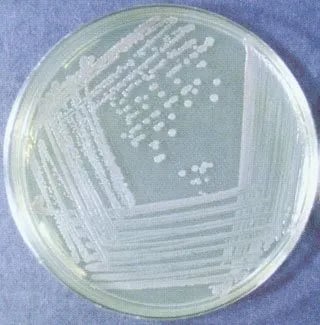 Figure: Nutrient Agar
| Ingredients | Amount (gm/L) |
|---|---|
| Beef extract | 3.0 gm |
| Peptone | 5.0 gm |
| Sodium chloride | 5.0 gm |
| Agar | 15.0 gm |
| Distilled water | 1000 mL |
Final pH 6.8 ± 0.2.
Composition of nutrient broth: Nutrient broth contains all these ingredients except agar.
Characteristics of the components used
- Beef extract is an aqueous extract of lean beef tissues. It contains water-soluble substances of animal tissue, which include carbohydrates, organic nitrogen compounds, water-soluble vitamins, and salts.
- Peptone is made by digesting proteinaceous materials e.g., meat, casein, gelatin, using acids or enzymes. Peptone is the principal source of organic nitrogen and may contain carbohydrates or vitamins. Depending upon the nature of protein and method of digestion, peptones differ in their constituents, differing in their ability to support the growth of bacteria.
- Agar is a complex carbohydrate obtained from certain marine algae. It is used as a solidifying media agent and has no nutritive value. Agar gels when the temperature of media reaches 45°C and melts when the temperature reaches 95 °C.
Preparation
Nutrient Agar
Both agar and broth are available from most suppliers of culture media in powdered (free-flowing, homogeneous) form.
- Dissolve the dehydrated medium in the appropriate volume of distilled water i.e., 23 gm dehydrated nutrient agar (see the manufacturer’s instruction) in 1000 mL distilled water.
- Heat with frequent agitation and boil for 1 minute to completely dissolve the powder.
- Sterilize the medium by autoclaving (121°C for 15 min)
- Dispense the medium into tubes(i.e. 3 ml to make slopes, 5 ml to make deeps)or plates.
- Leave the agar medium to solidify.
- Date the medium and give it a batch number.
- Store in a cool dark place.
Shelf life: Up to 2 years, providing there is no change in the appearance of the medium to suggest contamination or deterioration.
pH of medium: The pH of this agar should be within the range of pH 6.6-7.0 at room temperature.
Nutrient Broth
Prepare from ready to use dehydrated nutrient broth powder. The contents of nutrient broth are the same as those for nutrient agar except that the agar is omitted. Its preparation and storage are the same as described above.
Semisolid Nutrient Agar
- Mix 0.75 g nutrient agar and 1.3 g nutrient broth in 100 ml distilled water, and heat to 100°C to dissolve the ingredients (place the flask in a boiling water bath).
- Dispense the medium in 5–7 ml amounts in screw-cap bottles.
- Sterilize by autoclaving (with caps loosened) at 121°C for 15 minutes.
- When cool, tighten the bottle caps. Date the medium and give it a batch number.
- Store as described previously for nutrient agar.
The amount of medium mentioned in this procedure is adequate to make about 20 bottles. Please manage the amount accordingly, based on your requirements.
Uses of Nutrient Agar/broth
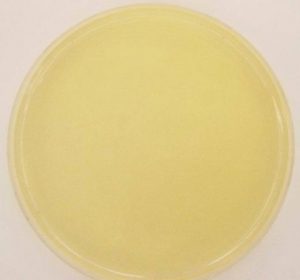 Figure: Un-inoculated Nutrient Agar
- For the enumeration of organisms in water, sewage, dairy products, feces, and other materials.
- For the cultivation and maintenance of non-fastidious species.
Why Doesn't My Nutrient Agar Solidify?
If prepared nutrient agar fails to solidify, or takes unusually long, the most common causes are:
- Agar concentration error. Agar is hygroscopic; it absorbs moisture from the air over time. A powder that's been open and exposed can weigh out to less agar-equivalent than the recipe assumes, even at the "correct" gram measurement.
- Incomplete dissolution before autoclaving. If the powder wasn't fully dissolved during the initial boiling step, undissolved agar granules will never gel properly, regardless of how long the autoclave cycle runs afterward.
- Degraded or excessively autoclaved agar. Repeated or prolonged autoclaving can break down the polysaccharide structure responsible for gelling.
Clarifying "Sterilize" vs. "Autoclave"
These aren't two separate, sequential steps. Autoclaving the medium at 121°C for 15 minutes is the sterilization step. There's no additional "warm first, then autoclave" stage required in the standard procedure; the autoclave cycle itself, reaching and holding 121°C under pressure for the specified time, is what achieves sterility.
Quality Control
- The color of prepared nutrient agar will be light amber, very slightly to slightly opalescent
- pH of the prepared media should be 6.8 ± 0.2.
- Media should be checked for their performance using stable, typical control cultures. When the prepared media are inoculated with Escherichia coli (ATCC 25922), Pseudomonas aeruginosa (ATCC 27853) and incubate at 35 ± 2°C for 18-48 hours, media should show good growth of these organisms.
Key exam facts in one table
| Fact | Detail |
|---|---|
| Classification | Basal, general-purpose medium — not enriched, not selective, not differential |
| Core ingredients | Peptone, beef extract, sodium chloride, agar |
| Final pH | 6.8 ± 0.2 |
| Shelf life | Up to 2 years if unopened and uncontaminated |
| QC organisms | E. coli (ATCC 25922), P. aeruginosa (ATCC 27853); both should show good growth |
| Modern clinical status | Largely superseded by tryptic soy agar in clinical diagnostic labs |
| Where it's still standard | Environmental, food, water, and dairy microbiology; teaching laboratories; general culture maintenance |
Where Students Get Confused
- Is nutrient agar enriched, selective, or differential? No to all three. It's a basal, general-purpose medium; this is precisely what real readers of this article have asked in the comments without getting an answer.
- Treating "sterilize" and "autoclave" as two separate steps. Autoclaving at 121°C for 15 minutes is itself the complete sterilization process; no separate pre-warming stage is required.
- Assuming nutrient agar is still the clinical standard. In most modern clinical bacteriology labs, tryptic soy agar has replaced it as the default general-purpose medium; nutrient agar's main modern use is in environmental, food, and teaching contexts.
References
- Madigan, M. T., Bender, K. S., Buckley, D. H., Sattley, W. M., & Stahl, D. A. (2018). Brock Biology of Microorganisms (15th ed.). Pearson.
- Koneman, E. W. et al. Color Atlas and Textbook of Diagnostic Microbiology (5th ed.).

Tankeshwar Acharya, MSc (Medical Microbiology)
Tankeshwar Acharya is an Assistant Professor in the Department of Microbiology at Patan Academy of Health Sciences (PAHS), Nepal, where he has been teaching and practicing clinical microbiology for over 14 years. He is the founder of Microbe Online, one of the leading free microbiology education resources on the web, covering bacteriology, mycology, parasitology, immunology, and clinical laboratory diagnostics written from direct experience in both the classroom and the diagnostic laboratory.