
Bacterial Transformation: Steps, Types, and Clinical Significance
How competent bacteria pick up free DNA and change identity, from Griffith's 1928 pneumonia mystery to lab-based E. coli cloning. Steps, natural vs. artificial types, and exam notes.
In 1928, British bacteriologist Frederick Griffith was trying to understand why some strains of Streptococcus pneumoniae caused fatal pneumonia in mice while others were completely harmless. He had two strains: a smooth (S) strain, encapsulated and lethal, and a rough (R) strain, unencapsulated and harmless.
Griffith ran a simple set of experiments. Mice injected with the live R strain survived. Mice injected with the live S strain died. Then he tried something that should have been safe: he killed the S strain with heat and injected the dead bacteria alone. The mice survived, as expected; dead bacteria shouldn't cause disease.
But then he mixed the heat-killed S strain with the live, harmless R strain and injected the mixture. The mice died. And when he cultured blood from the dead mice, he recovered live, fully virulent S strain bacteria.
 Something from the dead bacteria had reached into the living ones and rewritten what they were capable of. Griffith called it a "transforming principle." Sixteen years later, Avery, MacLeod, and McCarty would identify that principle as DNA itself, one of the experiments that proved DNA was the molecule of heredity.
That transferable "something" is what this article is about: bacterial transformation, the process by which bacteria pick up naked DNA from their environment and permanently change their own genetic makeup. It is not a historical curiosity. The same mechanism today lets Streptococcus pneumoniae swap capsule genes to dodge vaccine immunity, lets Neisseria gonorrhoeae constantly reshuffle its surface antigens, and is the exact lab technique BSc/MSc microbiology students use every time they transform E. coli with a plasmid in a cloning practical.
Bacterial transformation is one of the three mechanisms of horizontal gene transfer (HGT) in bacteria, alongside conjugation (transfer of F plasmid; transfer of chromosomal DNA by Hfr strains) and transduction (generalized transduction; specialized transduction). Unlike conjugation and transduction, transformation needs no direct cell-to-cell contact and no viral courier; the recipient cell simply picks up free DNA on its own.
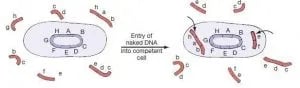 ### What is bacterial transformation
Transformation is the uptake and heritable incorporation of free (naked) extracellular DNA by a bacterial cell, resulting in a permanent change to that cell's genotype.
- DNA is released into the environment when a donor bacterial cell dies and lyses.
- A recipient cell takes up this free DNA from its surroundings.
- Not every bacterium can do this; only competent bacteria can.
A bacterium capable of taking up free DNA and undergoing transformation is called a competent bacterium.
Naturally competent pathogenic bacteria include:
- Haemophilus influenzae
- Streptococcus pneumoniae
- Neisseria gonorrhoeae and Neisseria meningitidis
Why this matters clinically: natural competence is not a lab curiosity in these three genera; it is a real driver of disease behavior.
- S. pneumoniae strains can pick up capsule-switching genes from other pneumococci by transformation, changing their capsular serotype. This lets a strain escape antibody immunity built against a different serotype, including serotypes targeted by pneumococcal conjugate vaccines.
- S. pneumoniae also acquires mosaic, low-affinity penicillin-binding protein (PBP) genes from related streptococci through transformation, which is the main mechanism behind penicillin-resistant pneumococci — not a plasmid, not a mutation, but transformation.
- N. gonorrhoeae uses natural transformation to constantly reshuffle the genes encoding its surface pilin protein, a major reason infection does not reliably produce lasting immunity and reinfection is common.
Natural transformation: step-by-step mechanism
In this worked example, an ampicillin-sensitive recipient cell becomes ampicillin-resistant by taking up an ampicillin-resistance gene through transformation.
Step 1 — DNA binding. Competent bacteria display DNA-binding receptors on their cell surface. Free, double-stranded donor DNA in the surrounding environment binds to these receptors.
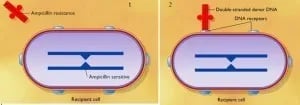 Step 2 — DNA uptake. As the bound DNA is pulled into the cell, only one strand of the donor DNA actually crosses into the cytoplasm. The other strand is degraded by nucleases at the cell surface.
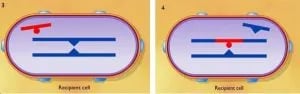 Step 3 — Homologous recombination. Inside the recipient cell, the incoming single strand of donor DNA is aligned against the recipient's own chromosome at a matching (homologous) sequence and is integrated in place of the corresponding recipient strand, forming a heteroduplex, a DNA molecule with one donor strand and one original recipient strand.
Step 4 — Resolution at replication. When this heteroduplex chromosome replicates, the two strands separate and are each copied independently. One daughter cell inherits the donor sequence (now ampicillin-resistant); the other inherits the original recipient sequence (still ampicillin-sensitive).
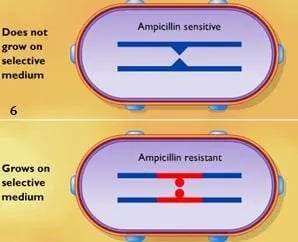 Step 5 — Selection. In the lab, this mixed population is grown on a medium containing ampicillin. Only the transformed, resistant cells survive and grow, allowing them to be identified and isolated.
Mnemonic for the mechanism steps — "B.U.R.R.S."
- Bind — donor DNA binds to receptors on the competent cell surface
- Uptake — one strand enters, the other is degraded
- Recombine — the single strand integrates into the recipient chromosome (heteroduplex forms)
- Replicate — the heteroduplex splits at replication into resistant and sensitive daughter cells
- Select — the lab (or nature) selects for the transformed phenotype
Natural vs. artificial transformation
Only a small number of bacterial genera are naturally competent. Everything else; including the E. coli used in most teaching and research labs has to be made competent artificially. This distinction matters both for exams and for anyone running a cloning practical.
| Natural transformation | Artificial transformation | |
|---|---|---|
| Occurs in | A limited set of naturally competent genera (Haemophilus, Streptococcus, Neisseria, Bacillus, Acinetobacter) | Any bacterial species, induced in the lab |
| Competence source | Bacterium's own competence genes, switched on under specific physiological conditions | Artificially induced by the experimenter |
| Common lab methods | Not applicable — happens without intervention | Heat shock: cells treated with CaCl₂ (which neutralizes charge repulsion between DNA and the membrane) are briefly heat-shocked at 42°C to drive plasmid DNA across the membrane; electroporation: a brief electric pulse creates transient pores in the membrane, allowing DNA entry |
| Typical DNA taken up | Chromosomal fragments from lysed relatives | Plasmid DNA (used for cloning and genetic engineering) |
| Clinical/exam relevance | Explains serotype switching, PBP mosaic genes, antigenic variation in the genera above | The routine technique behind recombinant DNA work, vaccine and insulin production, and every plasmid-cloning step done in a microbiology practical |
Why competence matters clinically?
Think of the mice in Griffith's experiment. The dead bacteria couldn't hurt anyone on their own; the danger was in what their DNA did once a living, competent cell picked it up. That is exactly what happens today when a penicillin-sensitive pneumococcus becomes resistant, or a gonococcus dodges the immune system; a competent cell reads DNA it finds lying around and rewrites itself.
Key exam facts in one table
| Fact | Detail |
|---|---|
| Definition | Uptake of free (naked) extracellular DNA by a bacterial cell, causing a heritable genotype change |
| Discovered by | Frederick Griffith, 1928, using Streptococcus pneumoniae in mice (transforming principle later identified as DNA by Avery, MacLeod, McCarty, 1944) |
| Requires cell contact? | No — the only one of the three HGT mechanisms that doesn't |
| Who can do it naturally | Only "competent" bacteria: Haemophilus, Streptococcus, Neisseria, Bacillus, Acinetobacter |
| DNA strand that integrates | Single strand only — the complementary strand is degraded during uptake |
| Mechanism of integration | Homologous recombination, forming a transient heteroduplex chromosome |
| Two types | Natural (a few genera, no lab intervention) vs. artificial (any species, CaCl₂/heat shock or electroporation) |
| Clinical example 1 | S. pneumoniae capsule-switching to escape vaccine-induced immunity |
| Clinical example 2 | S. pneumoniae mosaic PBP genes → penicillin resistance (not plasmid-mediated) |
| Clinical example 3 | N. gonorrhoeae pilin antigenic variation → repeated infection, no durable immunity |
| Lab/exam relevance | Artificial transformation (heat shock/electroporation) is the basis of routine plasmid cloning in molecular biology practicals |
Where Students Get Confused
- "Transformation" in bacteriology vs. "transformation" in cancer biology. In oncology, "malignant transformation" describes a normal cell becoming cancerous; a completely unrelated meaning. In bacteriology, transformation always means DNA uptake from the environment.
- Transformation vs. transfection. Transfection is the term used for introducing foreign DNA into eukaryotic cells; transformation is the bacterial (and plant/fungal) equivalent. Using them interchangeably is a common exam-writing error.
- Competence ≠ resistance ≠ virulence. A bacterium being "competent" only means it is physically capable of taking up DNA. It says nothing about whether that bacterium is already resistant or virulent; those are outcomes that may or may not follow a successful transformation event.
- Which DNA strand survives. Students often assume the whole double-stranded donor DNA enters the cell. Only one strand actually crosses into the cytoplasm; the other is degraded before entry.
- Natural competence is the exception, not the rule. Most bacteria used in labs (including standard E. coli strains) are not naturally competent and must be made artificially competent; this is why cloning protocols include a CaCl₂/heat-shock or electroporation step at all.
References
- Lorenz, M. G., & Wackernagel, W. (1994). Bacterial gene transfer by natural genetic transformation in the environment. Microbiological Reviews, 58(3), 563–602. https://doi.org/10.1128/mr.58.3.563-602.1994
- Gingold, E. B. (1985). Bacterial transformation. Methods in Molecular Biology (Clifton, N.J.), 2, 237–240. https://doi.org/10.1385/0-89603-064-4:237
- Griffith, F. (1928). The significance of pneumococcal types. Journal of Hygiene, 27(2), 113–159. https://doi.org/10.1017/S0022172400031879
Frequently Asked Questions
What is bacterial transformation?
Who discovered bacterial transformation?
What is a competent bacterium?
Which bacteria are naturally competent?
What is the difference between natural and artificial transformation?
How does bacterial transformation cause antibiotic resistance?
How is bacterial transformation different from conjugation and transduction?
Why do lab strains of E. coli need to be made "competent" artificially?

Tankeshwar Acharya, MSc (Medical Microbiology)
Tankeshwar Acharya is an Assistant Professor in the Department of Microbiology at Patan Academy of Health Sciences (PAHS), Nepal, where he has been teaching and practicing clinical microbiology for over 14 years. He is the founder of Microbe Online, one of the leading free microbiology education resources on the web, covering bacteriology, mycology, parasitology, immunology, and clinical laboratory diagnostics written from direct experience in both the classroom and the diagnostic laboratory.