
Bacterial Culture Media: Classification, Types, Uses
A complete guide to bacteriological culture media: classification by composition, consistency, and functional use, with examples of 35+ media, their selective agents, and clinical applications.
Midstream urine from a patient with suspected UTI is typically plated onto either CLED agar (to enumerate and color-differentiate uropathogens) or a combination of MacConkey agar (to select for Gram-negative organisms and show lactose fermentation), and blood agar (to catch any Gram-positive organisms missed by the selective media).
Each medium is asking a different question of the same specimen. CLED asks: how many organisms are present, and do they ferment lactose? MacConkey asks: are there Gram-negative enteric pathogens, and what is their lactose metabolism? Blood agar asks: is there anything fastidious that the selective media would have suppressed?
This battery of media is not chosen not randomly but deliberately, based on the likely pathogens and the biology of the specimen; is the foundation of diagnostic microbiology. Understanding how culture media are classified and why different media are used for different purposes is not an academic exercise. It is the logic that determines whether a pathogen is found or missed.
Overview
Bacterial culture media are nutrient-containing preparations that support the growth of microorganisms under controlled laboratory conditions. Without culture media, isolating, identifying, and studying bacteria would be impossible; making them the single most fundamental tool in any microbiology laboratory.
A culture medium works by providing everything a bacterial cell needs to survive and multiply: a carbon and energy source, a nitrogen source, minerals, water, and the correct pH. When these requirements are met, a single bacterial cell can divide repeatedly until a visible colony (containing millions of cells) appears on the surface of the medium.
Not all bacteria can be grown in culture. Some bacteria cannot be grown on any artificial (cell-free) medium. Rickettsia spp. and Chlamydia trachomatis are true obligate intracellular parasites: they require the machinery of a living host cell to replicate. Treponema pallidum (syphilis) and Mycobacterium leprae (leprosy) are not obligate intracellular organisms, but they remain uncultivable on standard laboratory media and are maintained in animal models instead. In all these cases, diagnosis relies on serology, microscopy, or molecular methods rather than culture.
For all other bacteria, the choice of culture medium depends on three questions:
- What is the physical form needed? (solid, semisolid, or liquid)
- What is the chemical composition? (defined or complex)
- What is the purpose? (general growth, selective isolation, differentiation, transport, or anaerobic culture)
These three questions form the basis of the standard classification of bacteriological culture media.
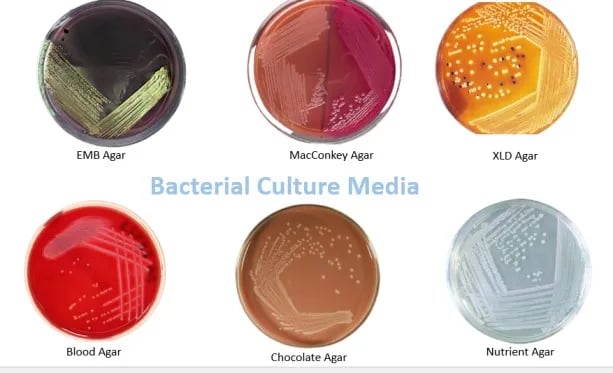 Figure: Common bacterial culture media
Based on Composition
Culture media are divided into two classes based on their chemical composition:
Defined (Synthetic) Media
Defined media are prepared by adding precise, known amounts of highly purified inorganic or organic chemicals to distilled water. Because only pure, characterized ingredients are used, the exact chemical composition of every batch is known and reproducible.
Defined media are essential for research applications where the nutritional environment must be precisely controlled for example, studying the effect of a single nutrient on bacterial growth, or investigating metabolic pathways. However, they are rarely used in routine clinical microbiology because many clinically important bacteria have complex nutritional requirements that are difficult to meet with purely defined ingredients.
Example: M9 minimal medium (used in research), Davis-Mingioli medium
Complex (Non-Synthetic) Media
Complex media are prepared using digests of biological materials — casein (from milk), beef extract, soybeans (tryptic soy broth), or yeast extract. Because these ingredients are biological in origin and not fully characterized, the exact chemical composition of complex media is not precisely known and can vary slightly between batches.
Despite this variability, complex media are the workhorses of clinical and diagnostic microbiology. They are rich in amino acids, vitamins, and growth factors that support the growth of a wide range of bacteria, including fastidious organisms.
Examples: Nutrient agar, blood agar, MacConkey agar, chocolate agar, brain-heart infusion broth
| Feature | Defined media | Complex media |
|---|---|---|
| Composition | Precisely known | Not fully characterized |
| Ingredients | Pure chemicals | Biological digests (meat, yeast, casein) |
| Reproducibility | Exact batch-to-batch | Slight batch variation |
| Primary use | Research, metabolic studies | Clinical and diagnostic microbiology |
| Fastidious organism support | Limited | Excellent |
| Examples | M9 minimal medium | Blood agar, nutrient agar, MacConkey agar |
Based on Consistency
Culture media are divided into three types; solid medium, semi-solid medium, and liquid medium, based on consistency. The percentage of agar used in the culture media determines the consistency of the medium.
Solid Medium
It contains agar at a concentration of 1.5-2.0% or some other primarily inert solidifying agent. Solid medium has a physical structure and allows bacteria to grow in physically informative or useful ways (e.g., as colonies or in streaks). MacConkey agar, chocolate agar, nutrient agar, blood agar, etc., are some examples of solid culture media.
Uses of solid culture media
- For isolating bacteria from various types of specimen
- For determining the colony characteristics of the isolate (such as colony morphology, hemolysis, pigment production, etc.
- For performing antimicrobial susceptibility testing using the Kirby Bauer disc diffusion method
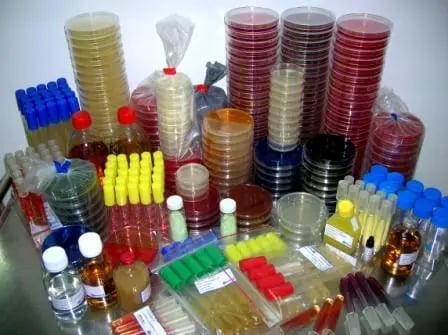 Figure: Different types of Bacteriological culture media used in Microbiology lab
Semisolid Medium
This type of culture media are prepared with agar at 0.5% or less concentrations. Semisolid medium has a soft custard-like consistency and is helpful for the cultivation of microaerophilic bacteria or for determining bacterial motility. Motility test medium, Stuart’s and Amies transport media, etc., are semisolid media.
Liquid (Broth) Medium
These media contain specific amounts of nutrients but don’t have a trace of gelling agents such as gelatin or agar. Commonly used liquid media in the lab are; nutrient broth, glucose broth, brain-heart infusion (BHI) broth, alkaline peptone water (APW), tryptic soy broth (TSB), and selenite F broth. Broth medium serves various purposes such as propagation of many organisms, fermentation studies, and various other tests.
Uses of liquid culture media
- To grow bacteria for inoculum production for antibiogram testing
- To revive bacteria from lyophilized or stock culture
- To study metabolism, toxin, and enzyme production
- To enrich and/or transport clinical material
Bacteria with complex nutritional requirements are called fastidious bacteria. Special nutritional supplements must be added to culture media to grow such bacteria. Bacteria having relatively basic and straightforward nutritional requirements are easy to grow in a lab, they are known as nonfastidious bacteria.
Based on Functional Use
Many special-purpose media are needed to facilitate the recognition, enumeration, and isolation of certain types of bacteria. To meet these needs, numerous media are available.
Based on their practical use, there are seven types of standard culture media in microbiology laboratories. They are; general-purpose (basal) media, enriched media, selective or enrichment media, differential or indicator media, transport media, anaerobic media, and assay media.
General-Purpose Media
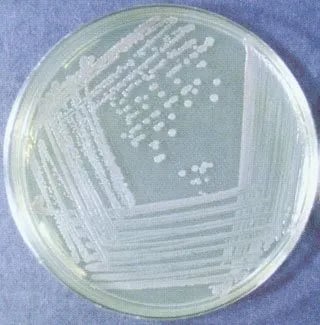 Figure: Nutrient Agar
Basal media, also called general-purpose media, are simple media that support the growth of most non-fastidious bacteria. Peptone Water, nutrient broth, and nutrient agar(NA) are basal media. These media are generally used for the primary isolation of microorganisms.
Enriched Media

Adding extra nutrients, such as blood, serum, egg yolk, etc., to the basal medium makes an enriched medium. Enriched media are used to grow nutritionally exacting (fastidious) bacteria. Blood agar, chocolate agar, Loeffler’s serum slope, etc., are a few examples of enriched media. Blood agar is prepared by adding 5-10% (by volume) blood to a blood agar base.
Chocolate agar is made by gently heating blood agar to about 80°C. Heating lyses the red cells to release X factor (hemin) and V factor (NAD), and also inactivates NADases in the medium that would otherwise destroy the V factor. This is why chocolate agar, not plain blood agar, is required for Haemophilus.
Selective and Enrichment Media
These media are designed to inhibit unwanted commensal or contaminating bacteria and help to recover pathogens from a mixture of bacteria. While selective media are agar-based, enrichment media are liquid. Both these media serve the same purpose. Any agar media can be selective by adding specific inhibitory agents that don’t affect the pathogen of interest. Various approaches to making a medium selective include addition of antibiotics, dyes, chemicals, alteration of pH, or a combination of these.
If you are interested to know about fungal culture media; you can find this post useful: Common Fungal Culture Media: Their Uses
Selective Media
Principle: Differential growth suppression
Selective medium is designed to suppress some microorganisms’ growth while allowing others’ growth. Selective medium is an agar-based (solid) medium so that individual colonies may be isolated.
Examples of selective media include
- Thayer Martin Agar used to recover Neisseria gonorrhoeae contains antibiotics; vancomycin, colistin, and nystatin.
- Mannitol Salt Agar and Salt Milk Agar used to recover S. aureus contains 10% NaCl.
- Potassium tellurite medium used to recover C. diphtheriae contains 0.04% potassium tellurite.
- MacConkey’s Agar used for Enterobacteriaceae members, contains bile salt that inhibits most gram-positive bacteria.
- Pseudosel Agar (cetrimide agar) used to recover Pseudomonas aeruginosa contains cetrimide (antiseptic agent).
- Crystal Violet Blood Agar used to recover S. pyogenes contains 0.0002% crystal violet.
- Lowenstein Jensen Medium used to recover M. tuberculosis is made selective by incorporating malachite green.
- Wilson and Blair’s Agar for recovering S. typhi is rendered selective by the addition of dye brilliant green.
- Selective media such as TCBS Agar for isolating Vibrio cholerae from fecal specimens have elevated pH (8.5-8.6), inhibiting most other bacteria.
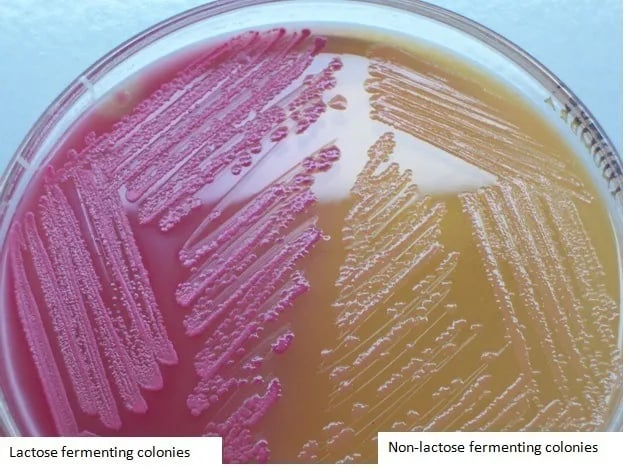 Figure: Lactose fermenting (pink) and non-lactose-fermenting (colorless/pale) colonies in MacConkey Agar
Enrichment Media
The enrichment medium increases the relative concentration of specific microorganisms in the culture before plating on a solid selective medium. Unlike selective media, enrichment culture is typically used as a broth medium. Enrichment media are liquid media that also serves to inhibit commensals in the clinical specimen. Selenite F broth, tetrathionate broth, and alkaline peptone water (APW) recover pathogens from fecal samples.
Differential/Indicator Media
Certain media are designed to recognize different bacteria based on their colony color. Various approaches include incorporating dyes, metabolic substrates, etc., so those bacteria that utilize them appear as differently colored colonies. Such media are called differential media or indicator media. Differential media allow the growth of more than one microorganism of interest but with morphologically distinguishable colonies.

Examples of differential media include:
1. Mannitol salts agar (mannitol fermentation = yellow)
2. Blood agar (various kinds of hemolysis i.e., α, β and γ hemolysis)
3. MacConkey agar (lactose fermenters, pink colonies whereas, non-lactose fermenter produces pale or colorless colonies.
4. TCBS (Vibrio cholerae produces yellow colonies due to fermentation of sucrose)
Transport Media
Clinical specimens must be transported to the laboratory immediately after collection to prevent overgrowth of contaminating organisms or commensals and maintain the viability of the potential pathogens. This can be achieved by using transport media. Such media prevent drying (desiccation) of a specimen, maintain the pathogen to commensal ratio, and inhibit the overgrowth of unwanted bacteria.
Some of these media (Stuart’s & Amie’s) are semi-solid. The addition of charcoal serves to neutralize inhibitory factors.
- Cary Blair transport medium and Venkatraman Ramakrishnan (VR) medium transport feces from suspected cholera patients.
- Sach’s buffered glycerol saline is used to transport feces from patients suspected of suffering from bacillary dysentery.
- Pike’s medium is used to transport streptococci from throat specimens.
Anaerobic Media
Anaerobic bacteria need special media for growth because they need low oxygen content, reduced oxidation-reduction potential, and extra nutrients.

Media for anaerobes may have to be supplemented with nutrients like hemin, and vitamin K. Such media may also have to be reduced by physical or chemical means. Boiling the medium serves to expel any dissolved oxygen. Adding 1% glucose, 0.1% thioglycollate, 0.1% ascorbic acid, 0.05% cysteine, or red hot iron filings can reduce the medium. Before using, the medium must be boiled in a water bath to expel any dissolved oxygen and then sealed with sterile liquid paraffin.
Robertson Cooked Meat (RCM)
medium commonly used to grow Clostridium spp contains a 2.5 cm column of bullock heart meat and 15 ml of nutrient broth. Thioglycollate broth contains sodium thioglycollate, glucose, cystine, yeast extract, and casein hydrolysate.
Methylene blue or resazurin is an oxidation-reduction potential indicator incorporated into the medium. Under the reduced conditions, methylene blue is colorless.
Assay Media
These media are used to assay vitamins, amino acids, and antibiotics. E.g., antibiotic assay media are used for determining antibiotic potency by the microbiological assay technique. Other types of medium include;
- Media for enumeration of bacteria,
- Media for characterization of bacteria,
- Maintenance media etc.
Culture Media Reference Guide
| Medium | Category | Primary organism(s) targeted | Key selective/differential feature |
|---|---|---|---|
| Nutrient agar | General purpose | Non-fastidious organisms | None — supports broad growth |
| Brain-heart infusion (BHI) agar/broth | General purpose / Enriched | Fastidious and non-fastidious organisms | Rich nutrients support demanding organisms |
| Blood agar (5% sheep blood) | Enriched / Differential | Fastidious organisms; streptococci | Alpha, beta, gamma hemolysis patterns |
| Chocolate agar (lysed blood agar) | Enriched | Haemophilus spp., Neisseria spp. | Lysed RBCs release X and V factors |
| Loeffler's serum slope | Enriched | Corynebacterium diphtheriae | Enhances metachromatic granule formation |
| MacConkey agar | Selective / Differential | Gram-negative enteric bacilli | Bile salts inhibit gram-positives; lactose fermenters produce pink colonies |
| MacConkey sorbitol agar | Selective / Differential | E. coli O157:H7 | Sorbitol replaces lactose; O157:H7 does not ferment sorbitol (colorless) |
| Mannitol salt agar (MSA) | Selective / Differential | Staphylococcus aureus | 10% NaCl inhibits most organisms; mannitol fermentation = yellow halo |
| Thayer-Martin agar | Selective | Neisseria gonorrhoeae, N. meningitidis | Vancomycin + colistin + nystatin inhibit normal flora |
| New York City medium | Selective | Neisseria gonorrhoeae | Similar to Thayer-Martin; supports gonococci from mixed specimens |
| Lowenstein-Jensen (LJ) medium | Selective | Mycobacterium tuberculosis | Malachite green inhibits non-mycobacterial organisms |
| Cetrimide agar (Pseudosel) | Selective | Pseudomonas aeruginosa | Cetrimide (antiseptic) inhibits most other organisms |
| TCBS agar | Selective / Differential | Vibrio cholerae, V. parahaemolyticus | Elevated pH (8.5–8.6); sucrose fermenters (cholera) = yellow colonies |
| Salmonella-Shigella (SS) agar | Selective / Differential | Salmonella spp., Shigella spp. | Bile salts + brilliant green inhibit coliforms; H₂S producers form black colonies |
| Hektoen enteric (HE) agar | Selective / Differential | Salmonella spp., Shigella spp. | Better than SS agar for Shigella; bile salts + indicators differentiate colonies |
| Xylose lysine desoxycholate (XLD) agar | Selective / Differential | Salmonella spp., Shigella spp. | Salmonella = red colonies with black centers; Shigella = red colonies |
| Eosin methylene blue (EMB) agar | Selective / Differential | Gram-negative enteric bacilli | E. coli = metallic green sheen; inhibits gram-positives |
| Wilson and Blair's agar | Selective | Salmonella typhi | Brilliant green dye; S. typhi produces jet-black colonies with metallic sheen |
| Potassium tellurite medium | Selective | Corynebacterium diphtheriae | 0.04% tellurite inhibits commensals; diphtheria produces black/grey colonies |
| Crystal violet blood agar | Selective | Streptococcus pyogenes | 0.0002% crystal violet inhibits staphylococci and gram-negatives |
| Columbia CNA agar | Selective | Gram-positive cocci | Colistin + nalidixic acid inhibit gram-negatives |
| Phenylethyl alcohol (PEA) agar | Selective | Gram-positive organisms, anaerobic gram-negatives | Phenylethyl alcohol inhibits gram-negative facultative anaerobes |
| Bile esculin agar (BEA) | Selective / Differential | Group D streptococci, Enterococcus | Bile tolerance + esculin hydrolysis = black precipitate |
| Bile esculin azide agar + vancomycin | Selective / Differential | Vancomycin-resistant Enterococcus (VRE) | Vancomycin in medium selects for resistant strains only |
| Cystine-tellurite blood agar | Selective | Corynebacterium diphtheriae | Tellurite produces black colonies; cystine enhances growth |
| Bordet-Gengou agar | Enriched / Selective | Bordetella pertussis (whooping cough) | Potato-blood agar; glycerol supports growth; cephalexin (or methicillin) added for selectivity in modern formulations |
| BCYE agar (buffered charcoal yeast extract) | Enriched | Legionella spp. | Charcoal detoxifies; L-cysteine and iron are essential growth factors |
| Campy-blood agar | Selective | Campylobacter spp. | Multiple antibiotics + 42°C incubation in microaerophilic conditions |
| Skirrow medium | Selective | Campylobacter spp. | Vancomycin + polymyxin B + trimethoprim in blood agar base |
| CLED agar | Differential | Urinary pathogens | Cystine lactose electrolyte-deficient; differentiates urinary organisms without swarming |
| Sabouraud dextrose agar (SDA) | Selective | Fungi (yeasts and molds) | Low pH (5.6) and high glucose inhibit most bacteria |
| Selenite F broth | Enrichment (liquid) | Salmonella spp. | Sodium selenite suppresses coliforms; used before plating on solid selective media |
| Tetrathionate broth | Enrichment (liquid) | Salmonella spp., Shigella spp. | Sodium tetrathionate selectively inhibits non-Salmonella/Shigella organisms |
| Alkaline peptone water (APW) | Enrichment (liquid) | Vibrio cholerae | Alkaline pH (8.4–8.6) enriches vibrios before TCBS plating |
| GN broth (gram-negative broth) | Enrichment (liquid) | Enteric gram-negative pathogens | Selective enrichment before plating on differential solid media |
| Thioglycollate broth | Anaerobic | Anaerobes, aerobes, microaerophiles, fastidious organisms | Sodium thioglycollate reduces oxygen tension throughout broth |
| Robertson's cooked meat (RCM) medium | Anaerobic | Clostridium spp., other anaerobes | Meat particles absorb oxygen and provide nutrients; reduces oxidation-reduction potential |
| Stuart's transport medium | Transport (semisolid) | Gonococci, other fastidious organisms | Prevents drying and maintains viability without allowing growth |
| Amies transport medium | Transport (semisolid) | General purpose transport; gonococci | Modified Stuart's with charcoal to neutralize inhibitory substances |
| Cary-Blair medium | Transport (semisolid) | Enteric pathogens in feces | Low nutrient content prevents overgrowth; maintains viability for 48–72 hours |
| Trypticase soy broth (TSB) | General purpose (liquid) | Broad range of organisms | Rich broth for subculturing, inoculum preparation, and storage |
How to Remember
The three classification axes and how they intersect:
Every culture medium can be described along three axes simultaneously:
- Consistency: solid, semisolid, or liquid
- Composition: defined (chemically precise) or complex (biological digests)
- Functional purpose: general-purpose, enriched, selective, differential, transport, anaerobic, or assay
A single medium can sit in multiple categories at once. Blood agar is: solid, complex, enriched, and differential (hemolysis patterns). MacConkey agar is: solid, complex, selective (bile salts, crystal violet inhibit Gram-positives), and differential (lactose fermentation, neutral red indicator).
The selective vs. differential distinction
| Question the medium answers | Type | Example |
|---|---|---|
| "Will this organism grow?" | General-purpose | Nutrient agar, TSA |
| "Does this organism need extra nutrients?" | Enriched | Blood agar, chocolate agar |
| "Can I suppress everything except my target?" | Selective | MacConkey, TCBS, MSA, LJ medium |
| "Can I tell different organisms apart by color?" | Differential | MacConkey (pink vs. colorless), CLED (yellow vs. blue-green), MSA (yellow vs. pink) |
| "Can I both suppress and color-code?" | Selective + differential | MacConkey, TCBS, DCA, XLD (most useful clinical media combine both) |
The most important media battery decisions:
| Specimen type | First-line media battery | What each adds |
|---|---|---|
| Urine | CLED (or MAC + blood agar) | Quantitative count + color differentiation |
| Stool (diarrhea) | MacConkey + XLD (or DCA) | GN enteric differentiation; Salmonella/Shigella isolation |
| Stool (cholera suspected) | TCBS + APW enrichment | Vibrio isolation from mixed flora |
| Blood (bacteremia) | TSB broth bottles (aerobic + anaerobic) | Recovery from low-inoculum blood |
| CSF | Blood agar + chocolate agar | Streptococci, Haemophilus, Neisseria |
| Throat swab | Blood agar ± crystal violet blood agar | Streptococcal pharyngitis; beta-hemolysis |
| Sputum (TB) | LJ medium ± MGIT liquid culture | Mycobacterium tuberculosis |
| Wound/abscess | Blood agar + MacConkey (anaerobic if deep) | Full range of aerobic and anaerobic pathogens |
The "DO NOT AUTOCLAVE" group — three media students always get wrong:
- TCBS agar: high pH and selective agents destroyed by autoclaving
- DCA agar: becomes soft and impossible to streak if autoclaved
- XLD agar: selective agents and pH indicators degraded by autoclaving All three are dissolved by boiling only, then poured directly into plates.
Transport media: Transport media do not support growth; they preserve viability. Stuart's and Amies media maintain organisms in a reduced, moist environment during the time between collection and laboratory processing. Cary-Blair maintains Vibrio cholerae and enteric pathogens in fecal specimens. The key concept: transport media buy time; they do not contribute to identification.
References
- Tille, P. M. (2022). Bailey & Scott’s diagnostic microbiology (15th ed.). Elsevier.
- Bonnet, M., Lagier, J. C., Raoult, D., & Khelaifia, S. (2019). Bacterial culture through selective and non-selective conditions: the evolution of culture media in clinical microbiology. New microbes and new infections, 34, 100622. https://doi.org/10.1016/j.nmni.2019.100622
Frequently Asked Questions
What is the difference between selective media and enrichment media?
What is the difference between selective media and differential media?
What is the role of agar in culture media and why can most bacteria not digest it?
What makes a bacterium fastidious and which media are used to grow fastidious bacteria?
What is the purpose of transport media and what do they contain?
What is the difference between alpha, beta, and gamma hemolysis on blood agar?
Why do some bacteria require anaerobic culture media?

Tankeshwar Acharya, MSc (Medical Microbiology)
Tankeshwar Acharya is an Assistant Professor in the Department of Microbiology at Patan Academy of Health Sciences (PAHS), Nepal, where he has been teaching and practicing clinical microbiology for over 14 years. He is the founder of Microbe Online, one of the leading free microbiology education resources on the web, covering bacteriology, mycology, parasitology, immunology, and clinical laboratory diagnostics written from direct experience in both the classroom and the diagnostic laboratory.