
Triple Sugar Iron (TSI) Agar: Principle, Results, and Interpretation
TSI agar: principle, composition, procedure, and complete interpretation guide — all possible slant/butt combinations with organisms, H2S production, gas formation, and comparison with KIA.
Whenever you see the name of this test i.e. ‘Triple Sugar Iron Agar‘, you have to remember that it’s a test that has three sugar (lactose, sucrose, and glucose) and also iron; and it contains agar as solidifying agent (TSI is a semi-solid media having slant and butt).
TSI agar is one of the most informative single-tube tests in clinical bacteriology. By detecting three separate metabolic activities simultaneously — carbohydrate fermentation pattern, gas production, and hydrogen sulfide (H₂S) production — it provides a rapid preliminary identification framework for gram-negative enteric bacteria within 18–24 hours of inoculation.
In the standard Enterobacteriaceae identification workflow, TSI is typically inoculated alongside SIM medium, urease agar, and citrate agar as part of the initial battery. The combination of TSI + SIM + urease + citrate results gives a distinctive metabolic fingerprint that often points directly to the genus — and sometimes the species — before any additional biochemical testing.
Composition of TSI Agar
Lactose, sucrose and glucose are in the concentration of 10:10:1 (i.e. 10 part lactose (1%), 10 part sucrose (1%) and 1 part glucose (0.1%)). TSI is similar to Kligler’s iron agar (KIA), except that Kligler’s iron agar contains only two carbohydrates: glucose (0.1%) and lactose (1%).
Ingredients | Grams/liter |
Beef extract | 3.0 g |
Yeast extract | 3.0 g |
Peptone | 20.0 g |
Glucose | 1.0 g |
Lactose | 10.0 g |
Sucrose | 10.0 g |
Ferrous sulfate or ferrous ammonium sulfate | 0.2 g |
NaCl | 5.0 g |
Sodium thiosulfate | 0.3 g |
Phenol red | 0.024 g |
Agar | 13.0 g |
Distilled water | 1,000 mL |
- 0.1% glucose: If only glucose is fermented, only enough acid is produced to turn the butt yellow. The slant will remain red.
- 1.0 % lactose/1.0% sucrose: If lactose or sucrose or both sugars are fermented, a large amount of acid will produce which turns both butt and slant yellow. So the appearance of yellow color in both slant and butt indicates that the isolate has the ability to ferment lactose or sucrose or both.
- Iron(ferrous sulfate): Indicator of H2S formation
- Phenol red: Indicator of acidification (It is yellow in acidic conditions and red under alkaline conditions).
- It also contains peptone which acts as a source of nitrogen (remember that whenever peptone is utilized under aerobic condition, ammonia is produced).
Why these concentrations matter
The unequal sugar concentrations in TSI — glucose 0.1%, lactose 1%, sucrose 1% — are not arbitrary. They are carefully calibrated to produce different visible reactions depending on which sugars the organism can ferment:
Glucose (0.1%) — present in very small amount. Even organisms that can only ferment glucose will produce enough acid to turn the entire medium yellow initially. But because the amount is small, the acid is quickly consumed (in the slant, where oxygen allows oxidative metabolism to continue) — the slant reverts to alkaline (red) while the butt remains acid (yellow) from anaerobic fermentation. This is the basis of the K/A pattern.
Lactose and sucrose (1% each) — present in large amounts. If the organism ferments either or both of these sugars, so much acid is produced that both slant and butt remain yellow (A/A pattern) — the acid overwhelms the alkaline reversion in the slant.
Iron (ferrous sulfate) — reacts with H₂S gas produced from sodium thiosulfate to form ferrous sulfide, a black precipitate visible in the butt and sometimes throughout the tube.
Why Sucrose is added to TSI Agar?
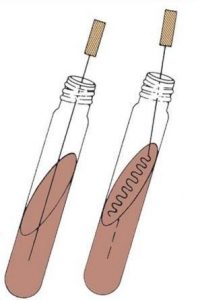 Figure: Inoculation in TSI agar
Addition of sucrose in TSI agar permits earlier detection of coliform bacteria that ferment sucrose more rapidly than lactose. Adding sucrose also aids the identification of certain gram-negative bacteria that could ferment sucrose but not lactose. Another basic understanding is TSI tube contains a butt-poorly oxygenated area on the bottom and a slant-angled well-oxygenated area on the top.
Preparation of TSI Agar
- Combine the ingredients, and adjust the pH to 7.3
- Boil to dissolve the agar
- Dispense it into tubes
- Sterilize by autoclaving at 121°C for 15 minutes
- Cool in a slanted position to give a 2.5 cm butt and a 3.8 cm slant.
TSI agar is also available commercially
Procedure for TSI Agar Test
- With a sterilized straight inoculation needle touch the top of a well-isolated colony
- Inoculate TSI agar by first stabbing through the center of the medium to the bottom of the tube and then streaking on the surface of the agar slant.
- Leave the cap on loosely and incubate the tube at 35°C in ambient air for 18 to 24 hours.
Principle of TSI Agar Test
- If lactose (or sucrose) is fermented, a large amount of acid is produced, which turns the phenol red indicator yellow both in the butt and in the slant. Some organisms generate gases, which produce bubbles/cracks in the medium.
- If lactose is not fermented but the small amount of glucose is, the oxygen-deficient butt will be yellow (remember that butt has comparatively more glucose than slant i.e. more media and more glucose), but on the slant, the acid produced (less acid produces in slant as media in slant is less) will be oxidized to carbon dioxide and water by the organism and the slant will be red (alkaline or neutral pH).
- If neither lactose/sucrose nor glucose is fermented, both the butt and the slant will be red. The slant can become a deeper red-purple (more alkaline) as a result of the production of ammonia from the oxidative deamination of amino acids (remember peptone is a major constituent of TSI agar).
- if H2S is produced, the black color of ferrous sulfide is seen.
Complete TSI Agar Interpretation Guide
Reading notation
- K = Alkaline (red/pink color — phenol red in alkaline pH)
- A = Acid (yellow color — phenol red in acidic pH)
- NC = No change (red — no fermentation)
- H₂S = Black precipitate in butt
- Gas = Cracks, displacement, or bubbles in agar
All possible TSI results and their meaning
| Slant | Butt | H₂S | Gas | Interpretation | Common organisms |
|---|---|---|---|---|---|
| K (red) | A (yellow) | Negative | Negative | Glucose only fermented; lactose/sucrose negative; no H₂S | Shigella spp., Providencia spp., some Pseudomonas |
| K (red) | A (yellow) | Negative | Positive | Glucose only fermented; lactose/sucrose negative; gas produced | Shigella sonnei (rare gas), some E. coli biotypes |
| K (red) | A (yellow) | Positive (often weak) | Negative | Glucose only; H₂S positive but characteristically weak; no gas — classic Salmonella Typhi pattern | Salmonella Typhi (weak H₂S, often just a thin line at the junction), some Citrobacter spp. |
| K (red) | A (yellow) | Positive | Positive | Glucose only; H₂S positive; gas positive — classic non-typhoidal Salmonella pattern | Salmonella typhimurium, Salmonella enteritidis, Proteus mirabilis, Citrobacter freundii |
| A (yellow) | A (yellow) | Negative | Negative | Glucose + lactose/sucrose fermented; no H₂S; no gas | Escherichia coli, Klebsiella pneumoniae, Enterobacter spp. |
| A (yellow) | A (yellow) | Negative | Positive | Glucose + lactose/sucrose fermented; gas produced | E. coli (most strains), Klebsiella pneumoniae, Klebsiella aerogenes |
| A (yellow) | A (yellow) | Positive | Positive | Glucose + lactose/sucrose fermented; H₂S; gas | Rare — some Citrobacter strains |
| K (red) | K (red) or NC | Negative | Negative | No fermentation — non-fermenter | Pseudomonas aeruginosa, Acinetobacter spp., Stenotrophomonas |
| K (red) | K (red) | Positive | Negative | Alkaline throughout; H₂S positive | Rare — seen in some non-fermenters with H₂S production |
Critical interpretation rules
Rule 1 — Read at 18–24 hours only. Reading TSI after 48 hours is unreliable. Organisms that initially ferment only glucose may eventually produce enough alkaline products to revert the butt from yellow to red, giving a false K/K (non-fermenter) result. Always read at exactly 18–24 hours.
Rule 2 — The slant reflects aerobic metabolism; the butt reflects anaerobic metabolism. The slant is exposed to oxygen, so acid produced from glucose fermentation is quickly neutralized by oxidative deamination of peptones (producing alkaline ammonia). The butt is anaerobic, so acid from glucose fermentation accumulates and persists.
Rule 3 — H₂S production requires an acid environment. The black precipitate (ferrous sulfide) only forms in the butt where acid conditions prevail. If a strongly alkaline reaction is present in the butt (K/K), H₂S production may be suppressed and appear negative even if the organism produces H₂S — this can give false-negative H₂S in alkaline butt conditions.
Rule 4 — Gas production is detected by cracks in the agar, displacement of the agar plug, or bubbles — not by the color of the medium. Some technicians miss gas production in heavily H₂S-positive tubes because the black precipitate obscures the agar cracks.
TSI Results of Clinically Important Organisms
Enterobacteriaceae
| Organism | Slant | Butt | H₂S | Gas | Additional notes |
|---|---|---|---|---|---|
| Escherichia coli | A | A | − | + | Indole positive; IMViC: + + − − |
| Klebsiella pneumoniae | A | A | − | + (large) | Mucoid colonies; urease positive; IMViC: − − + + |
| Klebsiella aerogenes | A | A | − | + | Similar to Klebsiella; VP positive |
| Salmonella typhi | K | A | + (variable, light) | − | No gas — distinguishes from other Salmonella; H₂S moderate |
| Salmonella typhimurium | K | A | + (strong) | + | Strong H₂S; strong gas production |
| Salmonella enteritidis | K | A | + | + | Similar to S. typhimurium |
| Shigella dysenteriae | K | A | − | − | No gas; no H₂S; no lactose/sucrose fermentation |
| Shigella sonnei | K | A | − | − (rarely +) | Late lactose fermenter; may be A/A after 48h |
| Proteus mirabilis | K | A | + | + | Swarming on blood agar; urease strongly positive; phenylalanine deaminase positive |
| Proteus vulgaris | K | A | + | + | Indole positive; distinguishes from P. mirabilis |
| Morganella morganii | K | A | − | + | Urease positive; indole positive; phenylalanine deaminase positive |
| Citrobacter freundii | K | A | + | + | H₂S positive — may be confused with Salmonella; ONPG positive; indole negative |
| Citrobacter koseri | K | A | − | + | Indole positive; distinguishes from C. freundii |
| Serratia marcescens | K or A | A | − | + | Red pigment at room temperature; DNase positive |
| Yersinia enterocolitica | K | A | − | − | Urease positive; grows better at 25°C; motile at 25°C, non-motile at 37°C |
Non-Enterobacteriaceae gram-negative rods
| Organism | Slant | Butt | H₂S | Gas | Notes |
|---|---|---|---|---|---|
| Pseudomonas aeruginosa | K | K/NC | − | − | Non-fermenter; oxidase positive; pyocyanin pigment |
| Acinetobacter baumannii | K | K/NC | − | − | Non-fermenter; oxidase negative; important MDR pathogen |
| Vibrio cholerae | A | A | − | − | Ferments glucose and sucrose — gives A/A on TSI but K/A on KIA; oxidase positive |
| Burkholderia cepacia | K | K/NC | − | − | Non-fermenter; oxidase positive; intrinsic carbapenem resistance |
| Organism group | Slant | Butt | Gas | H₂S |
|---|---|---|---|---|
| Escherichia, Klebsiella, Enterobacter | Acid (A) | Acid (A) | + | − |
| Shigella | Alkaline (K) | Acid (A) | − | − |
| Salmonella (non-typhoidal), Proteus | Alkaline (K) | Acid (A) | + | + |
| Salmonella Typhi | Alkaline (K) | Acid (A) | − | + (weak) |
| Serratia | K or A | Acid (A) | + | − |
| Pseudomonas (non-fermenter) | Alkaline (K) | Alkaline (K) | − | − |
TSI Agar vs Kligler's Iron Agar (KIA)
TSI and KIA are frequently confused because they look identical and work on the same principle. The only difference is the number of sugars:
| Feature | TSI Agar | Kligler's Iron Agar (KIA) |
|---|---|---|
| Sugars present | Glucose (0.1%), Lactose (1%), Sucrose (1%) | Glucose (0.1%), Lactose (1%) only |
| Sucrose | Present | Absent |
| H₂S detection | Yes | Yes |
| Gas detection | Yes | Yes |
| Key difference | Sucrose fermenters give A/A | Sucrose fermenters give K/A (appears as glucose-only fermenter) |
| Practical example | Vibrio cholerae (sucrose fermenter) gives A/A | Vibrio cholerae gives K/A |
| Most common use | Preferred in most labs — more information | Used when sucrose fermentation data not needed |
The clinical significance of sucrose in TSI: Vibrio cholerae ferments sucrose but not lactose. On TSI it gives an A/A result (because sucrose is present), but on KIA it gives K/A (appearing to ferment only glucose). This difference is important — on KIA, V. cholerae could be mistaken for Salmonella or Shigella, whereas on TSI its true sucrose fermentation is revealed.
References
- Tille PM. Bailey and Scott's Diagnostic Microbiology. 15th ed. St. Louis: Elsevier; 2022.
- Procop GW, Church DL, Hall GS, Janda WM, Koneman EW, Schreckenberger PC, Woods GL. Koneman's Color Atlas and Textbook of Diagnostic Microbiology. 7th ed. Philadelphia: Wolters Kluwer; 2017.
- Leber AL, editor. Clinical Microbiology Procedures Handbook. 4th ed. Washington, DC: ASM Press; 2016. doi:10.1128/9781555818814
Frequently Asked Questions
What does K/A mean in TSI results?
What does A/A mean in TSI?
How do you differentiate S. typhi from other Salmonella on TSI?
Why does Shigella give K/A without H2S or gas?
Why must TSI be read at exactly 18-24 hours?
What does H2S in TSI indicate?
What is the difference between TSI and KIA?
When is TSI used vs SIM medium?

Tankeshwar Acharya, MSc (Medical Microbiology)
Tankeshwar Acharya is an Assistant Professor in the Department of Microbiology at Patan Academy of Health Sciences (PAHS), Nepal, where he has been teaching and practicing clinical microbiology for over 14 years. He is the founder of Microbe Online, one of the leading free microbiology education resources on the web, covering bacteriology, mycology, parasitology, immunology, and clinical laboratory diagnostics written from direct experience in both the classroom and the diagnostic laboratory.