
Robert Koch and Koch's Postulates: Discoveries, Criteria, and Limitations
Robert Koch, the father of bacteriology: his discoveries (anthrax, TB, cholera), his laboratory techniques, and Koch's postulates with their limitations and modern molecular version.

On this page
Before Robert Koch, no one had ever proven that a particular microbe causes a particular disease. People suspected it, but suspicion is not proof. In 1876, working in a makeshift home laboratory with a microscope his wife had given him as a birthday present, Koch did what no one had done: he traced anthrax from a dying animal, to a pure culture of bacteria, to a healthy animal that then sickened with the same disease, and back to the same microbe. That chain of logic became Koch's postulates, and it is still how we think about proving a microbe causes a disease.
This article covers Koch's life and discoveries, the techniques he invented, and the postulates that carry his name.
Robert Koch (1843–1910) was a German physician and microbiologist, and one of the founders of modern bacteriology. He was the first person to prove that a specific bacterium causes a specific disease. Koch was born on December 11, 1843, in Clausthal, in the Harz Mountains of northwestern Germany, and died of a heart attack on May 27, 1910, in Baden-Baden, at the age of 66.
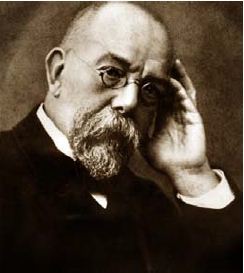 Figure: Robert Koch
Koch began as an ordinary district physician. Working from a small home laboratory, he developed the techniques and the logic that turned the study of bacteria into a rigorous science. He is best known for two things: his discoveries of the microbes that cause anthrax, tuberculosis, and cholera, and the set of criteria known as Koch's postulates. For his work on tuberculosis, he received the Nobel Prize in Physiology or Medicine in 1905.
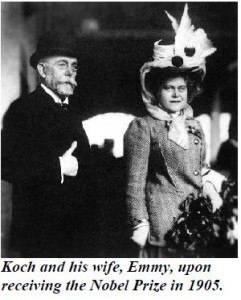 Figure: Robert Koch and His wife
Robert Koch's major discoveries
Anthrax (1876), the birth of modern bacteriology. Koch's breakthrough came with anthrax. He found rod-shaped bacteria (Bacillus anthracis) in the blood of cattle that had died of the disease, grew them outside the animal, and showed they could reproduce the disease in healthy animals. He also discovered that the bacterium forms spores that survive in soil for years, explaining how fields stayed infectious long after diseased animals were gone. His 1876 anthrax demonstration was the first proof that a specific bacterium causes a specific disease, and it is often called the birth of modern bacteriology.
Tuberculosis (1882). Koch identified Mycobacterium tuberculosis, still sometimes called "Koch's bacillus," as the cause of tuberculosis. He announced the discovery on March 24, 1882. That date is now commemorated each year as World Tuberculosis Day. This work earned him the 1905 Nobel Prize.
Cholera (1883). Koch identified Vibrio cholerae as the cause of cholera while studying outbreaks in Egypt and India. (The organism had actually been seen earlier by Filippo Pacini in 1854, but Koch established its role as the cause of the disease.)
Koch also worked on the bacteria of wound infections in the late 1870s, contributing to the understanding of traumatic infective diseases.
Koch's contributions to laboratory technique
Koch's discoveries were possible because he first invented the tools to make them. These techniques are as important to his legacy as the postulates:
- Pure culture technique. Koch developed reliable ways to grow a single species of bacterium in isolation, free of other organisms. A pure culture is essential for proving that one specific microbe causes a disease.
- Solid culture media. Koch was the first to grow bacteria on a solid surface, which lets separate colonies form from single cells. He first used gelatin as the solidifying agent, but gelatin melts at body temperature and is digested by many bacteria. The lasting solution was agar, suggested by Angelina (Fannie) Hesse, the wife of one of Koch's coworkers; agar stays solid at 37°C and is not broken down by most bacteria. Agar plates remain standard today.
- The Petri dish. Julius Petri, Koch's assistant, introduced the flat covered dish that still bears his name, the standard vessel for solid-media culture.
- Staining and microscopy. Koch pioneered bacterial staining, the use of the oil-immersion lens, and microphotography (photographing bacteria through the microscope), which allowed bacteria to be seen, identified, and documented clearly.
Together, these methods turned bacteriology into a repeatable laboratory science, which is why Koch is credited as a founder of the field.
What is Robert Koch the "father of"?
Robert Koch is most accurately called the father of bacteriology (or the father of medical bacteriology and medical microbiology), because he established the experimental methods and the logical criteria that made bacteriology a rigorous science. He is sometimes called the father of modern microbiology jointly with Louis Pasteur, and, because of his pure-culture and solid-media methods, is also credited with founding the pure culture technique.
A useful way to keep the two giants straight: Pasteur is often called the father of microbiology in the broad sense (fermentation, disproving spontaneous generation, vaccines), while Koch is specifically the father of bacteriology and medical microbiology (proving specific bacteria cause specific diseases, and the laboratory methods to do so).
Koch's postulates
Koch's postulates are four criteria used to establish that a specific microorganism causes a specific disease. Koch developed them from his anthrax and tuberculosis work and formally set them out in the 1880s (building on earlier ideas of his teacher's colleague Jakob Henle, so they are occasionally called the Henle-Koch postulates).
The four postulates:
- The microorganism must be found in every case of the disease and must be absent from healthy individuals.
- The microorganism must be isolated from a diseased host and grown in pure culture in the laboratory.
- The cultured microorganism must cause the disease when introduced into a healthy, susceptible host.
- The microorganism must be re-isolated from the newly infected host and shown to be identical to the original organism.
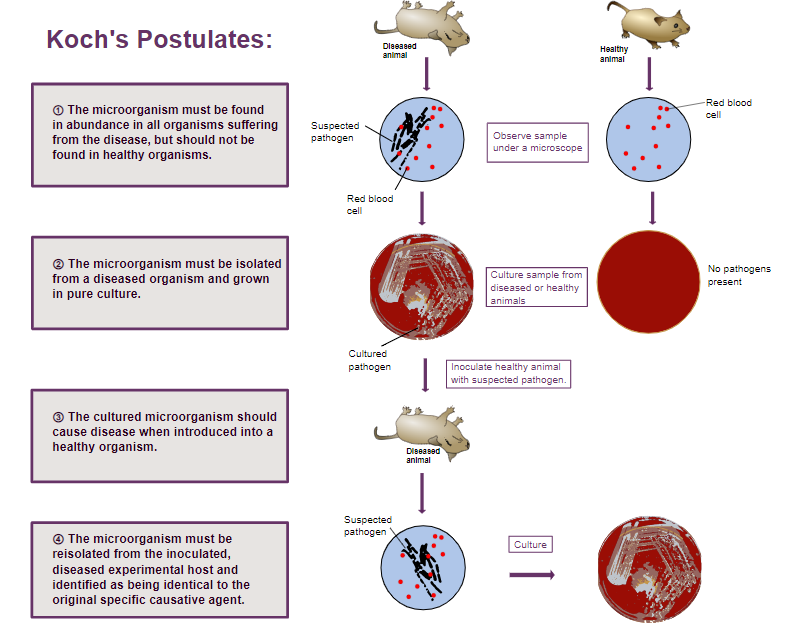 Figure: Koch Postulates (Image source: Estevezj)
In short: find it, grow it, give it, get it back.
Limitations of Koch's postulates
Koch's postulates were a landmark, but they were designed for culturable bacteria in the 1880s and do not fit every situation. The main limitations:
- Some microbes cannot be grown in pure culture. The second postulate requires culturing the microbe, but some cannot be grown on laboratory media, including Treponema pallidum (syphilis), Mycobacterium leprae (leprosy), and all viruses, which need living cells to grow. This makes the classic postulates hard to apply to them.
- Healthy carriers exist. The first postulate assumes the microbe is absent from healthy people, but many pathogens are carried harmlessly by healthy individuals (for example, Staphylococcus aureus or Streptococcus pneumoniae). Presence alone does not prove causation.
- Not every exposed person gets sick. The third postulate expects the microbe to cause disease in a healthy host, but infection outcomes depend on the dose, the host's immunity, and other factors, so a microbe may not cause disease in every inoculated host.
- Some diseases have more than one cause, and some microbes cause more than one disease. A single microbe-to-single-disease model does not always hold.
- Ethical limits. Deliberately infecting healthy humans to satisfy the third postulate is unethical, so the postulates often cannot be fully applied to human disease.
- They predate viruses and prions. The postulates were framed for bacteria and do not straightforwardly apply to viruses, prions, or the microbiome.
Molecular Koch's postulates
Because the original postulates could not handle microbes that will not culture, or explain why a microbe is harmful, the microbiologist Stanley Falkow proposed molecular Koch's postulates in 1988. Instead of linking a whole organism to a disease, they link a specific gene (a virulence factor) to the ability to cause disease:
- The gene (or its product) should be found in microbes that cause the disease and absent from harmless strains.
- Inactivating the gene should reduce the microbe's ability to cause disease.
- Restoring the gene should restore the microbe's disease-causing ability.
This molecular framework lets scientists study causation at the level of individual virulence genes, and it extends Koch's original logic to microbes and mechanisms the classic postulates could not reach.
How to remember
The postulates: find it, grow it, give it, get it back. Four steps in order. Find the microbe in every case, grow it in pure culture, give it to a healthy host to reproduce the disease, get it back from that host unchanged. "FIIR" if you like acronyms (Find, Isolate, Inoculate, Re-isolate).
Koch's big three diseases: A, T, C, in order 76, 82, 83. Anthrax (1876), Tuberculosis (1882), Cholera (1883). Anthrax first (and it's the "birth of bacteriology"), then TB (his Nobel), then cholera.
Pasteur is microbiology, Koch is bacteriology. If you have to split the two "fathers," Pasteur gets the broad microbiology title, Koch gets bacteriology and medical microbiology, because Koch proved specific bacteria cause specific diseases.
March 24 is TB's day. Koch announced the TB bacillus on March 24, 1882, so World TB Day is March 24
Key exam facts
| Point | Fact | Memory aid |
|---|---|---|
| Who | Robert Koch (1843–1910), German physician | Father of bacteriology |
| Known as | Father of bacteriology / medical microbiology | Koch = bacteriology |
| First disease proven | Anthrax, 1876 (Bacillus anthracis) | Birth of bacteriology |
| Tuberculosis | 1882 (M. tuberculosis, "Koch's bacillus") | Nobel + World TB Day (Mar 24) |
| Cholera | 1883 (Vibrio cholerae) | Third of the big three |
| Nobel Prize | 1905, for tuberculosis | Koch's Nobel = TB |
| Key techniques | Pure culture, solid media (agar), staining, microphotography | Made bacteriology repeatable |
| Postulates | Find, isolate, inoculate, re-isolate | FIIR |
| Can't-culture exceptions | T. pallidum, M. leprae, viruses | Some germs won't grow |
| Molecular version | Falkow, 1988 (links a virulence gene to disease) | Gene in, gene out |
Where students get confused
"Is Koch or Pasteur the father of microbiology?" Both are called founding fathers, but of different things. Pasteur is often called the father of microbiology broadly (fermentation, disproving spontaneous generation, vaccines). Koch is specifically the father of bacteriology and medical microbiology, because he proved specific bacteria cause specific diseases and built the laboratory methods to do it.
"Did Koch propose the germ theory?" No, he proved it for specific diseases. Germ theory, the broad idea that microbes cause disease, is usually credited to Pasteur. Koch's contribution was the rigorous experimental proof (anthrax, 1876) and the postulates that formalized how to establish causation. Read more about germ theory of disease.
"What is the difference between the classic and molecular postulates?" The classic postulates link a whole microbe to a disease and require growing it in culture. The molecular postulates (Falkow, 1988) link a specific gene to the ability to cause disease, and work even for microbes that cannot be cultured. The molecular version studies causation at the level of virulence genes.
"Why don't Koch's postulates work for all diseases?" Because some microbes will not grow in culture (like the syphilis and leprosy bacteria and viruses), some people carry pathogens harmlessly, some diseases have multiple causes, and deliberately infecting humans is unethical. The postulates are a foundational guideline, not an absolute rule.
References and further readings
- Lakhtakia R. The Legacy of Robert Koch: Surmise, search, substantiate. Sultan Qaboos Univ Med J. 2014;14(1):e37-41. PMID: 24516751.
- Falkow S. Molecular Koch's postulates applied to microbial pathogenicity. Rev Infect Dis. 1988;10(Suppl 2):S274-S276. doi:10.1093/cid/10.supplement_2.s274
- Madigan MT, Bender KS, Buckley DH, Sattley WM, Stahl DA. Brock Biology of Microorganisms. 16th ed. Pearson; 2021.
- Willey JM, Sherwood LM, Woolverton CJ. Prescott's Microbiology. 11th ed. New York: McGraw Hill; 2020.
- Tille PM. Bailey & Scott's Diagnostic Microbiology. 15th ed. St. Louis: Elsevier; 2022.
Frequently Asked Questions
Who was Robert Koch?
Who was Robert Koch?
Robert Koch (1843–1910) was a German physician and microbiologist, one of the founders of modern bacteriology. He proved that specific bacteria cause anthrax, tuberculosis, and cholera, developed key laboratory techniques, and formulated Koch's postulates. He won the 1905 Nobel Prize for his tuberculosis work.
What is Robert Koch the father of?
What is Robert Koch the father of?
He is most accurately called the father of bacteriology (and of medical microbiology), because he proved specific bacteria cause specific diseases and created the methods to study them. He shares the broader "father of microbiology" title with Louis Pasteur.
What are Koch's postulates?
What are Koch's postulates?
Four criteria for proving a microbe causes a disease: (1) the microbe is present in every case, (2) it can be isolated and grown in pure culture, (3) it reproduces the disease in a healthy host, and (4) it can be re-isolated from that host and matches the original.
What diseases did Robert Koch discover the cause of?
What diseases did Robert Koch discover the cause of?
Anthrax (1876, Bacillus anthracis), tuberculosis (1882, Mycobacterium tuberculosis), and cholera (1883, Vibrio cholerae). His anthrax work was the first proof that a specific bacterium causes a specific disease.
Why did Robert Koch win the Nobel Prize?
Why did Robert Koch win the Nobel Prize?
He received the 1905 Nobel Prize in Physiology or Medicine for his investigations and discoveries concerning tuberculosis, including identifying its causative bacterium.
What are the limitations of Koch's postulates?
What are the limitations of Koch's postulates?
Some microbes cannot be grown in culture (such as the syphilis and leprosy bacteria and viruses), some healthy people carry pathogens without disease, some diseases have multiple causes, deliberately infecting humans is unethical, and the postulates were not designed for viruses or prions.
What are molecular Koch's postulates?
What are molecular Koch's postulates?
A modern version proposed by Stanley Falkow in 1988 that links a specific virulence gene, rather than a whole organism, to the ability to cause disease. It works even for microbes that cannot be cultured.

Tankeshwar Acharya, MSc (Medical Microbiology)
Tankeshwar Acharya is an Assistant Professor in the Department of Microbiology at Patan Academy of Health Sciences (PAHS), Nepal, where he has been teaching and practicing clinical microbiology for over 14 years. He is the founder of Microbe Online, one of the leading free microbiology education resources on the web, covering bacteriology, mycology, parasitology, immunology, and clinical laboratory diagnostics written from direct experience in both the classroom and the diagnostic laboratory.
Comments
No comments yet. Be the first to share your thoughts.
Leave a comment
All comments are reviewed before they appear.