
Citrate Utilization Test: Principle, Procedure, Results & Citrate-Positive Organisms
Citrate test principle and procedure — including the one rule most students miss: growth alone counts as positive, even without the blue color change.
The citrate utilization test determines whether an organism can use sodium citrate as its sole carbon source and ammonium salts as its sole nitrogen source. It's the fourth and final test in the IMViC panel.
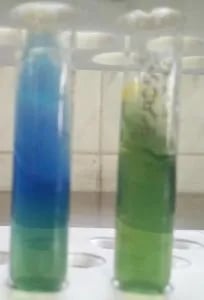 Figure: Citrate Test Right: Negative Left: Positive
Why It Matters
This test has a direct public-health pedigree: it's one of the classic ways to distinguish Klebsiella aerogenes (formerly Enterobacter aerogenes) — citrate-positive, naturally found in soil and water — from E. coli — citrate-negative, whose presence in a water sample specifically signals fecal contamination. Where indole and MR/VP separate organisms by what they ferment, citrate separates them by a different question entirely: can this organism survive on citrate as its only carbon source at all?
That's a transport-protein question first: without citrate permease to carry citrate across the membrane, the intracellular machinery never gets a substrate to work on. Many Enterobacteriaceae possess the downstream enzymes but lack the permease, so they test negative despite being biochemically capable on paper. This is why citrate doesn't always track the same way MR/VP does, and why it's run as a fourth, independent check rather than a confirmation of the first three. The Principle section below follows the citrate from the permease that admits it to the lyase that cleaves it.
Clinically, the same logic applies at the bench: Klebsiella pneumoniae (citrate-positive) and E. coli (citrate-negative) can look identical on a lactose-fermenting MacConkey colony; citrate is one of the fastest ways to split them apart before final identification comes back, which matters because Klebsiella carries a meaningfully different resistance profile than E. coli in most local antibiograms.
Principle
Citrate is an intermediate in the Krebs cycle. When an organism uses it as its carbon and energy source, the breakdown produces alkaline carbonates and bicarbonates, raising the medium's pH. This pH shift is what the test actually detects not citrate utilization directly, but its downstream alkalinizing effect.
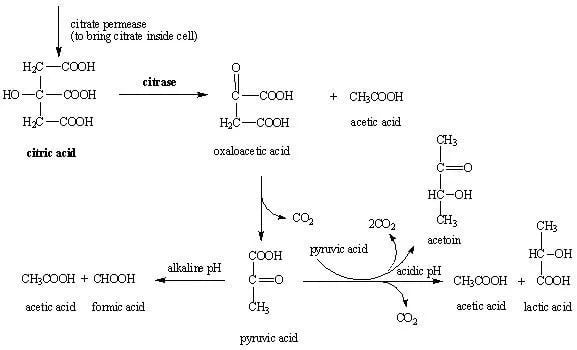 Figure: Citrate Utilization Test Chemistry
**The chemistry:**
The chemistry runs on two tracks, and the second one matters more than students are usually told.
Carbon track. Citrate permease first transports citrate into the cell. Inside, citrate lyase cleaves it to oxaloacetate and acetate, oxaloacetate is decarboxylated to pyruvate, and CO₂ is released. Some of that CO₂ combines with sodium in the medium to form sodium carbonate, which is mildly alkaline.
Nitrogen track, the dominant one. The medium's only nitrogen source is an ammonium salt (ammonium dihydrogen phosphate). To grow, the organism must strip nitrogen from it, releasing ammonia. Ammonia dissolves to ammonium hydroxide, and this is what drives most of the pH rise past 7.6.
So the blue color is really a report on two simultaneous demands being met: the organism is using citrate as its sole carbon source and the ammonium salt as its sole nitrogen source. The nitrogen half is why an organism that merely tolerates citrate will not turn the slant blue, while one that genuinely lives on this medium will.
The medium's bromothymol blue indicator is forest green at neutral pH and shifts to Prussian blue above pH 7.6.
Procedure
Simmons citrate agar is poured as a slant; this is an aerobic surface test, not a stab test.
- Touch the tip of a needle to a young colony (18–24 hours old).
- Streak the slant surface lightly. Do not stab. This test requires an aerobic environment; stabbing creates an anaerobic pocket that won't read correctly.
- Cap loosely and incubate aerobically at 35–37°C for 18–24 hours.
- Some slow-growing organisms may need up to 7 days before a positive shows.
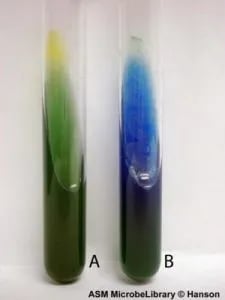 Figure: Citrate utilization test A: Negative B: Positive
(Image source: Microbe library)
Where students actually get confused
- Don't stab the slant. If you've just run a TSI or SIM tube, the instinct to stab is automatic — citrate is the opposite: surface streak only, aerobic incubation, no stab.
- Growth alone is a positive result, even without color change. This is the single most missed rule in this test. Some citrate-utilizing organisms grow visibly on the slant without ever turning it blue. If you see growth, it's positive — don't wait for blue that may never come.
- No growth at all = negative, and it will look almost identical to an uninoculated slant — deep forest green, no visible colonies. That's the actual negative result, not "green but with some growth."
- Don't call it negative too early. Some organisms are slow citrate utilizers and need up to 7 days of incubation. A 24-hour negative isn't final for every organism.
- Use a light inoculum from a young colony, never from a broth culture. Carryover nutrients from broth or an overly heavy inoculum can produce a false-positive by feeding growth that has nothing to do with citrate utilization.
Quality Control
Inspect agar for freezing damage, contamination, cracks, dehydration, or bubbles before use. Discard any tube that's already blue before inoculation.
| Organism | Expected result |
|---|---|
| Klebsiella pneumoniae ATCC 13883 | Citrate positive (growth, blue color) |
| Escherichia coli ATCC 25922 | Citrate negative (no growth, no color change) |
Result Interpretation
| Result | Appearance |
|---|---|
| Positive | Growth on the slant — color may or may not turn Prussian blue |
| Negative | No or trace growth, remains deep forest green, indistinguishable from an uninoculated slant |
| Equivocal | Repeat the test |
Citrate-positive organisms
Klebsiella pneumoniae, Enterobacter species (minority negative), Citrobacter freundii, Salmonella (other than Typhi/Paratyphi A), Serratia marcescens, Proteus mirabilis (minority negative), Providencia
Citrate-variable
Proteus vulgaris, Vibrio cholerae, Vibrio parahaemolyticus
Citrate-negative organisms
Escherichia coli, Shigella species, Salmonella Typhi, Salmonella Paratyphi A, Morganella morganii, Yersinia enterocolitica
Exceptions exist on both sides: rare citrate-positive E. coli variants and citrate-negative E. aerogenes strains have been isolated — a single citrate result should never be the sole basis for species-level identification.
Uses
Citrate is part of standard multitest identification kits, including API-20E and Enterotube II, alongside the rest of the IMViC battery.
Limitations
- Luxuriant growth without color change can still indicate a positive — but if the slant never turns blue even after extended incubation, repeat with a smaller inoculum.
- Never inoculate from a broth culture — carryover media can produce a false positive.
- Use a light inoculum to avoid carryover-driven false positives.
- Citrate results alone are not sufficient for species-level identification.
How to remember
"Citrate turns the sky blue over KECSS." The reliable citrate-positive Enterobacteriaceae:
- K — Klebsiella
- E — Enterobacter
- C — Citrobacter
- S — Salmonella (except Typhi and Paratyphi A)
- S — Serratia
And the anchor that matters clinically: E. coli lives in the gut, not on citrate. A citrate-negative result is part of what flags E. coli as a fecal indicator in water testing, while citrate-positive Klebsiella aerogenes is at home in soil and water. If citrate comes back positive on what you assumed was a fecal coliform, question the assumption.
References and further reading
- Leber AL, editor. Clinical Microbiology Procedures Handbook. 4th ed. Washington, DC: ASM Press; 2016. doi:10.1128/9781555818814
- Procop GW, Church DL, Hall GS, Janda WM, Koneman EW, Schreckenberger PC, Woods GL. Koneman's Color Atlas and Textbook of Diagnostic Microbiology. 7th ed. Philadelphia: Wolters Kluwer; 2017.
- MacFaddin JF. Biochemical Tests for Identification of Medical Bacteria. 3rd ed. Philadelphia: Lippincott Williams & Wilkins; 2000.
Frequently Asked Questions
I see growth on the slant but it's still green — is that positive or negative?
Why did I get a false positive on my citrate test?
Can I stab the citrate slant like I do for TSI?
Does the blue color come from the citrate breaking down?
Does the citrate test detect citrate permease or citrate lyase?

Tankeshwar Acharya, MSc (Medical Microbiology)
Tankeshwar Acharya is an Assistant Professor in the Department of Microbiology at Patan Academy of Health Sciences (PAHS), Nepal, where he has been teaching and practicing clinical microbiology for over 14 years. He is the founder of Microbe Online, one of the leading free microbiology education resources on the web, covering bacteriology, mycology, parasitology, immunology, and clinical laboratory diagnostics written from direct experience in both the classroom and the diagnostic laboratory.