
Buffered Charcoal Yeast Extract (BCYE) Agar: Composition, Principle, Uses, and Colony Characteristics
BCYE agar is the only medium that grows Legionella pneumophila, requiring L-cysteine and iron for growth. Learn its six-component principle, why charcoal is essential, how growth on BCYE but not blood agar confirms Legionella, and how selective BCYE variants work.
In July 1976, 221 people attending an American Legion convention at the Bellevue-Stratford Hotel in Philadelphia developed a severe pneumonia. Thirty-four of them died. The causative organism evaded detection for months — it did not grow on any of the standard culture media used at the time, and did not respond to many antibiotics. It was eventually identified as a previously unknown bacterium: Legionella pneumophila.
The reason it evaded culture was straightforward: Legionella requires L-cysteine and iron salts for growth, and neither of these was present in the blood agar, chocolate agar, or MacConkey agar routinely used in clinical laboratories. The subsequent development of Buffered Charcoal Yeast Extract agar by Feeley and colleagues (1979), modified by Edelstein, finally provided a medium that could consistently recover Legionella from clinical specimens.
Today, the single most useful presumptive clue that an isolate might be Legionella is growth on BCYE agar after 3 or more days of incubation with no growth on blood agar and/or chocolate agar. No other clinically significant bacterium routinely produces this pattern.
The clinician should inform the laboratory if infection with Legionella is suspected so that the appropriate media are set up. BCYE agar provides L-cysteine and other nutrients required for the growth of Legionella pneumophila, the causative agent of Legionnaires’ disease.
Principle
Legionella pneumophila is an aerobic, nutritionally fastidious, intracellular pathogen with growth requirements so unusual that no standard bacteriological medium supports its culture. BCYE agar addresses these requirements through six components, each serving a specific purpose:
| Component | Role | Why it matters for Legionella |
|---|---|---|
| L-cysteine HCl | Essential amino acid — absolute growth requirement | Legionella cannot synthesise cysteine; it must be supplied exogenously. This is the single most critical component — L-cysteine deficiency completely prevents growth regardless of all other nutrients |
| Ferric pyrophosphate | Iron supplement | Legionella requires iron for cytochrome production and oxidative metabolism; standard media provide insufficient bioavailable iron |
| Activated charcoal | Detoxification agent | Decomposes hydrogen peroxide (H₂O₂) — a metabolic byproduct toxic to Legionella — and adsorbs other toxic compounds including fatty acids; also modifies surface tension and CO₂ concentration at the agar surface |
| Alpha-ketoglutarate | Growth stimulant | Stimulates Legionella growth and colony development; improves recovery from clinical specimens at low inoculum |
| ACES buffer | pH buffering | Maintains stable pH at 6.9 ± 0.2 — ACES is a zwitterionic buffer particularly effective in this range without toxicity to Legionella |
| Yeast extract | Broad nutrient source | Provides nitrogen, vitamins, amino acids, and cofactors; supports growth and colony development |
The L-cysteine dependence test — a diagnostic cornerstone: Because L-cysteine is an absolute requirement for Legionella growth, a simple subculture experiment provides powerful presumptive evidence for genus identification:
- Subculture the suspect colony from BCYE agar onto both BCYE agar and BCYE agar without L-cysteine
- Incubate both at 37°C for 48–72 hours
- Growth on BCYE but NOT on BCYE minus L-cysteine = presumptive Legionella
- Simultaneous absence of growth on blood agar confirms the pattern
This test costs nothing beyond the cost of a single additional plate and can be performed by any laboratory capable of preparing BCYE agar.
Why standard media fail for Legionella:
- Blood agar and chocolate agar: provide neither supplemental L-cysteine nor adequate iron
- MacConkey agar: selective for Gram-negatives but contains no cysteine; additionally Legionella is inhibited by the bile salts
- Nutrient agar, TSA: no cysteine, no supplemental iron
The charcoal component additionally explains why BCYE agar appears grey-black — activated charcoal is dispersed throughout the medium, giving it its distinctive dark color.
Uses of BCYE Agar
1. Primary isolation of Legionella from clinical specimens BCYE agar is inoculated with respiratory specimens from patients with suspected Legionnaires' disease:
- Bronchoalveolar lavage (BAL) — highest yield for pulmonary Legionellosis
- Induced sputum — acceptable if BAL unavailable
- Pleural fluid — in parapneumonic effusion
- Lung biopsy — highest specificity but rarely obtained
Critical clinical communication: The clinician must specifically request Legionella culture and inform the laboratory of the suspicion. Laboratories do not routinely plate respiratory specimens onto BCYE agar. Without this request, Legionella will be missed entirely on standard respiratory culture media.
2. Environmental sampling for Legionella BCYE agar is the gold standard for detecting Legionella in water systems — cooling towers, hot water systems, air conditioning units, and hospital water supplies. Environmental sampling is performed during outbreak investigation and as part of water safety programmes (Legionella Water Safety Plans).
3. Legionella culture from blood (rare) L. pneumophila bacteraemia occurs in severe Legionnaires' disease. Lysis-centrifugation blood culture (Isolator tubes) followed by plating onto BCYE agar improves recovery from blood.
4. Selective BCYE variants for environmental specimens: Environmental samples typically contain heavy competing bacterial flora that overgrows Legionella on plain BCYE. Selective variants of BCYE are used:
| Medium | Added antibiotics | Purpose |
|---|---|---|
| BCYE + antibiotics (BMPA) | Cefamandole, polymyxin B, anisomycin | Suppresses Gram-negatives, Gram-positives, and fungi from environmental samples |
| GLYCINE-VANCOMYCIN-POLYMYXIN-CYCLOHEXIMIDE (GVPC) | Glycine, vancomycin, polymyxin B, cycloheximide | ISO 11731 standard for water samples |
| MWY (Modified Wadowsky-Yee) | Glycine, vancomycin, polymyxin B, anisomycin | Environmental water samples |
For clinical specimens (BAL, sputum), plain BCYE is preferred — the antibiotic additions suppress some Legionella strains.
5. Brucella species isolation As noted in the Raad 1990 reference, BCYE agar has been used for Brucella isolation from blood cultures because Brucella also grows on BCYE. This application is relevant in settings where brucellosis is endemic (including parts of Nepal and South Asia) and standard blood culture media may not reliably recover the organism.
Composition of BCYE Agar
- Yeast extract: Yeast extract supplies the protein and other nutrients necessary to support growth
- L-cysteine HCl: L-cysteine is an essential amino acid incorporated to satisfy specific nutritional requirements ofLegionella species
- Charcoal activated: Activated charcoal decomposes hydrogen peroxide, a metabolic product toxic to Legionella species, and may also collect carbon dioxide and modify the surface tension
- Ferric pyrophosphate: Used as an iron supplement; iron source
- ACES (N-(2-Acetamido)-2-aminoethanesulfonic acid) buffer: ACES buffer is added to maintain the proper pH for optimal growth.
- Ketoglutarate monopotassium salt: Alpha-ketoglutarate is added to stimulate growth
- Agar
Final pH ( at 25°C) 6.9±0.2
Preparation
- Suspend 20 grams in 500 ml distilled water.
- Heat to boiling to dissolve the medium completely.
- Sterilize by autoclaving at 15 lbs pressure (121°C) for 15 minutes.
- Cool to 50°C.
- Aseptically add sterile rehydrated contents of 1 vial each of Legionella supplements.
- Mix well and pour with constant stirring to ensure that charcoal particles get evenly distributed.
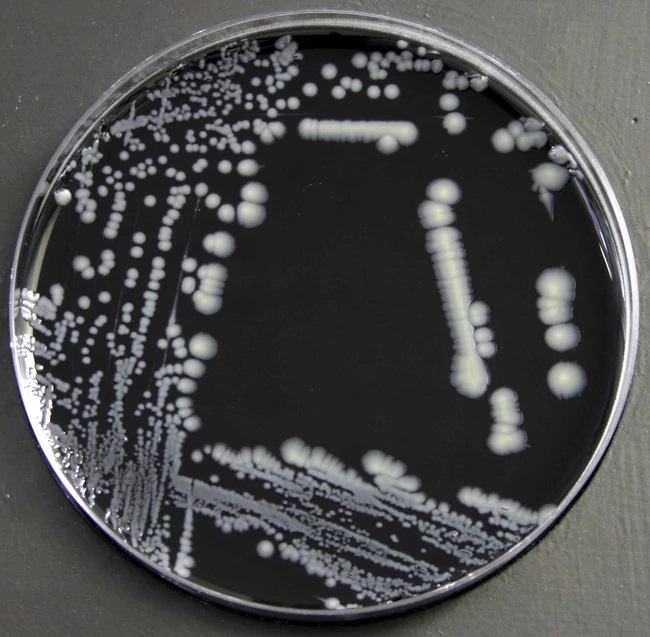 Figure: Legionellacolonies in BCYE Agar (Image source: ThermoFischer)
Quality Control
Legionella pneumophila ATCC 33153 grows well on BCYE agar and gives white grey to blue-grey colonies.
Colony Characteristics on BCYE Agar
Incubation conditions: 37°C, 5% CO2 (or candle jar), high humidity, 3–10 days.
Legionella pneumophila colonies:
- Days 3–4: Small (1–2 mm), white to grey-white, glistening, round, convex, entire edge
- Days 4–7: Colonies enlarge and develop grey color; some strains develop a characteristic ground-glass (iridescent) appearance — a shimmering quality under oblique lighting that is not seen with other bacteria
- UV fluorescence: Examine plates under long-wave UV light (360 nm). Some L. pneumophila strains (particularly serogroup 1) produce a yellow-green autofluorescence under UV — a useful screening tool for environmental plates
Distinguishing Legionella from contaminants on BCYE:
- Legionella colonies are slow-growing (3+ days), grey-white, glistening or iridescent
- Contaminants typically appear faster (24–48 hours) and larger
- Any colony growing only at 3 days or beyond on BCYE, showing no growth on blood agar, is a Legionella suspect until proven otherwise
Colony variation between Legionella species:
| Species | Colony color | UV fluorescence | Notes |
|---|---|---|---|
| L. pneumophila sg 1 | Grey-white to blue-grey | Yellow-green | Most common clinical species; serogroup 1 causes ~80% of cases |
| L. pneumophila other sg | Grey-white | Variable | Serogroups 2–15 |
| L. micdadei | Grey-white | Red | Associated with immunocompromised patients |
| L. bozemanae | Blue-white | Blue-white | Less common; environmental |
How to Remember
BCYE was built around one discovery: Legionella needs L-cysteine. All six components exist to either supply L-cysteine's requirements (ferric pyrophosphate for iron), protect the organism from its own metabolic toxins (charcoal for H₂O₂), or optimise the growth environment (ACES buffer, alpha-ketoglutarate, yeast extract). Remove L-cysteine from BCYE and Legionella will not grow — this is the entire basis of the L-cysteine dependence test.
The diagnostic pattern — growth on BCYE, no growth elsewhere: No other clinically significant bacterium produces this pattern. Blood agar grows almost everything; chocolate agar grows fastidious organisms; BCYE uniquely favours Legionella. When a respiratory culture grows on BCYE but fails to grow on blood agar or chocolate agar, the differential diagnosis is essentially: Legionella species.
The 1976 Philadelphia outbreak as a memory anchor: Legionella was unknown before 1976 because it could not be cultured on any available media. BCYE was designed specifically to fill this gap. Remembering the Philadelphia American Legion outbreak — the naming event for both the organism and the disease — anchors the historical context and the clinical significance of having a dedicated medium.
The name breakdown:
- Buffered → ACES buffer maintains pH
- Charcoal → detoxifies H₂O₂ and toxic metabolites
- Yeast Extract → broad nutrient base
- Together: a medium that solves four problems simultaneously (pH, toxins, nutrition, iron/cysteine supply)
References
- Feeley, J. C., Gibson, R. J., Gorman, G. W., Langford, N. C., Rasheed, J. K., Mackel, D. C., & Baine, W. B. (1979). Charcoal-yeast extract agar: primary isolation medium for Legionella pneumophila. Journal of Clinical Microbiology, 10(4), 437–441.
- Edelstein, P. H. (1981). Improved semiselective medium for isolation of Legionella pneumophila from contaminated clinical and environmental specimens. Journal of Clinical Microbiology, 14(3), 298–303.
- Tille, P. M. (2017). Bailey and Scott's Diagnostic Microbiology (14th ed.). Elsevier.
- World Health Organization. (2007). Legionella and the Prevention of Legionellosis. Geneva: WHO.
Frequently Asked Questions
Why is L-cysteine the most critical component of BCYE agar, and how is this used as a diagnostic test?
Why does BCYE agar contain activated charcoal, and what happens if it is not evenly distributed when pouring?
What is the clinical significance of Legionella colonies showing autofluorescence under UV light?

Tankeshwar Acharya, MSc (Medical Microbiology)
Tankeshwar Acharya is an Assistant Professor in the Department of Microbiology at Patan Academy of Health Sciences (PAHS), Nepal, where he has been teaching and practicing clinical microbiology for over 14 years. He is the founder of Microbe Online, one of the leading free microbiology education resources on the web, covering bacteriology, mycology, parasitology, immunology, and clinical laboratory diagnostics written from direct experience in both the classroom and the diagnostic laboratory.