
Bile Solubility Test: Principle, Procedure, Results

On this page
The bile (sodium deoxycholate) solubility test distinguishes Streptococcus pneumoniae from all other alpha-hemolytic streptococci. Streptococcus pneumoniae is bile soluble, whereas all other alpha-hemolytic streptococci are bile resistant. Sodium deoxycholate (2% in water) will lyse the pneumococcal cell wall.
Autolysin of Streptococcus pneumoniae is responsible for central depression or umbilication characteristics of older pneumococcal colonies on agar media. Such colonies are also known as draughtsman colonies.
Principle
Bile salts, specifically sodium deoxycholate and sodium taurocholate, can lyse Streptococcus pneumoniae selectively when added to actively growing bacteria in agar or broth media.
The exact mechanism of the bile solubility test is not fully known. Bile salts are speculated to lower surface tension at the medium–membrane interface. Under these conditions, S. pneumoniae is particularly susceptible to enzyme action or chemical agent disruption. The addition of bile salts also activates the autolysins (autolytic enzyme of S. pneumoniae) and accelerates the natural lytic reaction observed with cultures of pneumococci.
The bile-solubility test can be performed either with a broth culture of the organism or with colonies growing on agar media. The turbidity of a broth suspension visibly clears with the addition of bile salts if the organism is soluble. On agar medium, bile-soluble colonies dissolve when drops of the reagent are placed on them. Because sodium deoxycholate may precipitate at a pH of 6.5 or less, the broth culture medium must be adjusted to pH 7.0 to prevent false-negative reactions.
Media and Reagents
- A pure culture of the test organism grown at 35°C for 18–24 hours in Todd–Hewitt broth (or equivalent)
- Sheep blood agar plate
- Sodium deoxycholate (10% for tube test, 2% for plate test)
- Phenol red solution (1% aqueous)
- Sodium hydroxide (NaOH) solution, 0.10 N
Preparation of reagent:
Preparation of 2% and 10% sodium deoxycholate (bile salt) solution:
- Dissolve 2 g and 10 g of sodium deoxycholate into 100 ml sterile distilled water, respectively
- Dispense in small amounts to minimize contamination. Shelf life is 270 days.
- Store at 15 to 30°C. Storage of the reagent at cool temperatures can cause it to thicken.
Test Organism
- Any alpha-hemolytic, catalase-negative, Gram-positive cocci in chains having the characteristic central depression (flattened center) or mucoid colony morphology suggestive of S. pneumoniae
- Any Gram-positive cocci in lancet-shaped pairs from a positive blood culture. Grow the isolate(s) to be tested for 18-24 hours on a blood agar plate (BAP) at 35-37°C with ~5% CO₂ (or in a candle-jar).
Quality Control
- Test each new lot of sodium deoxycholate reagent with known positive and negative controls before using them.
- Do not use it if the bile reagent is not clear and very light amber.
- Organisms
- S. pneumoniae ATCC 49619: positive (bile soluble
- Enterococcus faecalis ATCC 29212: negative (bile insoluble)
- Streptococcus mitis ATCC 49456: negative (bile insoluble).
Procedure
Plate Spot Test
- Place one drop of 10% bile solubility reagent near suspected 18- to 24-hour-old colonies growing on sheep blood agar. Gently roll the drop over several representative colonies by tilting the plate. Take care not to dislodge the colonies.
- Incubate the plate aerobically in an upright position at 35°C to 37°C, and examine periodically for up to 30 minutes. Leave the lid slightly ajar to enhance evaporation of the reagent.
- Observe the colony for disintegration or solubility.
Tube Test
- Add bacterial growth from the overnight blood agar plate to 1.0 ml of 0.85% saline to achieve turbidity in a 0.5-1.0 McFarland standard range.
- Divide the cell suspension into two tubes (0.5 ml per tube).
- Add 0.5 ml of 2% sodium deoxycholate (bile salts) to one tube. Add 0.5 ml of 0.85% saline to the other tube. Mix each tube well.
- Incubate the tubes at 35-37°C in CO₂.
- Vortex the tubes.
- Observe the tubes for any clearing of turbidity after 10 minutes. Continue to incubate the tubes for up to 2 hours at 35-37°C in CO₂ if negative after 10 minutes. Observe again for clearing. The control suspension should remain turbid.
Results
A: Spot Test
- Positive test: Disintegration of colonies and/or the appearance of an α-hemolytic zone on the plate where the colony was located within 30 minutes.
- Negative test: Colonies on the plate remain intact with no change in colony integrity within 30 minutes.
B: Tube Test
- Positive test: Clearing or loss of turbidity of the test suspension within 3 hours. The Control suspension remains turbid.
- Negative test: Test and Control suspensions remain turbid after 3 hours.
Reporting results
- If either the spot or tube test demonstrates bile solubility of an alpha-hemolytic colony from a catalase-negative, lancet-shaped, Gram-positive coccus, definitively report as Streptococcus pneumoniae.
- If the organism is not bile-soluble, it is likely a viridans group streptococcus or still may be S. pneumoniae; further testing is indicated from typical pneumococcal colonies. Bile insoluble colonies resembling S. pneumoniae should be further identified using another method, such as optochin susceptibility and/or DNA Probe and/or matrix-assisted laser desorption ionization time-of-flight spectrometry (MALDI-TOF).
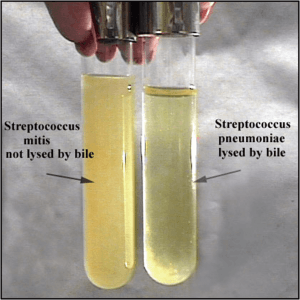 Figure: Bile Solubility Test
Troubleshooting in Bile solubility test:
Partial clearing (partial solubility) is not considered positive for pneumococcal identification. Partially soluble strains with optochin inhibition zones of less than 14 mm are not considered pneumococci.
Mnemonics: Remember the sentence “Streptococcus pnuemoniae is A BOSS” i.e. Streptococcus pneumoniae is
- Alpha hemolytic
- Bile Soluble
- Optochin Sensitive
Limitations
- Bile solubility test should be run only for α-hemolytic streptococci.
- Only 85% of pneumococcal strains will lyse completely in the bile solubility test; other S. pneumoniae will not lyse in the presence of bile, possibly due to the loss of virulence factor or capsule. If lysis is not present, the isolate may still be S. pneumoniae and further testing is required.
- When performing the spot test, keep the plate level to prevent the reagent from running, which may cause some non-pneumococcal colonies to be washed away and result in a false-negative test.
- Colonies older than 24 hours may have lost their active enzyme, resulting in a false-negative test.
Where students get confused
- "Bile soluble = definitely pneumococcus" is the textbook rule, but not an absolute one. Rare bile-soluble strains of other alpha-hemolytic streptococci, including S. mitis, have been documented. The combination of bile solubility plus optochin plus colony morphology is what makes the identification reliable, not bile solubility in isolation.
- Use fresh culture. Colonies past 24 hours commonly give false negatives (enzyme activity has declined). Always test from a fresh, actively growing culture.
- Partial clearing is not a positive result. Full disintegration or complete loss of turbidity is required. A colony that's merely "softened" or a tube that's "slightly less cloudy" should be read as negative.
- Plate tilting during the spot test can manufacture a false negative. If the reagent drop runs off the colony rather than sitting on it, a truly soluble organism can appear to resist lysis simply because the reagent never had enough contact time. Keep the plate level.
Key exam facts in one table
| Feature | Detail | Memory hook |
|---|---|---|
| Confirms | Streptococcus pneumoniae | Final confirmatory test |
| Mechanism | Bile salts activate the organism's own autolysin | Same enzyme behind draughtsman colonies |
| Spot test read time | Up to 30 minutes | Lid ajar to aid evaporation |
| Tube test read time | 10 min, extend to 2 hours if negative | |
| Sensitivity | ~85% complete lysis | A negative doesn't always rule out pneumococcus |
| Rare exception | Some S. mitis strains can be bile-soluble | Combine with optochin, don't rely on this test alone |
| Performs better than | Optochin susceptibility, in head-to-head comparisons | Still best used together |
References and further readings
- Winn, W. C., & Koneman, E. W. (2006). Koneman's Color Atlas and Textbook of Diagnostic Microbiology. Lippincott Williams & Wilkins.
- Pimenta, F. P., Souza, M. C., Pereira, G. A., Hirata, R., Jr, Camello, T. C., & Mattos-Guaraldi, A. L. (2008). DNase test as a novel approach for the routine screening of Corynebacterium diphtheriae. Letters in Applied Microbiology, 46(3), 307-311. https://doi.org/10.1111/j.1472-765X.2007.02310.x
- Kateete, D. P., Kimani, C. N., Katabazi, F. A., Okeng, A., Okee, M. S., Nanteza, A., Joloba, M. L., & Najjuka, F. C. (2010). Identification of Staphylococcus aureus: DNase and Mannitol salt agar improve the efficiency of the tube coagulase test. Annals of Clinical Microbiology and Antimicrobials, 9, 23. https://doi.org/10.1186/1476-0711-9-23
Frequently Asked Questions
Is bile solubility 100% specific for confirming Streptococcus pneumoniae?
Is bile solubility 100% specific for confirming Streptococcus pneumoniae?
Not absolutely. While bile solubility is a strong confirmatory test, rare bile-soluble strains of other alpha-hemolytic streptococci, including S. mitis, have been documented. It performs best combined with optochin susceptibility and colony morphology rather than used in isolation.
Why does the age of the culture matter for the bile solubility test?
What counts as a positive result on the bile solubility spot test?

Tankeshwar Acharya, MSc (Medical Microbiology)
Tankeshwar Acharya is an Assistant Professor in the Department of Microbiology at Patan Academy of Health Sciences (PAHS), Nepal, where he has been teaching and practicing clinical microbiology for over 14 years. He is the founder of Microbe Online, one of the leading free microbiology education resources on the web, covering bacteriology, mycology, parasitology, immunology, and clinical laboratory diagnostics written from direct experience in both the classroom and the diagnostic laboratory.
Comments
No comments yet. Be the first to share your thoughts.
Leave a comment
All comments are reviewed before they appear.