
Bile-Esculin test for Enterococcus species
Bile esculin test principle, procedure, and interpretation for identifying Group D streptococci and Enterococcus species using esculin hydrolysis.
Bile-esculin test is widely used to differentiate Enterococci and non-enterococcus group D streptococci, which are bile tolerant and can hydrolyze esculin to esculetin, from non-group D viridans group streptococci, which grow poorly on bile. It is a low-cost, rapid test with good sensitivity and specificity (>90%).
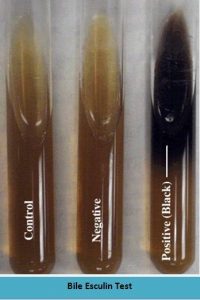 Figure: Bile esculin test results: Control, Positive and Negative
Principle of Bile-esculin test
Bile-esculin test is based on the ability of certain bacteria, notably the group D streptococci and Enterococcus species, to hydrolyze esculin in the presence of bile (4% bile salts or 40% bile).
Note: Many bacteria can hydrolyze esculin, but few can do so in the presence of bile.
Esculin is a glycosidic coumarin derivative (6-beta-glucoside-7-hydroxy-coumarin). The two moieties of the molecule (glucose and 7-hydroxycoumarin) are linked together by an ester bond through oxygen. For this test, esculin is incorporated into a medium containing 4% bile salts.
Bacteria that are bile-esculin positive are, first of all, able to grow in the presence of bile salts. Bile salts are detergent-like and damage bacterial cell membranes, most Gram-positive organisms simply can't survive the 4% concentration used here. Enterococcus and Group D streptococci carry dedicated stress-response systems that detect bile exposure and trigger protective changes to the cell envelope, which is what lets them survive long enough to also hydrolyze the esculin. Hydrolysis of the esculin in the medium results in the formation of glucose and a compound called esculetin.
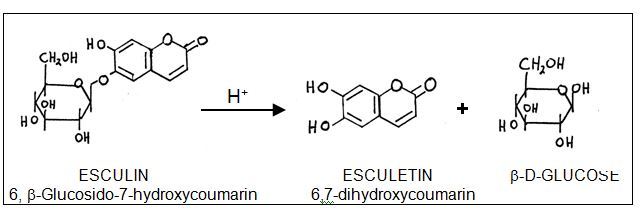 Figure: Esculin hydrolysis test
Esculetin, in turn, reacts with ferric ions (supplied by the inorganic medium component ferric citrate) to form a black diffusible complex. Group D streptococci and enterococci include opportunistic pathogens such as Enterococcus faecalis, Enterococcus faecium, and Streptococcus bovis.
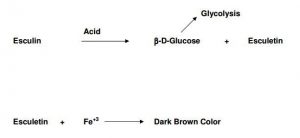 Figure: Chemical Reaction of the Bile Esculin Test
Materials
Bile-esculin agar medium is prepared as agar slants or plates. The constituents of bile-esculin agar medium are peptone, beef extract, oxgall (bile), esculin, ferric citrate, and agar. Bile esculin medium contains esculin and peptone for nutrition and bile to inhibit Gram-positive bacteria other than Group D streptococci and enterococci. Ferric citrate is added as a color indicator.
Procedure
- With an inoculating wire or loop, touch two or three morphologically similar streptococcal colonies and inoculate the slant of the bile esculin medium with an S-shaped motion, or streak the surface of a bile esculin plate for isolation. (Note: There is no need to stab the medium.)
- Incubate the inoculated tube at 35-37°C for 24 hours and then observe the results.
Note: The published optimum for this test is a bile concentration of 40% (4% oxgall), a standardized inoculum, and a reading at 24 hours, which gives greater than 99% sensitivity and 97% specificity (Rosa et al., 1998). Departing from these, especially a heavier inoculum or a lower bile concentration, is what lets non-group D viridans streptococci give a false positive.
Results and Interpretation
Diffuse blackening of more than half of the slant within 24-48 hours indicates esculin hydrolysis. On plates, black haloes will be observed around isolated colonies and any blackening is considered positive. All group D streptococci will be bile-esculin positive within 48 hours.
Where bile esculin fits: the group D differentiation at a glance
Bile esculin is the first step, not the whole answer. A positive result tells you the organism is either a group D Streptococcus (the S. gallolyticus / S. bovis group) or an Enterococcus, because both are bile-tolerant esculin hydrolyzers. It does not separate the two. Two more tests do that, and together the three form the standard presumptive workup:
| Test | Enterococcus | S. gallolyticus group (group D strep) | Non-group D viridans strep |
|---|---|---|---|
| Bile esculin | Positive | Positive | Negative |
| 6.5% NaCl | Positive | Negative | Negative |
| PYR | Positive | Negative | Negative |
Read the sequence like this:
- Bile esculin negative → not group D; think non-group D viridans streptococci. Stop here.
- Bile esculin positive, 6.5% NaCl positive → Enterococcus (confirmed by PYR positive). The salt tolerance is what separates enterococci from the group D streptococci.
- Bile esculin positive, 6.5% NaCl negative → S. gallolyticus group (non-enterococcal group D). PYR is negative here, and this is the organism whose presence in a blood culture prompts a colonoscopy (see the starch hydrolysis and S. gallolyticus articles).
Check the respective articles for the full methods for salt tolerance and PYR.
Quality Control
- Positive control: Enterococcus species (e.g. E. faecalis)
- Negative control: Viridans streptococcus, not group D
Where students actually get confused
- Esculin hydrolysis alone doesn't mean anything here, it has to happen in the presence of bile. Many bacteria can hydrolyze esculin under ordinary conditions. The bile is what makes this test selective, almost nothing survives the bile concentration except Group D strep and Enterococcus, so only survivors get the chance to show a positive esculin result.
- A positive result doesn't separate Enterococcus from non-enterococcal Group D strep (like S. bovis). Both give a positive bile-esculin result. Salt tolerance is the test that splits them apart, Enterococcus grows in 6.5% NaCl, S. bovis doesn't.
- About 3% of viridans streptococci can also hydrolyze esculin in bile. Rare, but real, this is why a positive bile-esculin result on its own should still be interpreted alongside colony morphology and other tests, not treated as an automatic Group D call.
- "Any blackening" counts, on plates, but on slants, the rule is more specific: diffuse blackening of more than half the slant within 24-48 hours. Don't apply the plate-reading rule to a slant or vice versa.
Key exam facts in one table
| Feature | Detail | Memory hook |
|---|---|---|
| Detects | Esculin hydrolysis in the presence of 4% bile | Bile is the selectivity filter |
| Chemistry | Esculin → glucose + esculetin → black ferric complex | |
| Positive (slant) | Blackening of >50% of slant within 24-48h | |
| Positive (plate) | Black halo around colonies, any blackening | Different rule than slant |
| Mechanism | Cell-envelope stress response to bile exposure | Same toughness story as salt tolerance |
| Confirms | Group D strep (Enterococcus + non-enterococcus) | Doesn't separate the two |
| Pairs with | Salt Tolerance Test | Splits Enterococcus from non-enterococcal Group D |
| Rare exception | ~3% of viridans streptococci | Don't read in isolation |
References
- Chuard, C., & Reller, L. B. (1998). Bile-esculin test for presumptive identification of enterococci and streptococci: effects of bile concentration, inoculation technique, and incubation time. Journal of clinical microbiology, 36(4), 1135–1136. https://doi.org/10.1128/JCM.36.4.1135-1136.1998
- Facklam, R. R., & Moody, M. D. (1970). Presumptive identification of group D streptococci: the bile-esculin test. Applied microbiology, 20(2), 245–250. https://doi.org/10.1128/am.20.2.245-250.1970
- Forbes, S., Sahm, D. F., & Weissfeld, A. S. (2002). Bailey & Scott’s Diagnostic Microbiology. Mosby.
- Rosa TT, et al. Bile-esculin test for presumptive identification of enterococci and streptococci: effects of bile concentration, inoculation technique, and incubation time. J Clin Microbiol. 1998;36(4):1135-1136. doi:10.1128/JCM.36.4.1135-1136.1998
Frequently Asked Questions
Why does esculin hydrolysis only count in this test when it happens in the presence of bile?
Does a positive bile-esculin test confirm Enterococcus specifically?
Can organisms other than Group D streptococci and Enterococcus give a positive bile-esculin test?
The organism grew on the slant but there is no black color. Is that positive?
Is Listeria bile esculin positive?

Tankeshwar Acharya, MSc (Medical Microbiology)
Tankeshwar Acharya is an Assistant Professor in the Department of Microbiology at Patan Academy of Health Sciences (PAHS), Nepal, where he has been teaching and practicing clinical microbiology for over 14 years. He is the founder of Microbe Online, one of the leading free microbiology education resources on the web, covering bacteriology, mycology, parasitology, immunology, and clinical laboratory diagnostics written from direct experience in both the classroom and the diagnostic laboratory.